- 160 pages
- English
- ePUB (mobile friendly)
- Available on iOS & Android
eBook - ePub
Structuralism/Poststructure For Beginners
About this book
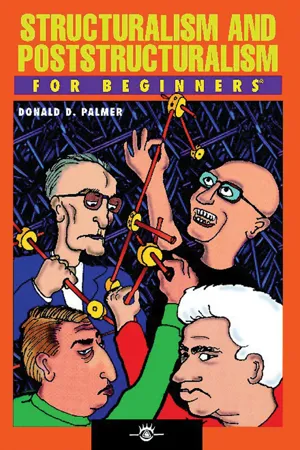
"What is Structuralism? How is it possible? And once the structures of Structuralism have been discovered how is Poststructuralism possible?"Thus begins Don Palmer's Structuralism and Poststructuralism For Beginners. If Nobel or Pulitzer ever made a prize for making the most difficult philosophers and ideas accessible to the greatest number of people one of the leading candidates would certainly be Professor Don Palmer. From his Sartre For Beginners and Kierkegaard For Beginners to his Looking at Philosophy author/illustrator Don Palmer has the magic touch when it comes to translating the most brutally difficult ideas into language and images that non-specialists can understand."In its less dramatic versions" writes Palme "structuralism is just a method of studying language society and the works of artists and novelists. But in its most exuberant form it is a philosophy an overall worldview that provides an account of reality and knowledge." Poststructuralism is a loosely knit intellectual movement comprised mainly of ex-structuralists who either became dissatisfied with the theory or felt they could improve it.Structuralism and Poststructuralism For Beginners is an illustrated tour through the mysterious landscape of Structuralism and Poststructuralism. The book's starting point is the linguistic theory of Ferdinand de Sausser. The book moves on to the anthropologist and literary critic Claude Lévi-Strauss; the semiologost and literary critic Roland Barthes; the Marxist philosopher Louis Althusser; the psychoanalyst Jacques Lacan; the deconstructionist Jacques Derrida. Learn among other things why structuralists say•Reality is composed of not Things but Relationships•Every "object" is both a presence and an absence•The total system is present in each of its parts•The parts are more real than the wholeThe book concludes by examining the postmodern obsession with language and with the radical claim of the disappearance of the individual – obsessions that unite the work of all these theorists.<
Information
Topic
PhilosophieSubtopic
Philosophie moderneINDEX
alienation, 143
Althusser, Louis, 9
Anglo-American philosophy, 4–6
anthropology, 27–29
a priori truths, 31–32, 146
arche-writing, 133, 143
Aristotle, 126
art, and unreason, 117–18
Artaud, Antonin, 117–18
associative relations, 24
atomism, 2, 5, 88, 143
authors, 61–64
avunculate, 37, 143
Balzac, Honoré de, 62
Barthes, Roland, 48, 49–64, 132, 141
Elements of Semiology, 54
A Lover’s Discourse: Fragments, 64
Mythologies, 55
“Myth Today,” 55–60
The Pleasure of the Text, 64
Sade/Fourier/Loyola, 55
S/Z, 62
“Wine and Milk,” 59
“The World of Wrestling,” 60
Berkeley, George, 5
binary opposites, 133–39, 140
biology, and the mind, 85–86
Blake, William, 104
books, readerly vs. writerly, 62
Bosch, Hieronymus, 99
Brecht, Bertolt, 62
Camus, Albert, 124
Carroll, Lewis, 108
Cervantes, Don Quixote, 100, 106, 107
civilization, 113
clans, and totems, 38–42
condensation, 69, 143
Continental philosophy, 4–6
Culler, Jonathan, 18
culture
myths of, 56–60...
Table of contents
- Cover Page
- Title Page
- Copyright
- Contents
- What Is Structuralism?
- Ferdinand de Saussure: Structural Linguistics
- Claude Lévi-Strauss: Structural Anthropology
- Roland Barthes: Semiotic Cultural and Literary Criticism
- Jacques Lacan: Psychoanalysis, Structuralism, and Post-Structuralism
- Michel Foucault: History, Structuralism, and Post-Structuralism
- Jacques Derrida: Post-Structuralist Deconstruction
- Glossary
- Bibliography
- Table of Citations
- Index
Trusted by 375,005 students
Access to over 1.5 million titles for a fair monthly price.
Study more efficiently using our study tools.
Frequently asked questions
Yes, you can cancel anytime from the Subscription tab in your account settings on the Perlego website. Your subscription will stay active until the end of your current billing period. Learn how to cancel your subscription
No, books cannot be downloaded as external files, such as PDFs, for use outside of Perlego. However, you can download books within the Perlego app for offline reading on mobile or tablet. Learn how to download books offline
We are an online textbook subscription service, where you can get access to an entire online library for less than the price of a single book per month. With over 1.5 million books across 990+ topics, we’ve got you covered! Learn about our mission
Look out for the read-aloud symbol on your next book to see if you can listen to it. The read-aloud tool reads text aloud for you, highlighting the text as it is being read. You can pause it, speed it up and slow it down. Learn more about Read Aloud
Yes! You can use the Perlego app on both iOS and Android devices to read anytime, anywhere — even offline. Perfect for commutes or when you’re on the go.
Please note we cannot support devices running on iOS 13 and Android 7 or earlier. Learn more about using the app
Please note we cannot support devices running on iOS 13 and Android 7 or earlier. Learn more about using the app
Yes, you can access Structuralism/Poststructure For Beginners by Donald D. Palmer in PDF and/or ePUB format, as well as other popular books in Philosophie & Philosophie moderne. We have over 1.5 million books available in our catalogue for you to explore.