- 192 pages
- English
- ePUB (mobile friendly)
- Available on iOS & Android
eBook - ePub
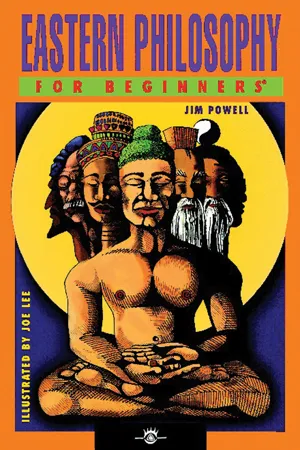
Eastern Philosophy For Beginners
About this book
The spiritual rewards and intellectual challenges of Eastern Philosophy are revealed in this visually stunning book illustrated by Joe Lee and with 19th Century engravings.Eastern Philosophy is not an intellectual pursuit but one that involves one's entire being. Much of it is so deeply entwined with the non-intellectual art of meditation that the two are impossible to separate. In this accessible survey of the major philosophies of India China Tibet and Japan Jim Powell draws upon his knowledge of Sanskrit and Chinese as well as decades of meditation. Whether tackling Buddha Confucius Lao Tzu Dogen the Dali Lama or Pantajal – Powell's insights are deeply illuminating. All the major philosophies of India China Tibet and Japan are explained and everyone – from beginner to expert – will find Eastern Philosophy For Beginners a beautiful and insightful overview.
Information
Topic
PhilosophySubtopic
Eastern PhilosophyTHE PHILOSOPHIES & RELIGIONS OF INDIA

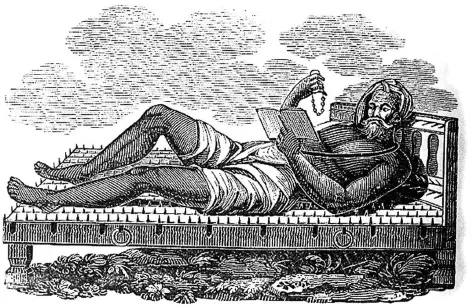
Just as the Himalayan summits rise up as the measure of all mountains, for many Western thinkers, Indian spirituality—exemplified by the meditations of yogis in their caves—has come to represent the peak of Indian culture. Yet there is a problem with these kinds of images. For Westerners have thought of India as a land of Gods sitting serenely atop pink lotuses floating on the cosmic waters; of Gods who have magically sprouted 3 heads and 5,000 arms; of naked fakirs sleeping on beds of nails; of snake charmers mesmerizing dark-hooded cobras; of elephants bathing in the moonlight; of turbaned rajas twiddling their dark, ornate mustaches while entwined with their lovers in impossible knots of flesh; of swarms of sagacious sahibs, worshippers, and sadhus swallowing sweetmeats.
The problem is that these are all Hindu images. And although introductions to Indian philosophy tend to center on Hinduism, India is far from being all Hindu. Verily, Hindus make up only about 60 percent of a diverse population of over 400 distinct religious communities. The waters flowing down from those Himalayan peaks quench the thirst not only of Hindus, but of Jews, Parsis, Jains, Sikhs, Buddhists, Christians, and Muslims—to name just a few.
And just as the United States, Australia, and New Zealand harbor native populations celebrating their own religions and philosophies, and speaking their own languages, India teems with a million tribal peoples speaking their own unique tongues and worshipping in distinct ways. India’s population speaks 325 languages, representing 12 language families. India, in other words, is so ragtag, so multiform, that one does it violence by attempting to reduce it to a single, Hindu culture.


The banyan begins its life as a single trunk that rises from a tiny seed. Yet its widespreading branches eventually form a vast canopy, spreading out to shade an entire acre. As these branches expand outward, they send down aerial roots that reach the ground, penetrate it, and become secondary trunks, often rivaling the original trunk in size. So substantial are these aerial root-trunks, that often one cannot distinguish them from the original.
The six trunks forming the basis of Indian religious and philosophical thought are, in historical order, as follows:
The Indus Valley Trunk (c. 3000-1500 B.C.)
The Indo-Brahmanical Trunk (c. 1500-600 B.C.)
The Indo-Shramanical Trunk (c. 600 B.C.-300 A.D.)
The Indic (Hindu, Buddhist, Jain) Trunk (c. 300-1200 A.D.)
The Indo-Islamic Trunk (c. 1200-1757 A.D.)
The Indo-Anglican Trunk (c. 1757-present)
The Indo-Brahmanical Trunk (c. 1500-600 B.C.)
The Indo-Shramanical Trunk (c. 600 B.C.-300 A.D.)
The Indic (Hindu, Buddhist, Jain) Trunk (c. 300-1200 A.D.)
The Indo-Islamic Trunk (c. 1200-1757 A.D.)
The Indo-Anglican Trunk (c. 1757-present)
The entire lush, tangled canopy of Indian religious and philosophical systems with all its Gods and Goddesses, images, and symbols, rests atop these major trunks. What’s more, this banyan tree of Indian religions and philosophies is a talking tree. It talks to itself, and has been doing so for thousands of years. For religion and philosophy, in India, have never been a single, unified tree. This talking tree sounds and resounds with the ongoing conversations, snippets of gossip, polemics, arguments, criticisms, and plagiarisms each trunk has exchanged with all the others, down through the ages.
THE INDUS VALLEY TRUNK (c. 3000-1500 B.C.)
INDUS VALLEY, INC.

The word “Hindu” was originally a Persian term for the area of the Indus River. Then, Alexander the Great called the people who lived on the banks of the Indus Hindus.
However, long before Alexander the Great came to India—long before Hinduism existed—an ancient civilization thrived on the banks of the Indus. Scholars know very little about this ancient Indus Valley civilization. They do know that, like the ancient civilizations of Egypt and Mesopotamia, the settlement flourished because it lay in a great river valley. From about 3000 B.C. to about 1500 B.C, it covered 750,000 square miles. Then, suddenly, it disappeared.
Its two largest cities, Mohenjo-Daro and Harrapa, sheltered some 80,000 inhabitants in orderly, streets laid out in an east-west/north-south grid. The citizens enjoyed the benefits of a public drainage system, municipal wells, and even public garbage collection. Everything was so uniform that even the size of the bricks from which the houses were built were the same.
HARAPPA’S BAZAAR
Fortified citadels, sitting atop raised mounds, crowned both Mohenjo-Daro and Harrapa. Surrounding these were government halls and temples. The view from these raised citadels took in streets teeming with shoppers. In fact, the great bazaars of Harappa and Mohenjo-Daro, seemed to have served the same function in th...
Table of contents
- Coverpage
- Copyright
- Table of Contents
- Introduction
- The Philosophies & Religions of India
- The Philosophies & Religions of China
- The Philosophies & Religions of Japan
- The Philosophies & Religions of Tibet
- Index
- Bibliography
- The Authors
Trusted by 375,005 students
Access to over 1.5 million titles for a fair monthly price.
Study more efficiently using our study tools.
Frequently asked questions
Yes, you can cancel anytime from the Subscription tab in your account settings on the Perlego website. Your subscription will stay active until the end of your current billing period. Learn how to cancel your subscription
No, books cannot be downloaded as external files, such as PDFs, for use outside of Perlego. However, you can download books within the Perlego app for offline reading on mobile or tablet. Learn how to download books offline
Perlego offers two plans: Essential and Complete
- Essential is ideal for learners and professionals who enjoy exploring a wide range of subjects. Access the Essential Library with 800,000+ trusted titles and best-sellers across business, personal growth, and the humanities. Includes unlimited reading time and Standard Read Aloud voice.
- Complete: Perfect for advanced learners and researchers needing full, unrestricted access. Unlock 1.5M+ books across hundreds of subjects, including academic and specialized titles. The Complete Plan also includes advanced features like Premium Read Aloud and Research Assistant.
We are an online textbook subscription service, where you can get access to an entire online library for less than the price of a single book per month. With over 1.5 million books across 990+ topics, we’ve got you covered! Learn about our mission
Look out for the read-aloud symbol on your next book to see if you can listen to it. The read-aloud tool reads text aloud for you, highlighting the text as it is being read. You can pause it, speed it up and slow it down. Learn more about Read Aloud
Yes! You can use the Perlego app on both iOS and Android devices to read anytime, anywhere — even offline. Perfect for commutes or when you’re on the go.
Please note we cannot support devices running on iOS 13 and Android 7 or earlier. Learn more about using the app
Please note we cannot support devices running on iOS 13 and Android 7 or earlier. Learn more about using the app
Yes, you can access Eastern Philosophy For Beginners by Jim Powell,Joe Lee in PDF and/or ePUB format, as well as other popular books in Philosophy & Eastern Philosophy. We have over 1.5 million books available in our catalogue for you to explore.