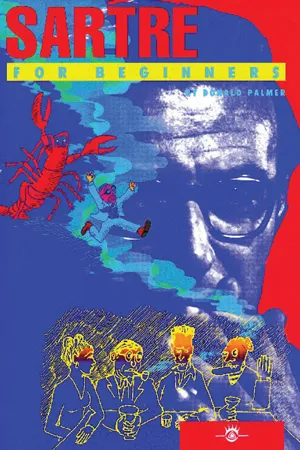
- 160 pages
- English
- ePUB (mobile friendly)
- Available on iOS & Android
eBook - ePub
Sartre For Beginners
About this book
Sartre For Beginners is an accessible yet sophisticated introduction to the life and works of the famous French philosopher Jean Paul Sartre. Sartre was a member of the French underground during WWII a novelist a playwright and a major influence in French political and intellectual life.The book opens with a biographical section introducing the significant events in the life of the man who coined the term "existentialism."Then it examines Sartre's early philosophical works. Ideas from Sartre's other fictional and dramatic works are discussed but the greatest part is the presentation of the main concepts from Sartre's Being and Nothingness (1943). These include the topics of consciousness freedom responsibility absurdity "bad faith" authenticity and the hellish confrontation with other people.Finally the book deals with Sartre's modification of his early existentialism to compliment his conversion to a kind of "existential" Marxism.Sartre For Beginners summarizes the work of the most renown philosopher of the 20th Century.
Information
Topic
FilosofíaSubtopic
Filosofía moderna
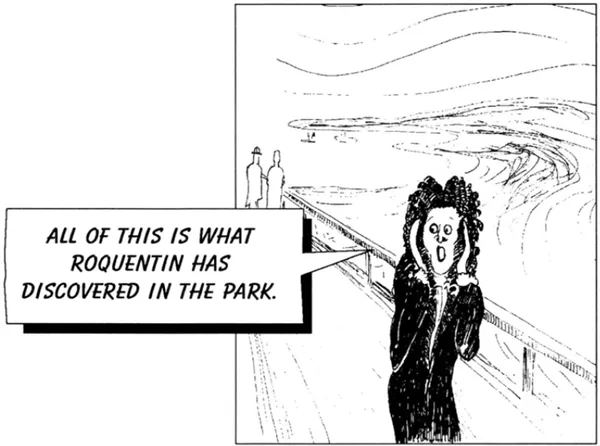
Sartre’s existentialism tries to reveal to human consciousness its strength and courage to accept the absurdity of existence, and its capacity for creating meaning in a meaningless world. Sartre develops these ideas in his massive work of 1943...
BEING AND NOTHINGNESS.
BEING AND NOTHINGNESS.
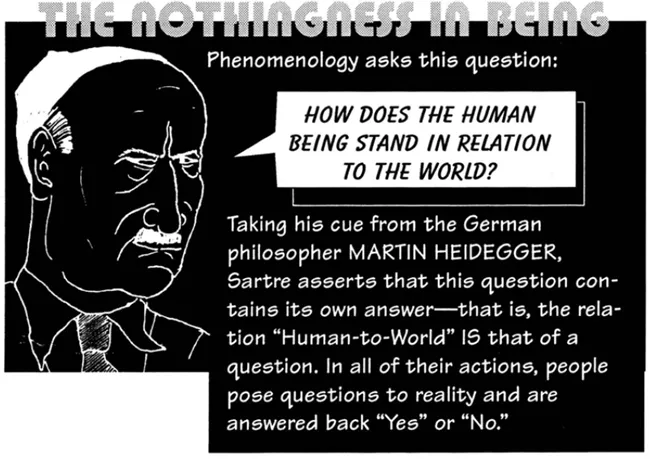
When I sit on a chair, I am asking, “Will I be supported?” When reality answers “Yes,” it reveals its “being” to us.
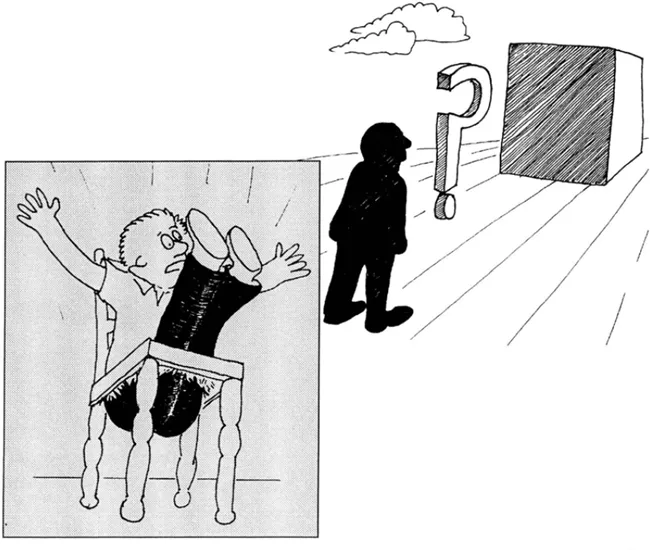
When it answers “No,” it reveals its “non-being,” its “nothingness.” (Remember, the title of Sartre’s main work is Being and Nothingness.)

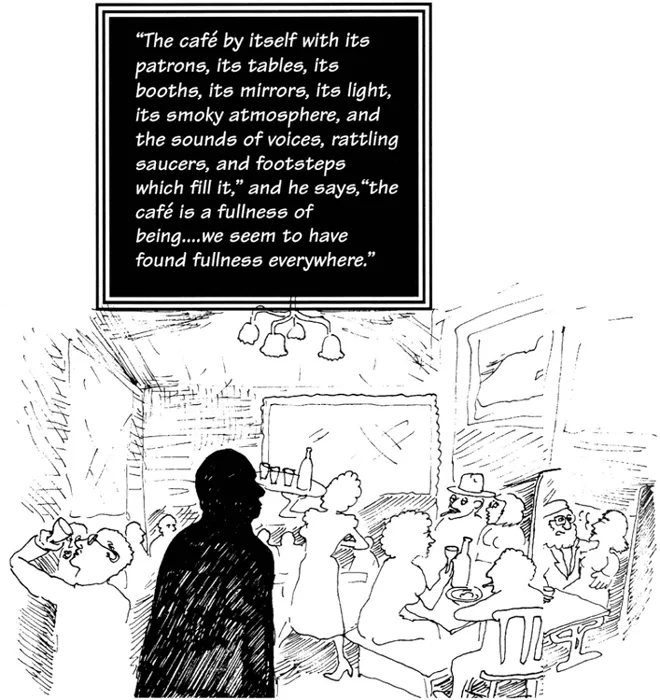
He describes the café as he enters:
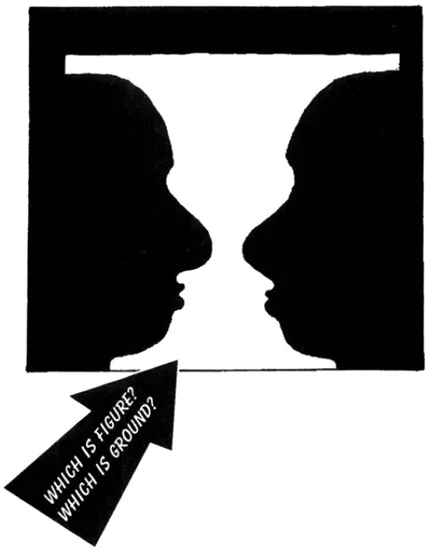
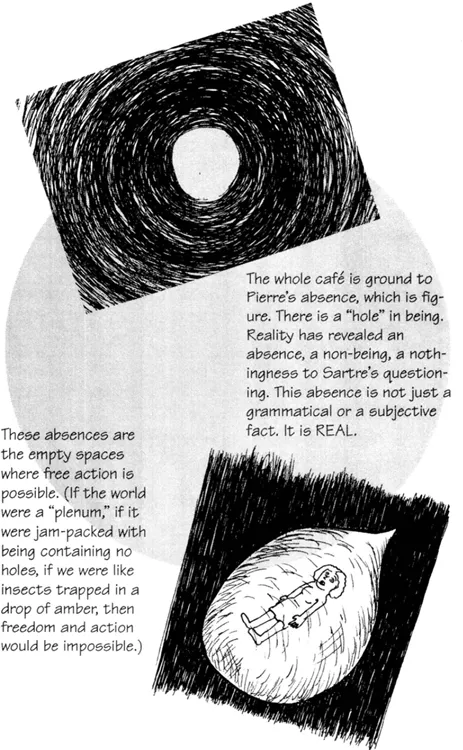
There is an important distinction in phenomenology between FIGURE and GROUND.
“Figure” is that feature of the field of perception on which you focus your attention.
“Ground” is the backdrop or foreground to “figure.”
Nothing is naturally either figure or ground. You create something (for example, a glass on the table) as “figure” by bestowing your attention upon it, and thereby you create the table as “ground.” Then, as you move your attention from the glass to a napkin, the napkin “leaps forward” as figure, and the glass slips into the ground.
Now, as Sartre scans the café for Pierre, different people and objects offer themselves up as “figure,” but each proves not to be Pierre, so they slide back into the “ground” as Sartre moves his attention to another part of the café.
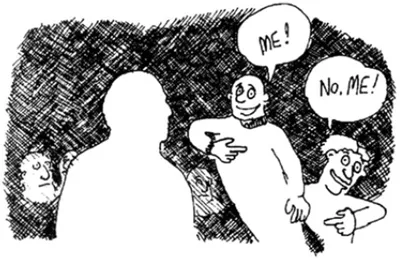

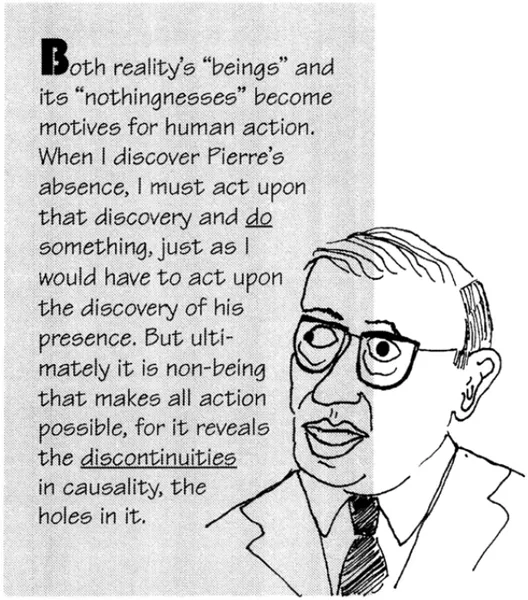
Without these discontinuities there would only be universal DETERMINISM (every event would be rigidly caused by an earlier event, in turn caused by an earlier event, and so on to infinity), and no true action could exist, only reflexes, only effects.
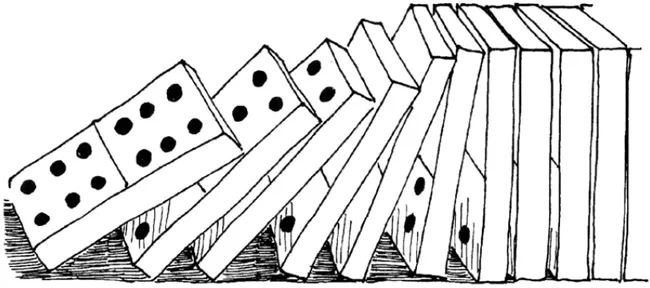
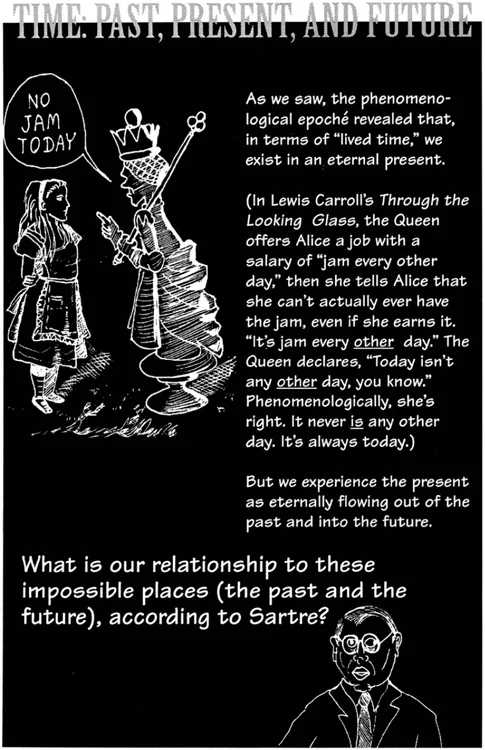


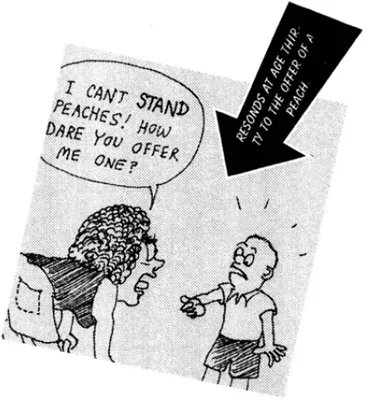
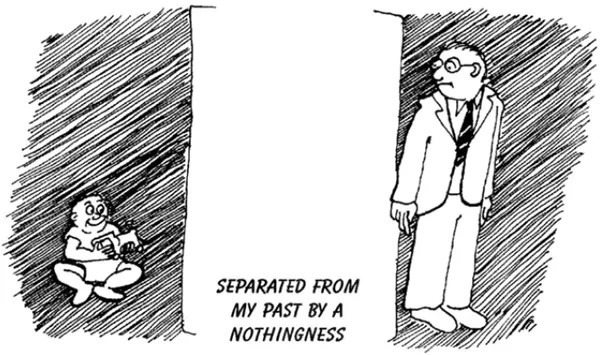
Sartre denies all of this. Being-for-itself is separated from its past by a nothingness. It is true that the past has “FACTICITY” That is, there are certain facts in the past that one cannot change. (I, for example, was born in San Jose, California, and I can’t do anything to change that fact—a heavy burden!) But nothing in the past can CAUSE me to do anything now. There is nothing that can be considered a human action (as opposed to reflexes or bodily functions) that follows necessarily from the past.

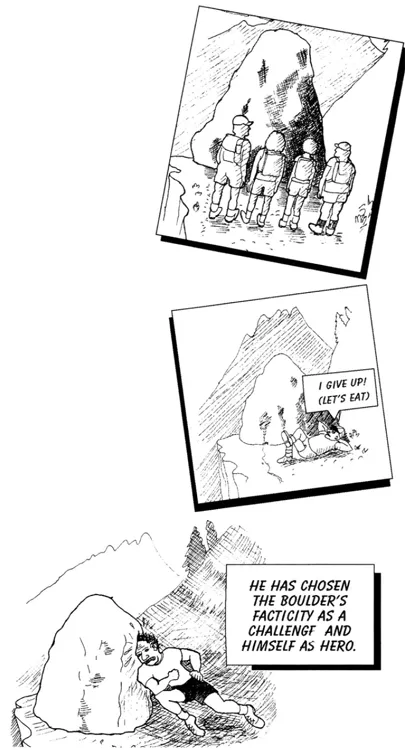
The determinist argues that there must be something in the past of each of these hikers that determined their response. Sartre denies this. There is nothing in the facticity of the past of any of the hikers, nor in the facticity of the boulder, that necessitates any particular response to the boulder’s presence. For Sartre, the facticity of the rock is undeniable, but each person chooses the MEANING of that facticity for him or herself. Because facticity in itself is meaningless, the source of the meaning is a decision on the part of the individual. There are always alternative interpretations of meaning available; we are never confronted with only one possible choice. There is alw...
Table of contents
- Coverpage
- Copyright
- TABLE OF CONTENTS
- WHO IS JEAN-PAUL SARTRE
- EXISTENTIALISM
- PHENOMENOLOGY
- THE TRANSCENDANCE OF THE EGO
- NAUSEA
- BEING AND NOTHINGNESS
- “EXISTENTIALISM IS A HUMANISM.”
- THE CRITIQUE OF DIALECTICAL REASON
- BIBLIOGRAPHY
- SOURCES
- GLOSSARY
- INDEX
Trusted by 375,005 students
Access to over 1.5 million titles for a fair monthly price.
Study more efficiently using our study tools.
Frequently asked questions
Yes, you can cancel anytime from the Subscription tab in your account settings on the Perlego website. Your subscription will stay active until the end of your current billing period. Learn how to cancel your subscription
No, books cannot be downloaded as external files, such as PDFs, for use outside of Perlego. However, you can download books within the Perlego app for offline reading on mobile or tablet. Learn how to download books offline
Perlego offers two plans: Essential and Complete
- Essential is ideal for learners and professionals who enjoy exploring a wide range of subjects. Access the Essential Library with 800,000+ trusted titles and best-sellers across business, personal growth, and the humanities. Includes unlimited reading time and Standard Read Aloud voice.
- Complete: Perfect for advanced learners and researchers needing full, unrestricted access. Unlock 1.5M+ books across hundreds of subjects, including academic and specialized titles. The Complete Plan also includes advanced features like Premium Read Aloud and Research Assistant.
We are an online textbook subscription service, where you can get access to an entire online library for less than the price of a single book per month. With over 1.5 million books across 990+ topics, we’ve got you covered! Learn about our mission
Look out for the read-aloud symbol on your next book to see if you can listen to it. The read-aloud tool reads text aloud for you, highlighting the text as it is being read. You can pause it, speed it up and slow it down. Learn more about Read Aloud
Yes! You can use the Perlego app on both iOS and Android devices to read anytime, anywhere — even offline. Perfect for commutes or when you’re on the go.
Please note we cannot support devices running on iOS 13 and Android 7 or earlier. Learn more about using the app
Please note we cannot support devices running on iOS 13 and Android 7 or earlier. Learn more about using the app
Yes, you can access Sartre For Beginners by Donald D. Palmer in PDF and/or ePUB format, as well as other popular books in Filosofía & Filosofía moderna. We have over 1.5 million books available in our catalogue for you to explore.