- English
- ePUB (mobile friendly)
- Available on iOS & Android
About this book
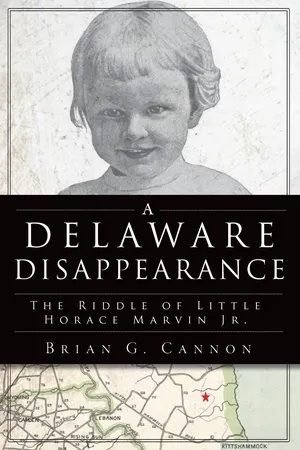
The disappearance of Horace Marvin, Jr. became a national sensation.
In early March 1907, young Horace, just a few weeks shy of his fourth birthday, was playing in the yard of his father's new farm in a sparsely populated area near Dover, Delaware. The family had just moved from Iowa and this was the first day Horace had to explore their new home. In the farmyard with Horace were his brother John and cousin Rose, all visible to neighbors helping the previous owner move off the farm. Then Horace disappeared without a trace. Within two weeks this heartbreaking event was being reported to hundreds of other families in newspapers across the country and around the world.
Horace's disappearance would be the most publicized missing child story until the Lindbergh kidnapping exactly twenty-five years later. Local author Brian G. Cannon tells the full story of this tragedy for the first time.
Frequently asked questions
- Essential is ideal for learners and professionals who enjoy exploring a wide range of subjects. Access the Essential Library with 800,000+ trusted titles and best-sellers across business, personal growth, and the humanities. Includes unlimited reading time and Standard Read Aloud voice.
- Complete: Perfect for advanced learners and researchers needing full, unrestricted access. Unlock 1.4M+ books across hundreds of subjects, including academic and specialized titles. The Complete Plan also includes advanced features like Premium Read Aloud and Research Assistant.
Please note we cannot support devices running on iOS 13 and Android 7 or earlier. Learn more about using the app.
Information
Table of contents
- Front Cover
- Half Page
- Title Page
- Copyright
- Contents
- 1. A Step Back in Time
- 2. “I Can’t Find Horace!”
- 3. The Family
- 4. Suspects
- 5. “Watch Murphy!”
- 6. The Trail North
- 7. Advertising a Kidnapping
- 8. The Black Hand
- 9. Here, There and Nowhere
- 10. Butler Did It
- 11. “But This Is at My Door.”
- 12. Questions
- 13. Judgment
- 14. Epilogue
- Acknowledgements
- Notes
- Bibliography
- About the Author