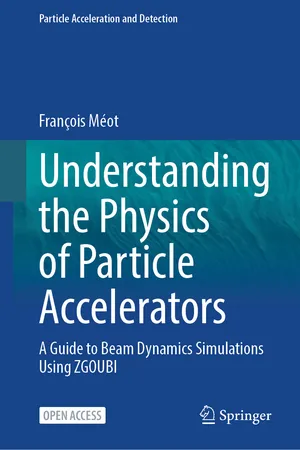
Understanding the Physics of Particle Accelerators
eBook - ePub

Understanding the Physics of Particle Accelerators

A Guide to Beam Dynamics Simulations Using ZGOUBI

  1. English
  2. ePUB (mobile friendly)
  3. Available on iOS & Android
eBook - ePub

Understanding the Physics of Particle Accelerators

A Guide to Beam Dynamics Simulations Using ZGOUBI

About this book

This open access book introduces readers to the physics of particle accelerators, by means of beam dynamics simulations and exercises using the computer code ZGOUBI. The respective chapters are organized chronologically and trace the historical development of accelerators from electrostatic columns to storage rings, to the numerous variations on resonant acceleration and focusing techniques, while also addressing side aspects such as synchrotron radiation and spin dynamics.

The book offers computer simulations in which readers can manipulate, guide, and accelerate charged particles and particle beams in most types of particle accelerator. By performing these simulation exercises, they will acquire a deeper understanding of charged particle beam optics, accelerator physics and technology, as well as the why and how of when to use one technology or the other. These exercises guide readers through a virtual world of accelerator and beam simulations, and involve e.g. manipulating beams for cancer therapy, producing synchrotron radiation for condensed matter research, accelerating polarized ion beams for nuclear physics research, etc. In addition to acquiring an enhanced grasp of physics, readers will discover the basic theoretical and practical aspects of particle accelerators' main components: guiding and focusing magnets, radio-wave accelerating cavities, wigglers, etc.

Frequently asked questions

Yes, you can cancel anytime from the Subscription tab in your account settings on the Perlego website. Your subscription will stay active until the end of your current billing period. Learn how to cancel your subscription.
At the moment all of our mobile-responsive ePub books are available to download via the app. Most of our PDFs are also available to download and we're working on making the final remaining ones downloadable now. Learn more here.
Perlego offers two plans: Essential and Complete
  • Essential is ideal for learners and professionals who enjoy exploring a wide range of subjects. Access the Essential Library with 800,000+ trusted titles and best-sellers across business, personal growth, and the humanities. Includes unlimited reading time and Standard Read Aloud voice.
  • Complete: Perfect for advanced learners and researchers needing full, unrestricted access. Unlock 1.4M+ books across hundreds of subjects, including academic and specialized titles. The Complete Plan also includes advanced features like Premium Read Aloud and Research Assistant.
Both plans are available with monthly, semester, or annual billing cycles.
We are an online textbook subscription service, where you can get access to an entire online library for less than the price of a single book per month. With over 1 million books across 1000+ topics, we’ve got you covered! Learn more here.
Look out for the read-aloud symbol on your next book to see if you can listen to it. The read-aloud tool reads text aloud for you, highlighting the text as it is being read. You can pause it, speed it up and slow it down. Learn more here.
Yes! You can use the Perlego app on both iOS or Android devices to read anytime, anywhere — even offline. Perfect for commutes or when you’re on the go.
Please note we cannot support devices running on iOS 13 and Android 7 or earlier. Learn more about using the app.
Yes, you can access Understanding the Physics of Particle Accelerators by François Méot in PDF and/or ePUB format, as well as other popular books in Physical Sciences & Radiology, Radiotherapy & Nuclear Medicine. We have over one million books available in our catalogue for you to explore.

Table of contents

  1. Cover
  2. Front Matter
  3. 1. Numerical Simulations
  4. 2. Electrostatic Systems
  5. 3. Classical Cyclotron
  6. 4. Relativistic Cyclotron
  7. 5. Betatron
  8. 6. Microtron
  9. 7. Synchrocyclotron
  10. 8. Weak Focusing Synchrotron
  11. 9. Strong Focusing Synchrotron
  12. 10. FFAG, Scaling
  13. 11. FFAG, Linear
  14. 12. Beam Lines
  15. 13. Spectrometer; Mass Separator
  16. 14. Optical Elements and Keywords, Complements
  17. Back Matter