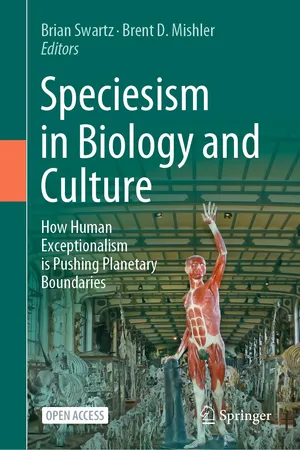
This open access book explores a wide-ranging discussion about the sociopolitical, cultural, and scientificramifications of speciesism and world views that derive from it. In this light, it integrates subjects across the naturalsciences, social sciences, and humanities. The 21st-century western world is anthropocentric to an extreme; we adopt unreasonably self-centered and self-serving ideas and lifestyles. Americans consume more energy resources per person than most other nations onEarth and have little concept of how human ecology and population biology interface with global sustainability.We draw upon religion, popular culture, politics, and technology to justify our views and actions, yet remain self-centered because our considerations rarely extend beyond our immediate interests. Stepping upward on thehierarchy from "racism, " "speciesism" likewise refers to the view that unique natural kinds (species) exist and are animportant structural element of biodiversity. This ideology manifests in the cultural idea that humans are distinctfrom and intrinsically superior to other forms of life. It further carries a plurality of implications for how we perceiveourselves in relation to nature, how we view Judeo-Christian religions and their tenets, how we respond toscientific data about social problems such as climate change, and how willing we are to change our actions in theface of evidence.
eBook - ePub
Speciesism in Biology and Culture
How Human Exceptionalism is Pushing Planetary Boundaries
- English
- ePUB (mobile friendly)
- Available on iOS & Android
eBook - ePub
Speciesism in Biology and Culture
How Human Exceptionalism is Pushing Planetary Boundaries
About this book
Information
Table of contents
- Cover
- Front Matter
- Part I. Biology and Culture
- Part II. Culture and History
- Part III. Conservation and Law
- Part IV. Sustainability and the Future
Trusted by 375,005 students
Access to over 1.5 million titles for a fair monthly price.
Study more efficiently using our study tools.
Frequently asked questions
Yes, you can cancel anytime from the Subscription tab in your account settings on the Perlego website. Your subscription will stay active until the end of your current billing period. Learn how to cancel your subscription
No, books cannot be downloaded as external files, such as PDFs, for use outside of Perlego. However, you can download books within the Perlego app for offline reading on mobile or tablet. Learn how to download books offline
Perlego offers two plans: Essential and Complete
- Essential is ideal for learners and professionals who enjoy exploring a wide range of subjects. Access the Essential Library with 800,000+ trusted titles and best-sellers across business, personal growth, and the humanities. Includes unlimited reading time and Standard Read Aloud voice.
- Complete: Perfect for advanced learners and researchers needing full, unrestricted access. Unlock 1.5M+ books across hundreds of subjects, including academic and specialized titles. The Complete Plan also includes advanced features like Premium Read Aloud and Research Assistant.
We are an online textbook subscription service, where you can get access to an entire online library for less than the price of a single book per month. With over 1.5 million books across 990+ topics, we’ve got you covered! Learn about our mission
Look out for the read-aloud symbol on your next book to see if you can listen to it. The read-aloud tool reads text aloud for you, highlighting the text as it is being read. You can pause it, speed it up and slow it down. Learn more about Read Aloud
Yes! You can use the Perlego app on both iOS and Android devices to read anytime, anywhere — even offline. Perfect for commutes or when you’re on the go.
Please note we cannot support devices running on iOS 13 and Android 7 or earlier. Learn more about using the app
Please note we cannot support devices running on iOS 13 and Android 7 or earlier. Learn more about using the app
Yes, you can access Speciesism in Biology and Culture by Brian Swartz,Brent D. Mishler in PDF and/or ePUB format, as well as other popular books in Biological Sciences & World History. We have over 1.5 million books available in our catalogue for you to explore.