eBook - PDF
Compendium of Neurosymbolic Artificial Intelligence
- 706 pages
- English
- PDF
- Available on iOS & Android
eBook - PDF
Compendium of Neurosymbolic Artificial Intelligence
About this book
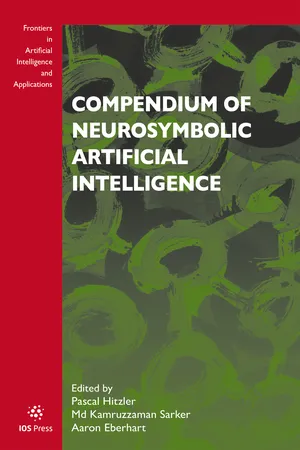
If only it were possible to develop automated and trainable neural systems that could justify their behavior in a way that could be interpreted by humans like a symbolic system. The field of Neurosymbolic AI aims to combine two disparate approaches to AI; symbolic reasoning and neural or connectionist approaches such as Deep Learning. The quest to unite these two types of AI has led to the development of many innovative techniques which extend the boundaries of both disciplines.
This book, Compendium of Neurosymbolic Artificial Intelligence, presents 30 invited papers which explore various approaches to defining and developing a successful system to combine these two methods. Each strategy has clear advantages and disadvantages, with the aim of most being to find some useful middle ground between the rigid transparency of symbolic systems and the more flexible yet highly opaque neural applications. The papers are organized by theme, with the first four being overviews or surveys of the field. These are followed by papers covering neurosymbolic reasoning; neurosymbolic architectures; various aspects of Deep Learning; and finally two chapters on natural language processing. All papers were reviewed internally before publication. The book is intended to follow and extend the work of the previous book, Neuro-symbolic artificial intelligence: The state of the art (IOS Press; 2021) which laid out the breadth of the field at that time.
Neurosymbolic AI is a young field which is still being actively defined and explored, and this book will be of interest to those working in AI research and development.
Information
Table of contents
- Title Page
- Introduction
- Contents
- Chapter 1. The Roles of Symbols in Neural-Based AI: They Are Not What You Think!
- Chapter 2. Neuro-Symbolic RDF and Description Logic Reasoners: The State-Of-The-Art and Challenges
- Chapter 3. Architectural Patterns for Neuro-Symbolic AI
- Chapter 4. Semantic Web Machine Learning Systems: An Analysis of System Patterns
- Chapter 5. Boolean Connectives and Deep Learning: Three Interpretations
- Chapter 6. Constructivism as a Paradigm for Neuro-Symbolic Artficial Intelligence
- Chapter 7. Neural-Symbolic Interaction and Co-Evolving
- Chapter 8. Neuro-Causal Models
- Chapter 9. Building Robust and Explainable AI with Commonsense Knowledge Graphs and Neural Models
- Chapter 10. Connectionist Neuroarchitectures in Cognition and Consciousness Theory Based on Integrative (Synchronization) Mechanisms
- Chapter 11. Autodidactic and Coachable Neural Architectures
- Chapter 12. The Neural Blackboard Theory of Neuro-Symbolic Processing: Logistics of Access, Connection Paths and Intrinsic Structures
- Chapter 13. Class Expression Learning with Multiple Representations
- Chapter 14. Embedding-Based First-Order Rule Learning in Large Knowledge Graphs
- Chapter 15. Lifted Relational Neural Networks: From Graphs to Deep Relational Learning
- Chapter 16. Discovering Visual Concepts and Rules in Convolutional Neural Networks
- Chapter 17. Approximate Answering of Graph Queries
- Chapter 18. Enhancing Case-Based Reasoning with Neural Networks
- Chapter 19. Neuro-Symbolic Spatio-Temporal Reasoning
- Chapter 20. Neuro-Symbolic Architectures for Combinatorial Problems in Structured Output Spaces
- Chapter 21. Neuro-Symbolic Semantic Learning for Chemistry
- Chapter 22. Semantic Loss Functions for Neuro-Symbolic Structured Prediction
- Chapter 23. Combining Symbolic and Deep Learning Approaches for Sentiment Analysis
- Chapter 24. Few-Shot Continual Learning Based on Vector Symbolic Architectures
- Chapter 25. Learning Logic Explanations by Neural Networks
- Chapter 26. Combining Sub-Symbolic and Symbolic Methods for Explainability
- Chapter 27. Explaining CNNs Using Knowledge Extraction and Graph Analysis
- Chapter 28. Effective Reasoning over Neural Networks Using Lukasiewicz Logic
- Chapter 29. Latent Trees for Compositional Generalization
- Chapter 30. Weakly Supervised Reasoning by Neuro-Symbolic Approaches
- Author Index
Trusted by 375,005 students
Access to over 1.5 million titles for a fair monthly price.
Study more efficiently using our study tools.
Frequently asked questions
Yes, you can cancel anytime from the Subscription tab in your account settings on the Perlego website. Your subscription will stay active until the end of your current billing period. Learn how to cancel your subscription
No, books cannot be downloaded as external files, such as PDFs, for use outside of Perlego. However, you can download books within the Perlego app for offline reading on mobile or tablet. Learn how to download books offline
Perlego offers two plans: Essential and Complete
- Essential is ideal for learners and professionals who enjoy exploring a wide range of subjects. Access the Essential Library with 800,000+ trusted titles and best-sellers across business, personal growth, and the humanities. Includes unlimited reading time and Standard Read Aloud voice.
- Complete: Perfect for advanced learners and researchers needing full, unrestricted access. Unlock 1.5M+ books across hundreds of subjects, including academic and specialized titles. The Complete Plan also includes advanced features like Premium Read Aloud and Research Assistant.
We are an online textbook subscription service, where you can get access to an entire online library for less than the price of a single book per month. With over 1.5 million books across 990+ topics, we’ve got you covered! Learn about our mission
Look out for the read-aloud symbol on your next book to see if you can listen to it. The read-aloud tool reads text aloud for you, highlighting the text as it is being read. You can pause it, speed it up and slow it down. Learn more about Read Aloud
Yes! You can use the Perlego app on both iOS and Android devices to read anytime, anywhere — even offline. Perfect for commutes or when you’re on the go.
Please note we cannot support devices running on iOS 13 and Android 7 or earlier. Learn more about using the app
Please note we cannot support devices running on iOS 13 and Android 7 or earlier. Learn more about using the app
Yes, you can access Compendium of Neurosymbolic Artificial Intelligence by P. Hitzler,M.K. Sarker,A. Eberhart,Md Kamruzzaman Sarker,Aaron Eberhart in PDF and/or ePUB format, as well as other popular books in Computer Science & Artificial Intelligence (AI) & Semantics. We have over 1.5 million books available in our catalogue for you to explore.