eBook - PDF
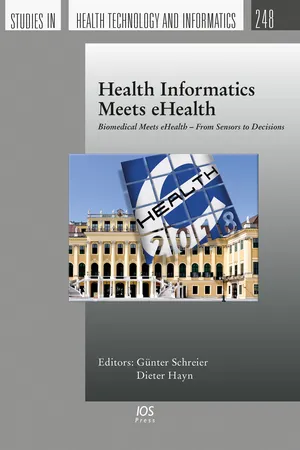
Health Informatics Meets eHealth
Biomedical Meets eHealth – From Sensors to Decisions. Proceedings of the 12th eHealth Conference
- 360 pages
- English
- PDF
- Available on iOS & Android
eBook - PDF
Health Informatics Meets eHealth
Biomedical Meets eHealth – From Sensors to Decisions. Proceedings of the 12th eHealth Conference
About this book
Biomedical engineering and health informatics are closely related to each other, and it is often difficult to tell where one ends and the other begins, but ICT systems in healthcare and biomedical systems and devices are already becoming increasingly interconnected, and share the common entity of data. This is something which is set to become even more prevalent in future, and will complete the chain and flow of information from the sensor, via processing, to the actuator, which may be anyone or anything from a human healthcare professional to a robot. Methods for automating the processing of information, such as signal processing, machine learning, predictive analytics and decision support, are increasingly important for providing actionable information and supporting personalized and preventive healthcare protocols in both biomedical and digital healthcare systems and applications.
This book of proceedings presents 50 papers from the 12th eHealth conference, eHealth2018, held in Vienna, Austria, in May 2018. The theme of this year's conference is Biomedical Meets eHealth – From Sensors to Decisions, and the papers included here cover a wide range of topics from the field of eHealth.
The book will be of interest to all those working to design and implement healthcare today.
Information
Table of contents
- Title Page
- Preface
- Scientific Program Committee
- Reviewers
- Contents
- The Effect of Latent Binary Variables on the Uncertainty of the Prediction of a Dichotomous Outcome Using Logistic Regression Based Propensity Score Matching
- A New Machine Learning Framework for Understanding the Link Between Cannabis Use and First-Episode Psychosis
- Separating Business Logic from Medical Knowledge in Digital Clinical Workflows Using Business Process Model and Notation and Arden Syntax
- Going Mobile: An Empirical Model for Explaining Successful Information Logistics in Ward Rounds
- Use of Mobile Apps Among Medical and Nursing Students in Iran
- Hospital CEOs Need Health IT Knowledge and Trust in CIOs: Insights from a Qualitative Study
- Improving Fluid Management in Critical Care - Towards the ICU of the Future
- Towards a Single Data Exchange Standard for Use in Healthcare and in Clinical Research
- Cross-Enterprise Communication and Data Exchange in Radiology in Austria: Technology and Use Cases
- Facilitating the Information Exchange Using a Modular Electronic Discharge Summary
- Effectiveness of Anonymization Methods in Preserving Patients' Privacy: A Systematic Literature Review
- Exporting Data from a Clinical Data Warehouse
- A Clinical Data Warehouse Based on OMOP and i2b2 for Austrian Health Claims Data
- EHR Text Categorization for Enhanced Patient-Based Document Navigation
- Modular Architecture for Integrated Model-Based Decision Support
- Cleansing and Imputation of Body Mass Index Data and Its Impact on a Machine Learning Based Prediction Model
- Effect of Nursing Assessment on Predictive Delirium Models in Hospitalised Patients
- Development of a Protocol for Automated Glucose Measurement Transmission Used in Clinical Decision Support Systems Based on the Continua Design Guidelines
- Identifying and Validating Requirements of a Mobile-Based Self-Management System for People Living with HIV
- Telemedicine in Diagnosis, Treatment and Management of Diseases in Children
- Towards an IMU Evaluation Framework for Human Body Tracking
- Automated Error Detection in Physiotherapy Training
- Mobile-Based Applications and Functionalities for Self-Management of People Living with HIV
- Effects of Medical Device Regulations on the Development of Stand-Alone Medical Software: A Pilot Study
- Development of a Computer-Aided Dosage and Telemonitoring System for Patients Under Oral Anticoagulation Therapy
- Clinical Knowledge Governance Framework for Nationwide Data Infrastructure Projects
- Modeling of ETL-Processes and Processed Information in Clinical Data Warehousing
- Evaluation of SNOMED CT Content Coverage: A Systematic Literature Review
- Nurses' Attitude for Using Barcode Medication Administration System in a Developing Country
- How to Measure Physical Motion and the Impact of Individualized Feedback in the Field of Rehabilitation of Geriatric Trauma Patients
- A Survey of Managers' Access to Key Performance Indicators via HIS: The Case of Iranian Teaching Hospitals
- Towards Designing a Secure Exchange Platform for Diabetes Monitoring and Therapy
- Development of a Clinical Decision Support System in Intensive Care
- Development and Evaluation of Cognitive Games to Promote Health and Wellbeing in Elderly People with Mild Cognitive Impairment
- Estimation of the Accuracy of Prognostic Scores for the Treatment of Children with Severe Trauma in a Specialized Trauma Hospital
- Feasibility and Design of an Electronic Surgical Safety Checklist in a Teaching Hospital: A User-Based Approach
- Using MEESTAR to Identify Ethical and Social Issues Implementing a Digital Patient-Centered Care Platform
- Proof of Concept of a Partial Weight-Bearing Supporting Real-Time Feedback System
- Towards Phenotyping of Clinical Trial Eligibility Criteria
- Improving Patient Safety by Reusing Clinical Routine Data - An Expert Survey on Patient Safety Indicators
- HEALTHeBIKES - Smart E-Bike Prototype for Controlled Exercise in Telerehabilitation Programs
- Two-Stage Evaluation of a Telehealth Nutrition Management Service in Support of Diabesity Therapy
- Is Austria Ready for Telemonitoring? A Readiness Assessment Among Doctors and Patients in the Field of Diabetes
- Challenges of a HL7 CDA Guideline for Telehealth Based DMP Systems
- Achieving Interoperability Between Arden-Syntax-Based Clinical Decision Support and openEHR-Based Data Systems
- Subject Index
- Author Index
Trusted by 375,005 students
Access to over 1.5 million titles for a fair monthly price.
Study more efficiently using our study tools.
Frequently asked questions
Yes, you can cancel anytime from the Subscription tab in your account settings on the Perlego website. Your subscription will stay active until the end of your current billing period. Learn how to cancel your subscription
No, books cannot be downloaded as external files, such as PDFs, for use outside of Perlego. However, you can download books within the Perlego app for offline reading on mobile or tablet. Learn how to download books offline
Perlego offers two plans: Essential and Complete
- Essential is ideal for learners and professionals who enjoy exploring a wide range of subjects. Access the Essential Library with 800,000+ trusted titles and best-sellers across business, personal growth, and the humanities. Includes unlimited reading time and Standard Read Aloud voice.
- Complete: Perfect for advanced learners and researchers needing full, unrestricted access. Unlock 1.5M+ books across hundreds of subjects, including academic and specialized titles. The Complete Plan also includes advanced features like Premium Read Aloud and Research Assistant.
We are an online textbook subscription service, where you can get access to an entire online library for less than the price of a single book per month. With over 1.5 million books across 990+ topics, we’ve got you covered! Learn about our mission
Look out for the read-aloud symbol on your next book to see if you can listen to it. The read-aloud tool reads text aloud for you, highlighting the text as it is being read. You can pause it, speed it up and slow it down. Learn more about Read Aloud
Yes! You can use the Perlego app on both iOS and Android devices to read anytime, anywhere — even offline. Perfect for commutes or when you’re on the go.
Please note we cannot support devices running on iOS 13 and Android 7 or earlier. Learn more about using the app
Please note we cannot support devices running on iOS 13 and Android 7 or earlier. Learn more about using the app
Yes, you can access Health Informatics Meets eHealth by G. Schreier,D. Hayn,Günter Schreier in PDF and/or ePUB format, as well as other popular books in Medicine & Public Health, Administration & Care. We have over 1.5 million books available in our catalogue for you to explore.