- 239 pages
- English
- PDF
- Available on iOS & Android
eBook - PDF
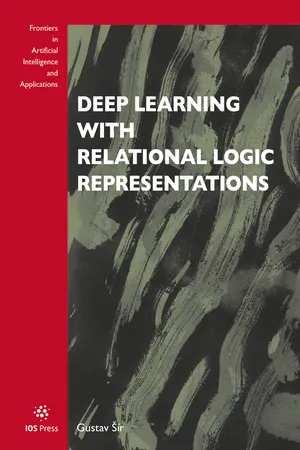
Deep Learning with Relational Logic Representations
About this book
Deep learning has been used with great success in a number of diverse applications, ranging from image processing to game playing, and the fast progress of this learning paradigm has even been seen as paving the way towards general artificial intelligence. However, the current deep learning models are still principally limited in many ways.
This book, 'Deep Learning with Relational Logic Representations', addresses the limited expressiveness of the common tensor-based learning representation used in standard deep learning, by generalizing it to relational representations based in mathematical logic. This is the natural formalism for the relational data omnipresent in the interlinked structures of the Internet and relational databases, as well as for the background knowledge often present in the form of relational rules and constraints. These are impossible to properly exploit with standard neural networks, but the book introduces a new declarative deep relational learning framework called Lifted Relational Neural Networks, which generalizes the standard deep learning models into the relational setting by means of a 'lifting' paradigm, known from Statistical Relational Learning. The author explains how this approach allows for effective end-to-end deep learning with relational data and knowledge, introduces several enhancements and optimizations to the framework, and demonstrates its expressiveness with various novel deep relational learning concepts, including efficient generalizations of popular contemporary models, such as Graph Neural Networks.
Demonstrating the framework across various learning scenarios and benchmarks, including computational efficiency, the book will be of interest to all those interested in the theory and practice of advancing representations of modern deep learning architectures.
Information
Table of contents
- Title Page
- Abstract
- Contents
- Acronyms
- Publications
- Acknowledgements
- Introduction
- Background
- The Framework
- Optimizations
- Applications
- Conclusions
- Appendix
Trusted by 375,005 students
Access to over 1.5 million titles for a fair monthly price.
Study more efficiently using our study tools.
Frequently asked questions
Yes, you can cancel anytime from the Subscription tab in your account settings on the Perlego website. Your subscription will stay active until the end of your current billing period. Learn how to cancel your subscription
No, books cannot be downloaded as external files, such as PDFs, for use outside of Perlego. However, you can download books within the Perlego app for offline reading on mobile or tablet. Learn how to download books offline
Perlego offers two plans: Essential and Complete
- Essential is ideal for learners and professionals who enjoy exploring a wide range of subjects. Access the Essential Library with 800,000+ trusted titles and best-sellers across business, personal growth, and the humanities. Includes unlimited reading time and Standard Read Aloud voice.
- Complete: Perfect for advanced learners and researchers needing full, unrestricted access. Unlock 1.5M+ books across hundreds of subjects, including academic and specialized titles. The Complete Plan also includes advanced features like Premium Read Aloud and Research Assistant.
We are an online textbook subscription service, where you can get access to an entire online library for less than the price of a single book per month. With over 1.5 million books across 990+ topics, we’ve got you covered! Learn about our mission
Look out for the read-aloud symbol on your next book to see if you can listen to it. The read-aloud tool reads text aloud for you, highlighting the text as it is being read. You can pause it, speed it up and slow it down. Learn more about Read Aloud
Yes! You can use the Perlego app on both iOS and Android devices to read anytime, anywhere — even offline. Perfect for commutes or when you’re on the go.
Please note we cannot support devices running on iOS 13 and Android 7 or earlier. Learn more about using the app
Please note we cannot support devices running on iOS 13 and Android 7 or earlier. Learn more about using the app
Yes, you can access Deep Learning with Relational Logic Representations by G. Šír, Gustav Šír in PDF and/or ePUB format, as well as other popular books in Computer Science & Computer Science General. We have over 1.5 million books available in our catalogue for you to explore.