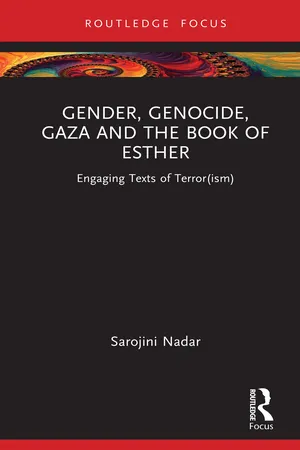
Gender, Genocide, Gaza and the Book of Esther bridges the gap between gendered and geopolitical analyses by interrogating both the sexual and ethnic violence embedded in the Book of Esther. While much scholarship has examined the potential genocide of the Jews in the narrative, far less attention has been paid to the Persian "retaliation genocide." Framed within decolonial feminist perspectives, this book shifts between the harem—the royal institution where women were sequestered for the king's use—and herem, the practice of divinely sanctioned warfare that justifies the extermination of an enemy. Rather than operating as discrete forms of violence, the book argues that the harem and the herem are co-constitutive, revealing how gendered and ethnic domination function in tandem. Through a combination of narrative inquiry, inter-textual readings, critical discourse analysis, and theological assessments of both the biblical text and its contemporary reception, Gender, Genocide, Gaza and the Book of Esther invites interpreters to consider the larger frameworks of ethnicity and racialization within which hermeneutics of sexual violence take place. A close literary reading of Esther is paired with an analysis of its contemporary geopolitical appropriations, particularly its use in Christian Zionist rhetoric. The explicit invocation of the Amalekite extermination trope by Israel's prime minister in October 2023 to justify attacks on Gaza, underscores the enduring political afterlives of texts of terror. This book contends that a feminist reading of Esther cannot limit itself to an analysis of sexual violence but must extend its critique intersectionally, engaging with the broader necropolitical economies that structure both ancient and modern deployments of biblical violence.
eBook - ePub
Gender, Genocide, Gaza and the Book of Esther
Engaging Texts of Terror(ism)
- English
- ePUB (mobile friendly)
- Available on iOS & Android
eBook - ePub
About this book
Information
Table of contents
- Cover
- Half-Title
- Series
- Title
- Copyright
- Dedication
- Contents
- Acknowledgements
- Preface: From Persia to Palestine—Rethinking the Harem and the Herem
- 1 The Journey from Texts of Terror to (Con)Texts of Terrorism
- 2 Sacred Economies of Violence and Interpretive Communities
- 3 Vashti: Patriarchy, Politics, and Power
- 4 “Like a Virgin,” Invisiblised, Invalidated, and Erased
- 5 Esther and Mordecai: Pretty Privilege and Theological Necropolitics
- 6 Esther and Haman, the Amalekite Trope: Blurring Boundaries of Self-Defence and Aggression
- 7 Conclusion, between the Harem and the Herem: Interpretative Practices to Counter Texts of Terror(ism)
- Bibliography
- Index
Trusted by 375,005 students
Access to over 1.5 million titles for a fair monthly price.
Study more efficiently using our study tools.
Frequently asked questions
Yes, you can cancel anytime from the Subscription tab in your account settings on the Perlego website. Your subscription will stay active until the end of your current billing period. Learn how to cancel your subscription
No, books cannot be downloaded as external files, such as PDFs, for use outside of Perlego. However, you can download books within the Perlego app for offline reading on mobile or tablet. Learn how to download books offline
Perlego offers two plans: Essential and Complete
- Essential is ideal for learners and professionals who enjoy exploring a wide range of subjects. Access the Essential Library with 800,000+ trusted titles and best-sellers across business, personal growth, and the humanities. Includes unlimited reading time and Standard Read Aloud voice.
- Complete: Perfect for advanced learners and researchers needing full, unrestricted access. Unlock 1.5M+ books across hundreds of subjects, including academic and specialized titles. The Complete Plan also includes advanced features like Premium Read Aloud and Research Assistant.
We are an online textbook subscription service, where you can get access to an entire online library for less than the price of a single book per month. With over 1.5 million books across 990+ topics, we’ve got you covered! Learn about our mission
Look out for the read-aloud symbol on your next book to see if you can listen to it. The read-aloud tool reads text aloud for you, highlighting the text as it is being read. You can pause it, speed it up and slow it down. Learn more about Read Aloud
Yes! You can use the Perlego app on both iOS and Android devices to read anytime, anywhere — even offline. Perfect for commutes or when you’re on the go.
Please note we cannot support devices running on iOS 13 and Android 7 or earlier. Learn more about using the app
Please note we cannot support devices running on iOS 13 and Android 7 or earlier. Learn more about using the app
Yes, you can access Gender, Genocide, Gaza and the Book of Esther by Sarojini Nadar in PDF and/or ePUB format, as well as other popular books in Theology & Religion & Biblical Criticism & Interpretation. We have over 1.5 million books available in our catalogue for you to explore.