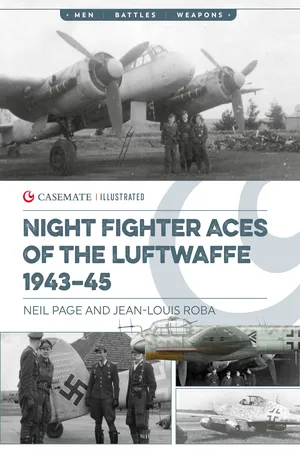
Features color profiles by acclaimed aviation artist Claes Sundin! The week-long Allied bombing campaign against Hamburg in late July 1943 was not only hugely destructive but also had a significant impact on the German night fighter arm. From now on, the "boxes" of Kammhuber's "Raumnachtjagd" would be the starting point from which fighters would be led into the bomber stream as early as possible, a tactic dubbed "Zahme Sau." The night fighters had to quickly adopt new "freelance" procedures, and also found themselves increasingly engaged in daylight operations. These actions resulted in heavy losses—especially of experienced aces—which the Nachtjagd could ill afford and struggled to replace. The winter of 1943/44 saw a series of huge raids on Berlin. Although hard pressed, the Nachtjagd aces were still able to score some heavy tactical victories. Over a thousand RAF "Viermots" were shot down—more than double the expected losses—before the campaign was cut short. New night fighter aces emerged, often former transport and reconnaissance pilots, and the upward firing armament of the Bf 110s and Ju 88s could cut swathes through the "stream." However, by mid-1944, as the Allies advanced, the night fighter aces were forced into new roles, including ground-strafing armor and troop concentrations, a role for which they were clearly unsuited. A small number of Me 262 jets were deployed in a new NJG 11, but exclusively committed against the rapid twin-engined Mosquitos of the RAF's Light Night Striking Force. Heinkel He 219s were never available in significant numbers and prowling Mosquito intruders were an ever-present danger to Nachtjagd crews. While the surviving night fighter aces continued their defensive actions virtually every night, by March 1945 the Nachtjagd was in terminal decline. Of the 1, 100 night fighter pilots and crew who claimed at least one victory, some 669 were lost, a casualty rate of around 74 percent. Fully illustrated and featuring newly translated personal accounts, this is a chronological account of the Luftwaffe night fighters in the second part of the war, covering major campaigns, the biographies of individual aces, and the details of their aircraft.
- English
- ePUB (mobile friendly)
- Available on iOS & Android
eBook - ePub
Night Fighter Aces of the Luftwaffe 1943-45
About this book
Table of contents
- Front Cover
- Half-title Page
- Title Page
- Copyright Page
- Contents
- Timeline of Events
- Introduction
- Reinforcing the Nachtjagd Ost: July–September 1943
- In the West: August–December 1943
- The Battle for Berlin: November 1943– March 1944
- The Normandy Campaign: June–August 1944
- In the East: January–September 1944
- In the West: September 1944–January 1, 1945
- Terminal Decline: January–May 1945
- Afterword
- References and Further Reading
Trusted by 375,005 students
Access to over 1.5 million titles for a fair monthly price.
Study more efficiently using our study tools.
Frequently asked questions
Yes, you can cancel anytime from the Subscription tab in your account settings on the Perlego website. Your subscription will stay active until the end of your current billing period. Learn how to cancel your subscription
No, books cannot be downloaded as external files, such as PDFs, for use outside of Perlego. However, you can download books within the Perlego app for offline reading on mobile or tablet. Learn how to download books offline
Perlego offers two plans: Essential and Complete
- Essential is ideal for learners and professionals who enjoy exploring a wide range of subjects. Access the Essential Library with 800,000+ trusted titles and best-sellers across business, personal growth, and the humanities. Includes unlimited reading time and Standard Read Aloud voice.
- Complete: Perfect for advanced learners and researchers needing full, unrestricted access. Unlock 1.5M+ books across hundreds of subjects, including academic and specialized titles. The Complete Plan also includes advanced features like Premium Read Aloud and Research Assistant.
We are an online textbook subscription service, where you can get access to an entire online library for less than the price of a single book per month. With over 1.5 million books across 990+ topics, we’ve got you covered! Learn about our mission
Look out for the read-aloud symbol on your next book to see if you can listen to it. The read-aloud tool reads text aloud for you, highlighting the text as it is being read. You can pause it, speed it up and slow it down. Learn more about Read Aloud
Yes! You can use the Perlego app on both iOS and Android devices to read anytime, anywhere — even offline. Perfect for commutes or when you’re on the go.
Please note we cannot support devices running on iOS 13 and Android 7 or earlier. Learn more about using the app
Please note we cannot support devices running on iOS 13 and Android 7 or earlier. Learn more about using the app
Yes, you can access Night Fighter Aces of the Luftwaffe 1943-45 by Neil Page,Jean-Louis Roba in PDF and/or ePUB format, as well as other popular books in History & 20th Century History. We have over 1.5 million books available in our catalogue for you to explore.