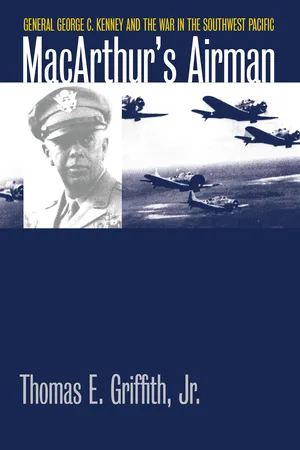
A fighter pilot who flew 75 combat missions in World War I, George C. Kenney was a charismatic leader who established himself as an innovative advocate of air power. As General MacArthur’s air commander in the Southwest Pacific during World War II, Kenney played a pivotal role in the conduct of the war, but until now his performance has remained largely unexplored.
Thomas Griffith offers a critical assessment of Kenney’s numerous contributions to MacArthur’s war efforts. He depicts Kenney as a staunch proponent of airpower’s ability to shape the outcome of military engagements and a commander who shared MacArthur’s strategic vision. He tells how Kenney played a key role in campaigns from New Guinea to the Philippines; adapted aircraft, pilots, doctrine, and technology to the demands of aerial warfare in the southwest Pacific; and pursued daring strategies that likely would have failed in the European theater.
Kenney is shown to have been an operational and organizational innovator who was willing to scrap doctrine when the situation called for ingenuity, such as shifting to low-level attacks for more effective bombing raids. Griffith tells how Kenney established air superiority in every engagement, provided close air support for troops by bombing enemy supply lines, attacked and destroyed Japanese supply ships, and carried out rapid deployment by airlifting troops and supplies.
Griffith draws on Kenney’s diary and correspondence, the personal papers of other officers, and previously untapped sources to present a comprehensive portrayal of both the officer and the man. He illuminates Kenney’s relationship with MacArthur, General “Hap” Arnold, and other field commanders, and closely examines factors in air warfare often neglected in other accounts, such as intelligence, training, and logistical support.
MacArthur’s Airman is a rich and insightful study that shows how air, ground, and marine efforts were integrated to achieve major strategic objectives. It firmly establishes the importance of MacArthur’s campaign in New Guinea and reveals Kenney’s instrumental role in turning the tide against the Japanese.