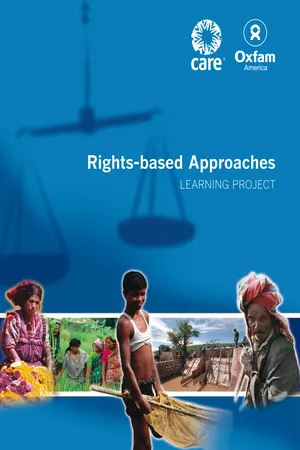
Case studies that provide compelling conclusions about the differences between rights-based and more traditional projects, and their relative impacts. The failure to respect, protect, or fulfil human rights is a fundamental and leading obstacle to economic development and social justice. Practically speaking, however, we are still struggling to understand what this major organisational shift means. The term rights-based approaches; (RBAs) has become so familiar that we tend to assume that it is well- understood and that it is a foregone conclusion that rights-based approaches offer more potential for sustainable impact. This report presents the findings of a collaborative Learning Project between CARE USA and Oxfam America, who compared RBA projects with non-RBA projects and identified best practices; and lessons that could be used to improve the application of rights-based approaches in programming. In doing this they confirmed that rights-based approaches strengthen development work. For field-based staff, partners, and other development practitioners working on the design and implementation of rights-based projects.
eBook - PDF
Rights-Based Approaches
About this book
Information
Table of contents
Trusted by 375,005 students
Access to over 1.5 million titles for a fair monthly price.
Study more efficiently using our study tools.
Frequently asked questions
Yes, you can cancel anytime from the Subscription tab in your account settings on the Perlego website. Your subscription will stay active until the end of your current billing period. Learn how to cancel your subscription
No, books cannot be downloaded as external files, such as PDFs, for use outside of Perlego. However, you can download books within the Perlego app for offline reading on mobile or tablet. Learn how to download books offline
Perlego offers two plans: Essential and Complete
- Essential is ideal for learners and professionals who enjoy exploring a wide range of subjects. Access the Essential Library with 800,000+ trusted titles and best-sellers across business, personal growth, and the humanities. Includes unlimited reading time and Standard Read Aloud voice.
- Complete: Perfect for advanced learners and researchers needing full, unrestricted access. Unlock 1.5M+ books across hundreds of subjects, including academic and specialized titles. The Complete Plan also includes advanced features like Premium Read Aloud and Research Assistant.
We are an online textbook subscription service, where you can get access to an entire online library for less than the price of a single book per month. With over 1.5 million books across 990+ topics, we’ve got you covered! Learn about our mission
Look out for the read-aloud symbol on your next book to see if you can listen to it. The read-aloud tool reads text aloud for you, highlighting the text as it is being read. You can pause it, speed it up and slow it down. Learn more about Read Aloud
Yes! You can use the Perlego app on both iOS and Android devices to read anytime, anywhere — even offline. Perfect for commutes or when you’re on the go.
Please note we cannot support devices running on iOS 13 and Android 7 or earlier. Learn more about using the app
Please note we cannot support devices running on iOS 13 and Android 7 or earlier. Learn more about using the app
Yes, you can access Rights-Based Approaches by Jude Rand in PDF and/or ePUB format, as well as other popular books in Social Sciences & Global Development Studies. We have over 1.5 million books available in our catalogue for you to explore.