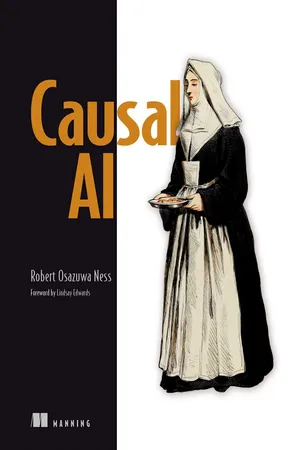
How do you know what might have happened, had you done things differently? Causal AI gives you the insight you need to make predictions and control outcomes based on causal relationships instead of pure correlation, so you can make precise and timely interventions. Causal AI is a practical introduction to building AI models that can reason about causality.
In Causal AI you will learn how to:
- Build causal reinforcement learning algorithms
- Implement causal inference with modern probabilistic machine tools such as PyTorch and Pyro
- Compare and contrast statistical and econometric methods for causal inference
- Set up algorithms for attribution, credit assignment, and explanation
- Convert domain expertise into explainable causal models
Foreword by Lindsay Edwards.
About the technology
Traditional ML models can’t answer causal questions like, “Why did that happen?” or, “What factors should I change to get a particular outcome?” This book blends advanced statistical methods, computational techniques, and new algorithms to create machine learning systems that automate the process of causal inference.
About the book
Causal AI introduces the tools, techniques, and algorithms of causal reasoning for machine learning. This unique book masterfully blends Bayesian and probabilistic approaches to causal inference with practical hands-on examples in Python. Along the way, you’ll learn to integrate causal assumptions into deep learning architectures, including reinforcement learning and large language models. You’ll also use PyTorch, Pyro, and other ML libraries to scale up causal inference.
What's inside
- End-to-end causal inference with DoWhy
- Deep Bayesian causal generative AI models
- A code-first tour of the do-calculus and Pearl’s causal hierarchy
- Code for fine-tuning causal large language models
For data scientists and machine learning engineers. Examples in Python.
About the author
Robert Osazuwa Ness is an AI researcher at Microsoft Research and professor at Northeastern University. He is a contributor to open-source causal inference packages such as Python’s DoWhy and R’s bnlearn.
Table of Contents
Part 1
1 Why causal AI
2 A primer on probabilistic generative modeling
Part 2
3 Building a causal graphical model
4 Testing the DAG with causal constraints
5 Connecting causality and deep learning
Part 3
6 Structural causal models
7 Interventions and causal effects
8 Counterfactuals and parallel worlds
9 The general counterfactual inference algorithm
10 Identification and the causal hierarchy
Part 4
11 Building a causal inference workflow
12 Causal decisions and reinforcement learning
13 Causality and large language models