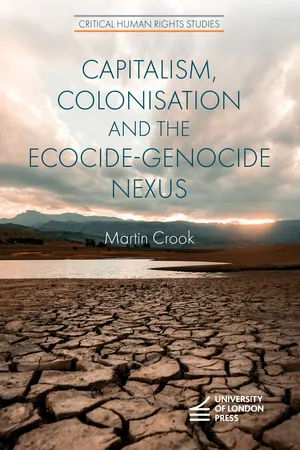
With climate change and a looming ecological crisis impacting the systems and institutions that support life, this timely publication examines the drivers of ecologically induced genocide – the environmental destruction resulting in conditions of life that fundamentally threaten a social group's cultural or physical existence. Focusing on the former British colonies of Kenya and Australia, both united by a discourse of developmentalism, the book draws attention to the critical role that the destructions of ecologies has historically played, and continues to play, in the genocide of Indigenous and place-based peoples. It synthesises radical political ecology with a political-economic approach to illuminate the nexus between the inherently genocidal and ecocidal properties of the capitalist global system and the manner in which the ecocidal logic of capital intersects with settler and post-colonial structures. In exploring the genocidal effects of climate governance and market environmentalism on Indigenous peoples in Kenya and forms of energy extraction on Indigenous groups in Australia, the book also draws on original interviews to prioritise the lived experiences of, and give voice to, the groups that have suffered structural violence and social harms. Fundamentally, it puts forward a political economy of genocide, which seeks to explain the manner in which material forces, on local and global scales, underpin and give rise to ever-evolving relations of genocide. As such, this important book deepens and enriches our knowledge of genocide and the eco-genocidal nature of colonisation, and the capitalist mode of production that underpins developmentalism.
- English
- ePUB (mobile friendly)
- Available on iOS & Android
eBook - ePub
Capitalism, Colonisation and the Ecocide-Genocide Nexus
About this book
Information
Publisher
University of London PressYear
2024Print ISBN
9781912250592
9781912250585
eBook ISBN
9781912250615
Table of contents
- Cover
- Series Page
- Title Page
- Copyright
- Contents
- Acknowledgements
- List of abbreviations
- 1. Introduction: ecological inequity, ‘exterminism’ and genocide
- 2. Australia then: the architecture of dispossession
- 3. Australia now: the architecture of dispossession
- 4. Kenya then: the architecture of dispossession
- 5. Kenya now: the architecture of dispossession
- Conclusion: a neo-Lemkian ontology in the age of the Anthropocene
- Bibliography
- Index
Trusted by 375,005 students
Access to over 1.5 million titles for a fair monthly price.
Study more efficiently using our study tools.
Frequently asked questions
Yes, you can cancel anytime from the Subscription tab in your account settings on the Perlego website. Your subscription will stay active until the end of your current billing period. Learn how to cancel your subscription
No, books cannot be downloaded as external files, such as PDFs, for use outside of Perlego. However, you can download books within the Perlego app for offline reading on mobile or tablet. Learn how to download books offline
Perlego offers two plans: Essential and Complete
- Essential is ideal for learners and professionals who enjoy exploring a wide range of subjects. Access the Essential Library with 800,000+ trusted titles and best-sellers across business, personal growth, and the humanities. Includes unlimited reading time and Standard Read Aloud voice.
- Complete: Perfect for advanced learners and researchers needing full, unrestricted access. Unlock 1.5M+ books across hundreds of subjects, including academic and specialized titles. The Complete Plan also includes advanced features like Premium Read Aloud and Research Assistant.
We are an online textbook subscription service, where you can get access to an entire online library for less than the price of a single book per month. With over 1.5 million books across 990+ topics, we’ve got you covered! Learn about our mission
Look out for the read-aloud symbol on your next book to see if you can listen to it. The read-aloud tool reads text aloud for you, highlighting the text as it is being read. You can pause it, speed it up and slow it down. Learn more about Read Aloud
Yes! You can use the Perlego app on both iOS and Android devices to read anytime, anywhere — even offline. Perfect for commutes or when you’re on the go.
Please note we cannot support devices running on iOS 13 and Android 7 or earlier. Learn more about using the app
Please note we cannot support devices running on iOS 13 and Android 7 or earlier. Learn more about using the app
Yes, you can access Capitalism, Colonisation and the Ecocide-Genocide Nexus by Martin Crook in PDF and/or ePUB format, as well as other popular books in Politics & International Relations & Political Economy. We have over 1.5 million books available in our catalogue for you to explore.