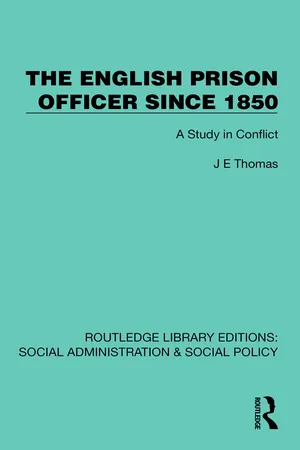
When this book was originally published in 1972 very little had been written about prison staff. The author acknowledges that interest should of course be concentrated on the prisoner community but maintains that the prison staff must also be examined if prisons are to be fully understood. This book demonstrates that the central figure in any prison system is the basic grade uniformed officer and that the collective views of officers have a direct and supreme impact on the working of the system. The book discusses the role of the prison officer in the English prison system, a highly centralized organization which has been in operation for over 150 years. The definition of new organizational tasks during this time brought problems of adjustment for staff which were never properly examined or understood, and which led to major crises. This examination of the English prison service is relevant to prison systems in all advanced societies and raises many controversial issues of importance to policymakers in prison services.
- English
- ePUB (mobile friendly)
- Available on iOS & Android
eBook - ePub
About this book
Information
Table of contents
- Cover
- Half Title
- Title Page
- Copyright Page
- Original Title Page
- Original Copyright Page
- Dedication
- Table of Contents
- Acknowledgments
- Introduction
- 1 The organisation and the task
- 2 The background to the centralisation of the prison system
- 3 Building the prison service
- 4 1850–80: the early years
- 5 1880–91: two major inquiries
- 6 1892–5: the Gladstone Committee
- 7 1895–1921: a change of direction
- 8 1922’45: the Paterson initiative
- 9 1945–68: the crisis erupts
- 10 Postscript
- Appendix: The closing of prisons in 1878
- Bibliography
- Index
Trusted by 375,005 students
Access to over 1.5 million titles for a fair monthly price.
Study more efficiently using our study tools.
Frequently asked questions
Yes, you can cancel anytime from the Subscription tab in your account settings on the Perlego website. Your subscription will stay active until the end of your current billing period. Learn how to cancel your subscription
No, books cannot be downloaded as external files, such as PDFs, for use outside of Perlego. However, you can download books within the Perlego app for offline reading on mobile or tablet. Learn how to download books offline
We are an online textbook subscription service, where you can get access to an entire online library for less than the price of a single book per month. With over 1.5 million books across 990+ topics, we’ve got you covered! Learn about our mission
Look out for the read-aloud symbol on your next book to see if you can listen to it. The read-aloud tool reads text aloud for you, highlighting the text as it is being read. You can pause it, speed it up and slow it down. Learn more about Read Aloud
Yes! You can use the Perlego app on both iOS and Android devices to read anytime, anywhere — even offline. Perfect for commutes or when you’re on the go.
Please note we cannot support devices running on iOS 13 and Android 7 or earlier. Learn more about using the app
Please note we cannot support devices running on iOS 13 and Android 7 or earlier. Learn more about using the app
Yes, you can access The English Prison Officer Since 1850 by J. E. Thomas in PDF and/or ePUB format, as well as other popular books in Social Sciences & Social Policy. We have over 1.5 million books available in our catalogue for you to explore.