Since Myanmar's 2021 military coup, the reach and influence of non-state authorities have spread considerably, providing them with greater scope to govern economic activity in parts of Myanmar. Taxation is among non-state authorities' most widespread aspects of economic governance. Numerous groups rely on checkpoints and road tolls, with other common taxes covering natural resource extraction, agricultural production, and business activity. At least one non-state authority collects monthly household taxes, with higher rates for wealthier households. Other forms of economic governance implemented by non-state authorities include land titling and regulation, business licensing, business registration, and infrastructure repair/development. Numerous groups have authority over aspects of trade, and some have either stated policies or informal engagement with foreign investors. Economic governance varies due to historical experience and group capacity, among other factors, but there are numerous promising practices that show policy experimentation and responsiveness to local needs and concerns. The Karen National Union's governance of land shows that sophisticated governance at scale by non-state authorities is possible. However, there are examples of policies and practices that distort economic activity, negatively affect livelihoods, and raise revenue in regressive ways. Non-state authorities face challenges in governing economic activities, including ongoing conflict; the international community's state-centric economic approach; contestation between groups about the authority to govern; the scale of illicit economic activity in Myanmar; and differences in economic motivations. While some non-state authorities are focused on governing economic activities, others are focused on doing business—including illicit business—and have little interest in governing. Collaboration to develop and implement joint quasi-federal governance for national-level economic powers, such as trade, has been limited. This raises questions about whether Myanmar's non-state authorities can offer a viable national-level alternative to the State Administration Council (SAC), or whether they constitute an alternative only for some subnational areas and powers.
- 38 pages
- English
- PDF
- Available on iOS & Android
eBook - PDF
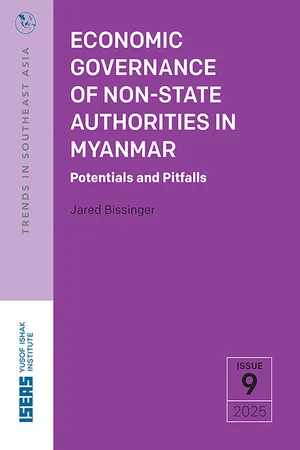
Economic Governance of Non-State Authorities in Myanmar
About this book
Information
Subtopic
Economic PolicyIndex
EconomicsTable of contents
Trusted by 375,005 students
Access to over 1.5 million titles for a fair monthly price.
Study more efficiently using our study tools.
Frequently asked questions
Yes, you can cancel anytime from the Subscription tab in your account settings on the Perlego website. Your subscription will stay active until the end of your current billing period. Learn how to cancel your subscription
No, books cannot be downloaded as external files, such as PDFs, for use outside of Perlego. However, you can download books within the Perlego app for offline reading on mobile or tablet. Learn how to download books offline
Perlego offers two plans: Essential and Complete
- Essential is ideal for learners and professionals who enjoy exploring a wide range of subjects. Access the Essential Library with 800,000+ trusted titles and best-sellers across business, personal growth, and the humanities. Includes unlimited reading time and Standard Read Aloud voice.
- Complete: Perfect for advanced learners and researchers needing full, unrestricted access. Unlock 1.5M+ books across hundreds of subjects, including academic and specialized titles. The Complete Plan also includes advanced features like Premium Read Aloud and Research Assistant.
We are an online textbook subscription service, where you can get access to an entire online library for less than the price of a single book per month. With over 1.5 million books across 990+ topics, we’ve got you covered! Learn about our mission
Look out for the read-aloud symbol on your next book to see if you can listen to it. The read-aloud tool reads text aloud for you, highlighting the text as it is being read. You can pause it, speed it up and slow it down. Learn more about Read Aloud
Yes! You can use the Perlego app on both iOS and Android devices to read anytime, anywhere — even offline. Perfect for commutes or when you’re on the go.
Please note we cannot support devices running on iOS 13 and Android 7 or earlier. Learn more about using the app
Please note we cannot support devices running on iOS 13 and Android 7 or earlier. Learn more about using the app
Yes, you can access Economic Governance of Non-State Authorities in Myanmar by Jared Bissinger Bissinger in PDF and/or ePUB format, as well as other popular books in Economics & Economic Policy. We have over 1.5 million books available in our catalogue for you to explore.