Despite more than 15 years of effort, it is widely acknowledged that internal reform of the public schools has produced little if any success. This has led to renewed interest in alternative forms of educational delivery to devolve decision-making through charter schools, public and private voucher plans, contracting out educational services, and home schooling. However, such reforms have largely been resisted by public school interest groups, including teacher unions, state departments of education, colleges of education, and school board and administrator organizations that have fought any but the most benign changes.
Less attention has been given to another option that has been quietly growing in importance: private, for-profit schools. Firms in the private sector are typically more productive and responsive to consumer demands than their public sector counterparts. Historically, for-profit schools have had a good track record and they are increasingly common today. In Can Teachers Own Their Own Schools?, Richard Vedder examines the economics, history, and politics of education and argues that public schools should be privatized. Privatized public schools would benefit from competition, market discipline, and the incentives essential to produce cost-effective, educational quality, and attract the additional funding and expertise needed to revolutionize school systems.
Drawing inspiration from Margaret Thatcher’s privatization of government council housing in England, privatization reforms in Latin America, and the E.S.O.P. (Employee Stock Ownership Plan) movement in the United States, Vedder presents a bold plan in which teachers, administrators and others involved in the educational process would become the owners of schools, acquiring an attractive financial stake in the process. Such privatization reforms could empower those directly involved and affected by school performance and end interest group barriers, paving the way for new, cost-effective means of improving educational outcomes. As a result, schools in which teachers, administrators, and parents have a significant financial stake would foster vibrant school communities with increased parental involvement and the innovation and efficiency essential to produce educational excellence.
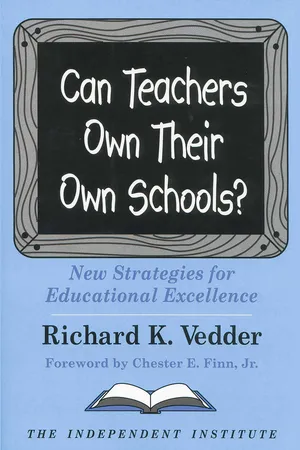
eBook - ePub
Can Teachers Own Their Own Schools?
New Strategies for Educational Excellence
- English
- ePUB (mobile friendly)
- Available on iOS & Android
eBook - ePub
About this book
Information
Topic
EducationSubtopic
Education AdministrationTable of contents
- Cover
- Title Page
- Copyright
- Contents
- Foreword by Chester E. Finn, Jr.
- 1. Introduction
- 2. American Education: Poor Outcomes and Declining Efficiency
- 3. Long-Term Benefits of the For-Profit Approach
- 4. A Historical Perspective on For-Profit Schools
- 5. For-Profit Education in America Today
- 6. Illustrating the “ESOP” Approach to Public Education
- 7. Conclusion
- Notes
- Bibliography
- About the Author
Trusted by 375,005 students
Access to over 1.5 million titles for a fair monthly price.
Study more efficiently using our study tools.
Frequently asked questions
Yes, you can cancel anytime from the Subscription tab in your account settings on the Perlego website. Your subscription will stay active until the end of your current billing period. Learn how to cancel your subscription
No, books cannot be downloaded as external files, such as PDFs, for use outside of Perlego. However, you can download books within the Perlego app for offline reading on mobile or tablet. Learn how to download books offline
We are an online textbook subscription service, where you can get access to an entire online library for less than the price of a single book per month. With over 1.5 million books across 990+ topics, we’ve got you covered! Learn about our mission
Look out for the read-aloud symbol on your next book to see if you can listen to it. The read-aloud tool reads text aloud for you, highlighting the text as it is being read. You can pause it, speed it up and slow it down. Learn more about Read Aloud
Yes! You can use the Perlego app on both iOS and Android devices to read anytime, anywhere — even offline. Perfect for commutes or when you’re on the go.
Please note we cannot support devices running on iOS 13 and Android 7 or earlier. Learn more about using the app
Please note we cannot support devices running on iOS 13 and Android 7 or earlier. Learn more about using the app
Yes, you can access Can Teachers Own Their Own Schools? by Richard K. Vedder in PDF and/or ePUB format, as well as other popular books in Education & Education Administration. We have over 1.5 million books available in our catalogue for you to explore.