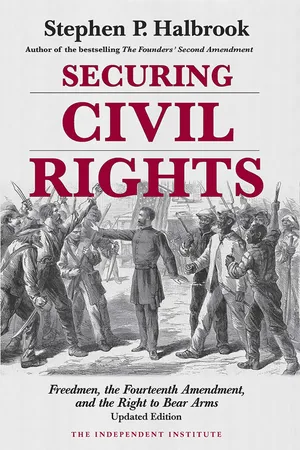
Stephen Halbrook's groundbreaking study of freed slaves and the right to bear arms in the aftermath of the Civil War, cited in Supreme Court cases, now with a new foreword by Robert J. Cottrol.
What did it mean to take civil rights seriously—especially the "right to bear arms"—in the years following the abolition of slavery? By quoting legislative debates, Congressional hearings on Ku Klux Klan violence, and newspapers and law books of the time, constitutional scholar Stephen Halbrook shows that both supporters and opponents of the Fourteenth Amendment (1868) believed that it protected all Bill of Rights guarantees—especially the Second Amendment—from infringement by the states.
From the Freedmen’s Bureau Act of 1866 to the Supreme Court’s decision in United States v. Cruikshank (1876), Halbrook paints a vivid portrait of a political and legal system grappling with the true meaning of civil rights.
“Trusting ex-slaves to own firearms was, by any definition, the cutting edge in true belief in civil rights,” Halbrook writes. “It remains to be seen whether contemporary society will accommodate the same rights of the freedmen that the Framers of the Fourteenth Amendment sought to guarantee.”
Although Halbrook concentrates on the right to keep and bear arms, he also includes a comprehensive analysis of the general topic of the relationship between the Bill of Rights and the state governments after the ratification of the Fourteenth Amendment.
Cited by both the U.S. Supreme Court in its historic landmark decision in the McDonald case (2010) and the Washington Supreme Court in State of Washington v. Christopher William Sieyes case (2010) as the leading account of the relationship between the Second Amendment and the states during Reconstruction, Halbrook’s insightful narrative will help a larger audience better understand why earlier generations of Americans viewed the right to bear arms as essential for securing civil rights.
eBook - ePub
Securing Civil Rights
Freedmen, the Fourteenth Amendment, and the Right to Bear Arms
- English
- ePUB (mobile friendly)
- Available on iOS & Android
eBook - ePub
Securing Civil Rights
Freedmen, the Fourteenth Amendment, and the Right to Bear Arms
About this book
Information
Subtopic
American Civil War HistoryIndex
HistoryTable of contents
- Cover
- Title Page
- Copyright
- Contents
- Foreword to the Updated Edition by Robert J. Cottrol
- Preface to the Updated Edition
- 1. The Civil Rights and Freedmen’s Bureau Acts and the Proposal of the Fourteenth Amendment
- 2. Congress Reacts to Southern Rejection of the Fourteenth Amendment
- 3. The Southern State Constitutional Conventions
- 4. The Freedmen’s Bureau Act Reenacted and the Fourteenth Amendment Ratified
- 5. Toward Adoption of the Civil Rights Act of 1871
- 6. From the Klan Trials and Hearings Through the End of the Civil Rights Revolution
- 7. The Cruikshank Case, from Trial to the Supreme Court
- 8. Unfinished Jurisprudence
- Notes
- Table of Cases
- Bibliography
- About the Author
Trusted by 375,005 students
Access to over 1.5 million titles for a fair monthly price.
Study more efficiently using our study tools.
Frequently asked questions
Yes, you can cancel anytime from the Subscription tab in your account settings on the Perlego website. Your subscription will stay active until the end of your current billing period. Learn how to cancel your subscription
No, books cannot be downloaded as external files, such as PDFs, for use outside of Perlego. However, you can download books within the Perlego app for offline reading on mobile or tablet. Learn how to download books offline
We are an online textbook subscription service, where you can get access to an entire online library for less than the price of a single book per month. With over 1.5 million books across 990+ topics, we’ve got you covered! Learn about our mission
Look out for the read-aloud symbol on your next book to see if you can listen to it. The read-aloud tool reads text aloud for you, highlighting the text as it is being read. You can pause it, speed it up and slow it down. Learn more about Read Aloud
Yes! You can use the Perlego app on both iOS and Android devices to read anytime, anywhere — even offline. Perfect for commutes or when you’re on the go.
Please note we cannot support devices running on iOS 13 and Android 7 or earlier. Learn more about using the app
Please note we cannot support devices running on iOS 13 and Android 7 or earlier. Learn more about using the app
Yes, you can access Securing Civil Rights by Stephen P. Halbrook in PDF and/or ePUB format, as well as other popular books in History & American Civil War History. We have over 1.5 million books available in our catalogue for you to explore.