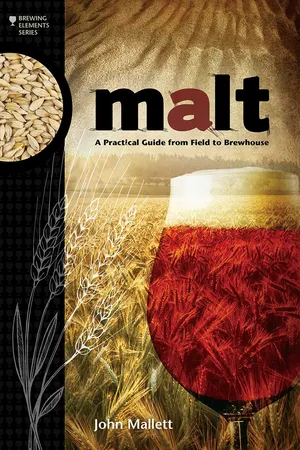
Often playing second fiddle to hops in the minds of craft beer drinkers, malt is the backbone of beer: "No barley, no beer." Malt defines the color, flavor, body, and alcohol of beer and has been cultivated for nearly as long as agriculture has existed. In this book, author John Mallett explains why he feels a book on malt is necessary, taking the reader on a brief history of malting from the earliest records of bappir through to the Middle Ages and Early Modern Period. When Mallett touches on the major changes wrought by the Industrial Revolution and beyond, he illustrates how developments in malting technology were intertwined with politics and taxation, which increasingly came to bear on the world of maltsters and brewers.Of course, no book on malt would be complete without a look at the processes behind malting and how different malts are made. Mallett neatly conveys the basics of malt chemistry, Maillard reactions, and diastatic power—the enzymes, starches, sugars, glucans, phenols, proteins, and lipids involved. Descriptions of the main types of malt are included, from base malt, caramel malts, and roasted malts through to specialty malts and other grains like wheat, rye, and oats. Information is interspersed with the thoughts and wisdom of some of America's most respected craft brewers.Understanding an ingredient requires appreciating where it comes from and how it is grown. The author condenses the complexities of barley anatomy and agriculture into easy, readable sections, seamlessly combining these details with high-level look at the economic and environmental pressures that dictate the livelihoods of farmers and maltsters. Mallett explains how to interpret—and when to rely on—malt quality and analysis sheets, an essential skill for brewers. There is a summary of the main barley varieties, both modern and heritage, from Europe and America. The book finishes with what happens to the malt once it reaches the brewery, addressing issues of malt packaging, handling, preparation, storage, conveyance, and milling in the brewhouse.
- English
- ePUB (mobile friendly)
- Available on iOS & Android
eBook - ePub
About this book
Information
Table of contents
- Title Page
- Copyright Page
- Dedication
- Table of Contents
- Acknowledgments
- Foreword
- Introduction
- 1. Harry Harlan—The ‘Indiana Jones’ of Barley
- 2. Malt: The Soul of Beer
- 3. History of Malting
- Malthouse Tour—Floor Malting in Great Britain
- 4. From Barley to Malt
- 5. Specialty Malts
- Malthouse Tour—Full Scale Modern Malting
- 6. Malt Chemistry
- 7. Malt Family Descriptions
- 8. Barley Anatomy and Agriculture
- Malthouse Tour—Craft Micro-maltsters
- 9. Barley Varieties
- 10. Malt Quality and Analysis
- 11. Malt Handling and Preparation
- 12. Milling
- Appendix A: Commercially Available Malts
- Appendix B: Worldwide and North American Malthouse Capacities
- Appendix C: Craft Maltster Listing
- Appendix D: Introduction To Home Malting
- Bibliography
- Index
Trusted by 375,005 students
Access to over 1.5 million titles for a fair monthly price.
Study more efficiently using our study tools.
Frequently asked questions
Yes, you can cancel anytime from the Subscription tab in your account settings on the Perlego website. Your subscription will stay active until the end of your current billing period. Learn how to cancel your subscription
No, books cannot be downloaded as external files, such as PDFs, for use outside of Perlego. However, you can download books within the Perlego app for offline reading on mobile or tablet. Learn how to download books offline
Perlego offers two plans: Essential and Complete
- Essential is ideal for learners and professionals who enjoy exploring a wide range of subjects. Access the Essential Library with 800,000+ trusted titles and best-sellers across business, personal growth, and the humanities. Includes unlimited reading time and Standard Read Aloud voice.
- Complete: Perfect for advanced learners and researchers needing full, unrestricted access. Unlock 1.5M+ books across hundreds of subjects, including academic and specialized titles. The Complete Plan also includes advanced features like Premium Read Aloud and Research Assistant.
We are an online textbook subscription service, where you can get access to an entire online library for less than the price of a single book per month. With over 1.5 million books across 990+ topics, we’ve got you covered! Learn about our mission
Look out for the read-aloud symbol on your next book to see if you can listen to it. The read-aloud tool reads text aloud for you, highlighting the text as it is being read. You can pause it, speed it up and slow it down. Learn more about Read Aloud
Yes! You can use the Perlego app on both iOS and Android devices to read anytime, anywhere — even offline. Perfect for commutes or when you’re on the go.
Please note we cannot support devices running on iOS 13 and Android 7 or earlier. Learn more about using the app
Please note we cannot support devices running on iOS 13 and Android 7 or earlier. Learn more about using the app
Yes, you can access Malt by John Mallett in PDF and/or ePUB format, as well as other popular books in Art & Agronomy. We have over 1.5 million books available in our catalogue for you to explore.