Grounded in examples from across the social sciences, this book walks you through the process of doing quantitative text analysis step by step. Clear and accessible, it empowers you to progress from beginner level to understanding and using computational social science concepts with ease. Covering key steps in the research process like ethics, data collection, and model choice, it helps you develop important research skills – and equips you with the programming tools you need to handle text data without error.
The textbook offers R software guidance at an easy-to-follow pace, the book presents the coding skills you need to collect and prepare data, providing a strong foundation as you move into data analysis. It will:
· Help you develop key data skills like cleaning, managing, classifying and visualizing data
· Encourage your ability to be critical and reflective when dealing with data
· Offer clear guidance on using messy, real-world data and big data from sources like Wikipedia
Supported by practical online resources including extensive coding examples and software guidance, this book will give you confidence in applying your programming skills and enable you to take control of handling textual data in your own research.
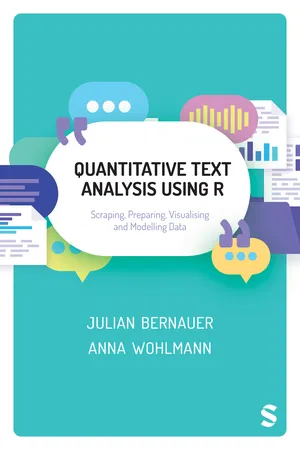
eBook - ePub
Quantitative Text Analysis Using R
Scraping, Preparing, Visualising and Modelling Data
- English
- ePUB (mobile friendly)
- Available on iOS & Android
eBook - ePub
Quantitative Text Analysis Using R
Scraping, Preparing, Visualising and Modelling Data
About this book
Information
Publisher
SAGE Publications LtdYear
2025Print ISBN
9781526467003
9781526467010
Edition
1eBook ISBN
9781529742107
Table of contents
- Cover
- Half Title
- Title Page
- Copyright Page
- Contents
- Preface
- Acknowledgements
- About the Authors
- Meet the Case Study Contributors
- GitHub Repository
- 1 Calculating with Letters
- 2 Using R for Text Analysis
- 3 Text as Data: Obtaining, Preparing and Cleaning
- 4 Extracting and Visualising Information from Text
- 5 Supervised Machine Learning for Text Data
- 6 Unsupervised Machine Learning for Text Data
- 7 Evaluation and Validation of Quantitative Text Analysis
- 8 Using Python within R for Quantitative Text Analysis
- 9 Communicating Text Analysis
- References
- Index
Trusted by 375,005 students
Access to over 1.5 million titles for a fair monthly price.
Study more efficiently using our study tools.
Frequently asked questions
Yes, you can cancel anytime from the Subscription tab in your account settings on the Perlego website. Your subscription will stay active until the end of your current billing period. Learn how to cancel your subscription
No, books cannot be downloaded as external files, such as PDFs, for use outside of Perlego. However, you can download books within the Perlego app for offline reading on mobile or tablet. Learn how to download books offline
Perlego offers two plans: Essential and Complete
- Essential is ideal for learners and professionals who enjoy exploring a wide range of subjects. Access the Essential Library with 800,000+ trusted titles and best-sellers across business, personal growth, and the humanities. Includes unlimited reading time and Standard Read Aloud voice.
- Complete: Perfect for advanced learners and researchers needing full, unrestricted access. Unlock 1.5M+ books across hundreds of subjects, including academic and specialized titles. The Complete Plan also includes advanced features like Premium Read Aloud and Research Assistant.
We are an online textbook subscription service, where you can get access to an entire online library for less than the price of a single book per month. With over 1.5 million books across 990+ topics, we’ve got you covered! Learn about our mission
Look out for the read-aloud symbol on your next book to see if you can listen to it. The read-aloud tool reads text aloud for you, highlighting the text as it is being read. You can pause it, speed it up and slow it down. Learn more about Read Aloud
Yes! You can use the Perlego app on both iOS and Android devices to read anytime, anywhere — even offline. Perfect for commutes or when you’re on the go.
Please note we cannot support devices running on iOS 13 and Android 7 or earlier. Learn more about using the app
Please note we cannot support devices running on iOS 13 and Android 7 or earlier. Learn more about using the app
Yes, you can access Quantitative Text Analysis Using R by Julian Bernauer,Anna Wohlmann in PDF and/or ePUB format, as well as other popular books in Social Sciences & Social Science Research & Methodology. We have over 1.5 million books available in our catalogue for you to explore.