- English
- ePUB (mobile friendly)
- Available on iOS & Android
eBook - ePub
About this book
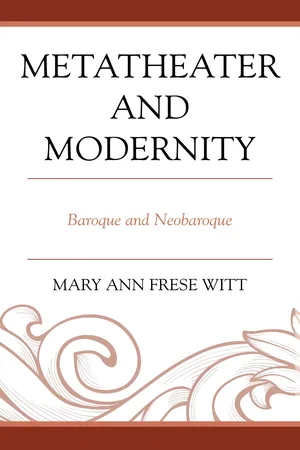
Metatheater and Modernity: Baroque and Neobaroque is the first work to link the study of metatheater with the concepts of baroque and neobaroque. Arguing that the onset of European modernity in the early seventeenth century and both the modernist and the postmodernist periods of the twentieth century witnessed a flourishing of the phenomenon of theater that reflects on itself as theater, the author reexamines the concepts of metatheater, baroque, and neobaroque through a pairing and close analysis of seventeenth and twentieth century plays. The comparisons include Jean Rotrou's The True Saint Genesius with Jean-Paul Sartre's Kean and Jean Genet's The Blacks; Pierre Corneille's L'Illusion comique with Tony Kushner's The Illusion; Gian Lorenzo Bernini's The Impresario with Luigi Pirandello's theater-in-theater trilogy; Shakespeare's Hamlet with Pirandello's Henry IV and Tom Stoppard's Rosencrantz and Guildenstern are Dead; Molière's Impromptu de Versailles with "impromptus" by Jean Cocteau, Jean Giraudoux, and Eugène Ionesco. Metatheater and Modernity also examines the role of technology in the creating and breaking of illusions in both centuries. In contrast to previous work on metatheater, it emphasizes the metatheatrical role of comedy. Metatheater, the author concludes, is both performance and performative: it accomplishes a perceptual transformation in its audience both by defending theater and exposing the illusory quality of the world outside.
Information
Subtopic
20th Century HistoryTable of contents
- Acknowledgments
- Introduction
- 1 From Saint Genesius to Saint Genet
- 2 La Comédie des comédiens and the Defense of Theatrical Illusion
- 3 La commedia da fare
- 4 Hamlet and Meta-Hamlets
- 5 Metatheater as Manifesto
- Epilogue
- Bibliography
- Index
- About the Author
Trusted by 375,005 students
Access to over 1.5 million titles for a fair monthly price.
Study more efficiently using our study tools.
Frequently asked questions
Yes, you can cancel anytime from the Subscription tab in your account settings on the Perlego website. Your subscription will stay active until the end of your current billing period. Learn how to cancel your subscription
No, books cannot be downloaded as external files, such as PDFs, for use outside of Perlego. However, you can download books within the Perlego app for offline reading on mobile or tablet. Learn how to download books offline
Perlego offers two plans: Essential and Complete
- Essential is ideal for learners and professionals who enjoy exploring a wide range of subjects. Access the Essential Library with 800,000+ trusted titles and best-sellers across business, personal growth, and the humanities. Includes unlimited reading time and Standard Read Aloud voice.
- Complete: Perfect for advanced learners and researchers needing full, unrestricted access. Unlock 1.5M+ books across hundreds of subjects, including academic and specialized titles. The Complete Plan also includes advanced features like Premium Read Aloud and Research Assistant.
We are an online textbook subscription service, where you can get access to an entire online library for less than the price of a single book per month. With over 1.5 million books across 990+ topics, we’ve got you covered! Learn about our mission
Look out for the read-aloud symbol on your next book to see if you can listen to it. The read-aloud tool reads text aloud for you, highlighting the text as it is being read. You can pause it, speed it up and slow it down. Learn more about Read Aloud
Yes! You can use the Perlego app on both iOS and Android devices to read anytime, anywhere — even offline. Perfect for commutes or when you’re on the go.
Please note we cannot support devices running on iOS 13 and Android 7 or earlier. Learn more about using the app
Please note we cannot support devices running on iOS 13 and Android 7 or earlier. Learn more about using the app
Yes, you can access Metatheater and Modernity by Mary Ann Frese Witt in PDF and/or ePUB format, as well as other popular books in Media & Performing Arts & 20th Century History. We have over 1.5 million books available in our catalogue for you to explore.