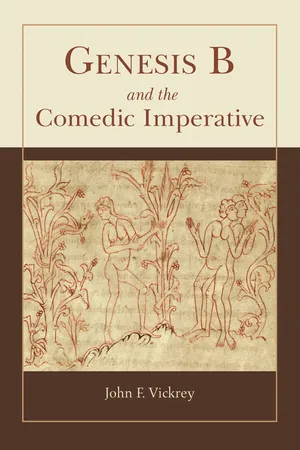
Readers of Old English would generally agree that the poem Genesis B, a translation into Old English of an Old Saxon (that is, continental) retelling of the story of the Fall, is a vigorous and moving narrative. They would disagree, however, as to the meaning of the poem. Some hold that it reflects an orthodox Christian viewpoint and others claim that it assumes a distinctly unorthodox position in portraying Adam and Eve as not morally culpable in their disobedience but merely tricked into disobedience through the wiles of the Devil's agent. The study Genesis B and the Comedic Imperative, examining these incompatible readings, infers that the poem is essentially orthodox, that it demonstrates sufficiently the moral culpability of Adam and Eve, and that it departs from orthodoxy only insofar as it conveys a strong impression that Adam and Even will undertake what amounts to Christian penance, leading them eventually to Heaven. The poem thereby attains the happy ending typical of early medieval Christian narrative. Hence the titular "Comedic Imperative."
The inference of orthodoxy follows as a nigh-inevitable conclusion of the interpretation of several motifs: the poem's culturally imbued martiality, its allegorical bent, and also what A. N. Doane noted as its tropological bent. The argument depends heavily upon philological inquiry and on examination of prevailing beliefs and attitudes of contemporaneous Frankish society, religious and civil, leading to the reinterpretation of crucial passages. Of these, most notably, is the passage in which Adam, in refusing the Tempter's invitation to eat the fruit, observes that the Tempter has given no tacen 'sign' as evidence that he truly is God's emissary. Other passages that have impeded critical perception of the poem's significance are also examined, such as the notorious micel wundor clause (lines 595-98) and the pseudo-gnomic declaration swa hire eaforan sculon after lybban (623-35). In sum, Genesis B sustains the orthodoxy otherwise of the Junius 11 manuscript.
- English
- ePUB (mobile friendly)
- Available on iOS & Android
eBook - ePub
Genesis B and the Comedic Imperative
About this book
Information
Table of contents
- Contents
- Preface
- Abbreviations
- Acknowledgments
- Chapter I: Deposition of a Dame
- Chapter II: Comedy, Wit, Tropology, Allegory
- Chapter III: Adamic Resolve
- Chapter IV: Adamic Failure
- Chapter V: Father of Lies
- Chapter VI: “God was Himself a Warlord”
- Chapter VII: ‘No Fiend Here in the Realm’
- Chapter VIII: DOM is Darker and Deeper
- Chapter IX: The BODA and Gottschalk
- Chapter X: Adam and Eve and the Light
- Notes
- Bibliography
- About the Author
Trusted by 375,005 students
Access to over 1.5 million titles for a fair monthly price.
Study more efficiently using our study tools.
Frequently asked questions
Yes, you can cancel anytime from the Subscription tab in your account settings on the Perlego website. Your subscription will stay active until the end of your current billing period. Learn how to cancel your subscription
No, books cannot be downloaded as external files, such as PDFs, for use outside of Perlego. However, you can download books within the Perlego app for offline reading on mobile or tablet. Learn how to download books offline
Perlego offers two plans: Essential and Complete
- Essential is ideal for learners and professionals who enjoy exploring a wide range of subjects. Access the Essential Library with 800,000+ trusted titles and best-sellers across business, personal growth, and the humanities. Includes unlimited reading time and Standard Read Aloud voice.
- Complete: Perfect for advanced learners and researchers needing full, unrestricted access. Unlock 1.5M+ books across hundreds of subjects, including academic and specialized titles. The Complete Plan also includes advanced features like Premium Read Aloud and Research Assistant.
We are an online textbook subscription service, where you can get access to an entire online library for less than the price of a single book per month. With over 1.5 million books across 990+ topics, we’ve got you covered! Learn about our mission
Look out for the read-aloud symbol on your next book to see if you can listen to it. The read-aloud tool reads text aloud for you, highlighting the text as it is being read. You can pause it, speed it up and slow it down. Learn more about Read Aloud
Yes! You can use the Perlego app on both iOS and Android devices to read anytime, anywhere — even offline. Perfect for commutes or when you’re on the go.
Please note we cannot support devices running on iOS 13 and Android 7 or earlier. Learn more about using the app
Please note we cannot support devices running on iOS 13 and Android 7 or earlier. Learn more about using the app
Yes, you can access Genesis B and the Comedic Imperative by John F. Vickrey in PDF and/or ePUB format, as well as other popular books in Literature & English Literary Criticism. We have over 1.5 million books available in our catalogue for you to explore.