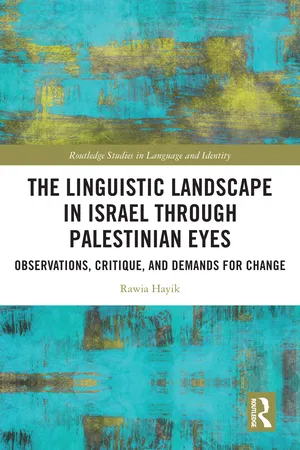
This book uses a sociolinguistic framework to explore how language serves as a marker of national identity in conflict zones, focusing on the dystopian representation of Arabic as a minority language in Israel through the perspectives of Israeli Palestinian students. Using a documentary photography research tool, PhotoVoice, minoritized college students from Northern Israel were invited to document and reflect on the signage in their area. Content analysis of students' reflections revealed not only a problematic linguistic reality in which the presence of Arabic was limited and inaccurate, but also their experience of the space as local inhabitants. The book chapters shed light on their profound perceptions and aspirations as passers-by toward the (mis)representation of their native language in the country. The contribution of the book lies in demonstrating the potential of the innovative tool PhotoVoice in developing awareness of the explicit and implicit messages delivered through linguistic landscapes. It encourages action for achieving utopian, more inclusive linguistic realities where minority languages are appropriately represented.
eBook - ePub
The Linguistic Landscape in Israel through Palestinian Eyes
Observations, Critique, and Demands for Change
- English
- ePUB (mobile friendly)
- Available on iOS & Android
eBook - ePub
The Linguistic Landscape in Israel through Palestinian Eyes
Observations, Critique, and Demands for Change
About this book
Information
Table of contents
- Cover
- Half-Title
- Series
- Title
- Copyright
- Contents
- Foreword
- Acknowledgments
- Introduction
- 1 Arabic in Israel
- 2 Linguistic Landscape Research
- 3 Theoretical Framework
- 4 Methodology
- 5 Abundance of Mistakes in Arabic
- 6 The Presence of Arabic on the Top-Down Signs
- 7 Hebraization in the Israeli Public Space
- 8 The Absence of Arabic from Commercial Signs in Arab Localities
- 9 Final Reflections and Newly Developed Realizations
- 10 Concluding Remarks and Implication
- Index
Trusted by 375,005 students
Access to over 1.5 million titles for a fair monthly price.
Study more efficiently using our study tools.
Frequently asked questions
Yes, you can cancel anytime from the Subscription tab in your account settings on the Perlego website. Your subscription will stay active until the end of your current billing period. Learn how to cancel your subscription
No, books cannot be downloaded as external files, such as PDFs, for use outside of Perlego. However, you can download books within the Perlego app for offline reading on mobile or tablet. Learn how to download books offline
Perlego offers two plans: Essential and Complete
- Essential is ideal for learners and professionals who enjoy exploring a wide range of subjects. Access the Essential Library with 800,000+ trusted titles and best-sellers across business, personal growth, and the humanities. Includes unlimited reading time and Standard Read Aloud voice.
- Complete: Perfect for advanced learners and researchers needing full, unrestricted access. Unlock 1.5M+ books across hundreds of subjects, including academic and specialized titles. The Complete Plan also includes advanced features like Premium Read Aloud and Research Assistant.
We are an online textbook subscription service, where you can get access to an entire online library for less than the price of a single book per month. With over 1.5 million books across 990+ topics, we’ve got you covered! Learn about our mission
Look out for the read-aloud symbol on your next book to see if you can listen to it. The read-aloud tool reads text aloud for you, highlighting the text as it is being read. You can pause it, speed it up and slow it down. Learn more about Read Aloud
Yes! You can use the Perlego app on both iOS and Android devices to read anytime, anywhere — even offline. Perfect for commutes or when you’re on the go.
Please note we cannot support devices running on iOS 13 and Android 7 or earlier. Learn more about using the app
Please note we cannot support devices running on iOS 13 and Android 7 or earlier. Learn more about using the app
Yes, you can access The Linguistic Landscape in Israel through Palestinian Eyes by Rawia Hayik in PDF and/or ePUB format, as well as other popular books in Languages & Linguistics & Languages. We have over 1.5 million books available in our catalogue for you to explore.