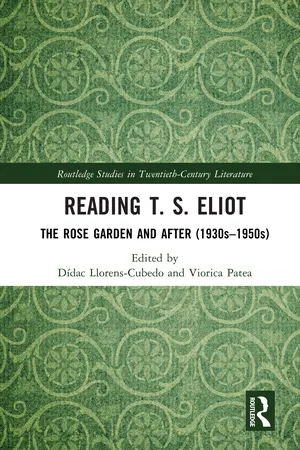
In "Burnt Norton," the poetic speaker enters a rose garden, a space of envisioned timeless illumination. This experience sets in motion a spiritual quest, which will confer unity upon Four Quartets. For the poet himself, it inaugurates a creative phase (mid-1930s to late-1950s) that strengthens his sense of faith and community. Eliot, increasingly interested in playwriting, completed his meditative masterpiece (Four Quartets) while undertaking his ambitious project to revive verse drama. Devotion to drama reflects Eliot's stronger social awareness, leading him to adopt popular forms: the pageant (The Rock), drawing-room comedy (The Cocktail Party, The Confidential Clerk, and The Elder Statesman), and children's literature (Old Possum's Book of Practical Cats). As a critic, he widened his scope to write about social issues (The Idea of a Christian Society, Notes Towards a Definition of Culture). These aspects of Eliot's career are influenced by concrete historical and biographical circumstances such as the impact of war and his ongoing relationship with Emily Hale, who played a decisive role as his muse, guide, and mentor in his newfound passion for the stage. Reading T. S. Eliot: The Rose Garden and After (1930s-1950s) presents original work by numerous scholars addressing these facets of Eliot's writing.
eBook - ePub
Reading T. S. Eliot
The Rose Garden and After (1930s–1950s)
- English
- ePUB (mobile friendly)
- Available on iOS & Android
eBook - ePub
About this book
Information
Table of contents
- Cover
- Half-Title
- Series
- Title
- Copyright
- Contents
- Notes on Contributors
- Acknowledgments
- List of Abbreviations for T. S. Eliot’s Works
- Introduction: “Through the first gate,” into the Rose Garden and Beyond
- Part I The Poet, the Rose Garden, and the Playhouse (1930s)
- Part II Full-Time Dramatist with a Vision (late 1930s–late 1950s)
- Part III Critic with a Wider Scope (1940s–1950s)
- Index
Trusted by 375,005 students
Access to over 1.5 million titles for a fair monthly price.
Study more efficiently using our study tools.
Frequently asked questions
Yes, you can cancel anytime from the Subscription tab in your account settings on the Perlego website. Your subscription will stay active until the end of your current billing period. Learn how to cancel your subscription
No, books cannot be downloaded as external files, such as PDFs, for use outside of Perlego. However, you can download books within the Perlego app for offline reading on mobile or tablet. Learn how to download books offline
Perlego offers two plans: Essential and Complete
- Essential is ideal for learners and professionals who enjoy exploring a wide range of subjects. Access the Essential Library with 800,000+ trusted titles and best-sellers across business, personal growth, and the humanities. Includes unlimited reading time and Standard Read Aloud voice.
- Complete: Perfect for advanced learners and researchers needing full, unrestricted access. Unlock 1.5M+ books across hundreds of subjects, including academic and specialized titles. The Complete Plan also includes advanced features like Premium Read Aloud and Research Assistant.
We are an online textbook subscription service, where you can get access to an entire online library for less than the price of a single book per month. With over 1.5 million books across 990+ topics, we’ve got you covered! Learn about our mission
Look out for the read-aloud symbol on your next book to see if you can listen to it. The read-aloud tool reads text aloud for you, highlighting the text as it is being read. You can pause it, speed it up and slow it down. Learn more about Read Aloud
Yes! You can use the Perlego app on both iOS and Android devices to read anytime, anywhere — even offline. Perfect for commutes or when you’re on the go.
Please note we cannot support devices running on iOS 13 and Android 7 or earlier. Learn more about using the app
Please note we cannot support devices running on iOS 13 and Android 7 or earlier. Learn more about using the app
Yes, you can access Reading T. S. Eliot by Dídac Llorens-Cubedo,Viorica Patea in PDF and/or ePUB format, as well as other popular books in Literature & Literary Criticism. We have over 1.5 million books available in our catalogue for you to explore.