- English
- ePUB (mobile friendly)
- Available on iOS & Android
eBook - ePub
About this book
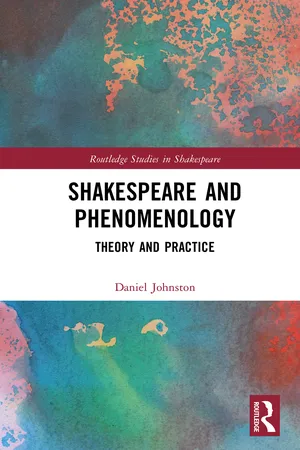
This book considers how Shakespeare's theatre investigates and reveals "Being-in-the-world". Through the lens of phenomenology (the study of how the world shows itself to conscious experience) Johnston examines how Shakespeare's texts and dramaturgy reveal aspects of Being. This volume explores philosophical themes in Shakespeare's drama, including perceptions of stage space and fictional place, temporality, bodies, authenticity, and memory in early modern English staging. It examines how Shakespeare asks the question of the meaning of Being by playing with the distinction between "what is" and "what is not". The work offers practical performance tips and exercises to connect with modern audiences. Each chapter aims to inspire creative artists in production and rehearsal through a unique focus and provide a critical approach to performance. Through a phenomenological exploration of dramatic possibilities drawn from the key concepts of philosophers such as Edmund Husserl, Martin Heidegger, Maurice Merleau-Ponty, and Edith Stein, Johnston investigates theatre as a practical form of philosophical investigation. Theatre-makers should not only consider the fictional world of the play, but also the historical context of Shakespeare's world and the contemporary context for connecting with audiences here, today, now.
Information
Table of contents
- Cover
- Half-Title Page
- Series Page
- Title Page
- Copyright Page
- Dedication
- Table of Contents
- Introduction: The Empathy Drum
- 1 Being in the Atmosphere: Emotional Weather in Twelfth Night
- 2 Being Out of Time: Temporality in Macbeth
- 3 Touching Palms with Being: Romeo and Juliet
- 4 Becoming Oneself: Authenticity and Selfhood in Richard III
- 5 Traumatic Being: Memory in The Tempest
- Conclusion: Breathing Being
- Index
Trusted by 375,005 students
Access to over 1.5 million titles for a fair monthly price.
Study more efficiently using our study tools.
Frequently asked questions
Yes, you can cancel anytime from the Subscription tab in your account settings on the Perlego website. Your subscription will stay active until the end of your current billing period. Learn how to cancel your subscription
No, books cannot be downloaded as external files, such as PDFs, for use outside of Perlego. However, you can download books within the Perlego app for offline reading on mobile or tablet. Learn how to download books offline
Perlego offers two plans: Essential and Complete
- Essential is ideal for learners and professionals who enjoy exploring a wide range of subjects. Access the Essential Library with 800,000+ trusted titles and best-sellers across business, personal growth, and the humanities. Includes unlimited reading time and Standard Read Aloud voice.
- Complete: Perfect for advanced learners and researchers needing full, unrestricted access. Unlock 1.5M+ books across hundreds of subjects, including academic and specialized titles. The Complete Plan also includes advanced features like Premium Read Aloud and Research Assistant.
We are an online textbook subscription service, where you can get access to an entire online library for less than the price of a single book per month. With over 1.5 million books across 990+ topics, we’ve got you covered! Learn about our mission
Look out for the read-aloud symbol on your next book to see if you can listen to it. The read-aloud tool reads text aloud for you, highlighting the text as it is being read. You can pause it, speed it up and slow it down. Learn more about Read Aloud
Yes! You can use the Perlego app on both iOS and Android devices to read anytime, anywhere — even offline. Perfect for commutes or when you’re on the go.
Please note we cannot support devices running on iOS 13 and Android 7 or earlier. Learn more about using the app
Please note we cannot support devices running on iOS 13 and Android 7 or earlier. Learn more about using the app
Yes, you can access Shakespeare and Phenomenology by Daniel Johnston in PDF and/or ePUB format, as well as other popular books in Literature & Shakespeare Drama. We have over 1.5 million books available in our catalogue for you to explore.