An examination of how settler colonialism shaped the thinking of America's leading philosopher of democracy and education, John Dewey
John Dewey is regarded as a towering figure in the history of American philosophy, widely remembered by educators as an advocate for experiential and child-centered pedagogy, as evidenced by the mantra "learning by doing." At first blush, such ideas appear to a share strong resonance with Indigenous ways of teaching and learning. After all, Native educators have long emphasized the importance of hands-on learning drawn from close relationships to place. This resemblance begs the question: What might Dewey have learned from Indigenous people?
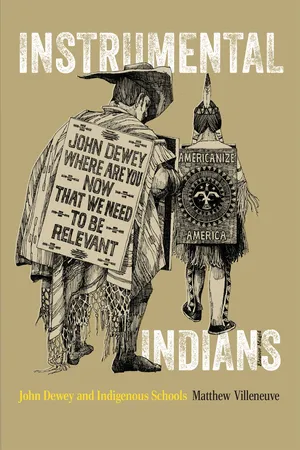
Instrumental Indians shows that, despite such affinities, Dewey wrote a great deal about Indians as he imagined them rather than as they are. He did so through the lens of the frontier discourse, a pervasive cultural mythology that represented Indigenous people as savage foils and background actors in the settlement of a frontier across North America. Consequently, Dewey's imagined Indians became both instrumental and instrumentalized in his philosophy, a paradox that reduced Indigenous people to mere evidence for his pragmatism rather than as a contemporary constituency who might have benefited from its application. By instrumentalizing Indians, Dewey's contributions to American philosophy were made under the shadow of US settler colonialism.
As Matthew Villeneuve demonstrates, Dewey's disregard for his Indigenous contemporaries was far from harmless. His career coincided with the height of the federal Indian boarding school system, an era when Native families were subjected to the violence of imposed schooling. Where Dewey failed to offer a critique of such antidemocratic schools, a contemporary of his, Oneida philosopher of education Laura Cornelius, succeeded. In 1920, Cornelius offered an Indigenous theory of democracy and education, an alternative the US government failed to pursue. In Instrumental Indians, Villeneuve provides the first comprehensive account of Dewey's relationship to Indigenous people—one that challenges the philosopher's place in the canon of democratic education.
- English
- ePUB (mobile friendly)
- Available on iOS & Android
eBook - ePub
About this book
Information
Topic
EducationSubtopic
Education BiographiesTable of contents
- Cover
- Series Page
- Title Page
- Copyright
- Contents
- A Note on Language
- Introduction
- Chapter 1. Ann Arbor: John Dewey and Nanabozho
- Chapter 2. Chicago: The Indians in Intelligence
- Chapter 3. New York: Reconstructing the Frontier
- Chapter 4. Oneida: Laura Cornelius’s Synthesis of Schooling and Self-Determination
- Chapter 5. Pine Ridge: The “John Dewey” Approach at the Little Wound Day School
- Chapter 6. Honolulu: Experimentalism and Colonialism in Hawai‘i
- Conclusion
- Notes
- Index
- Acknowledgments
Trusted by 375,005 students
Access to over 1.5 million titles for a fair monthly price.
Study more efficiently using our study tools.
Frequently asked questions
Yes, you can cancel anytime from the Subscription tab in your account settings on the Perlego website. Your subscription will stay active until the end of your current billing period. Learn how to cancel your subscription
No, books cannot be downloaded as external files, such as PDFs, for use outside of Perlego. However, you can download books within the Perlego app for offline reading on mobile or tablet. Learn how to download books offline
Perlego offers two plans: Essential and Complete
- Essential is ideal for learners and professionals who enjoy exploring a wide range of subjects. Access the Essential Library with 800,000+ trusted titles and best-sellers across business, personal growth, and the humanities. Includes unlimited reading time and Standard Read Aloud voice.
- Complete: Perfect for advanced learners and researchers needing full, unrestricted access. Unlock 1.5M+ books across hundreds of subjects, including academic and specialized titles. The Complete Plan also includes advanced features like Premium Read Aloud and Research Assistant.
We are an online textbook subscription service, where you can get access to an entire online library for less than the price of a single book per month. With over 1.5 million books across 990+ topics, we’ve got you covered! Learn about our mission
Look out for the read-aloud symbol on your next book to see if you can listen to it. The read-aloud tool reads text aloud for you, highlighting the text as it is being read. You can pause it, speed it up and slow it down. Learn more about Read Aloud
Yes! You can use the Perlego app on both iOS and Android devices to read anytime, anywhere — even offline. Perfect for commutes or when you’re on the go.
Please note we cannot support devices running on iOS 13 and Android 7 or earlier. Learn more about using the app
Please note we cannot support devices running on iOS 13 and Android 7 or earlier. Learn more about using the app
Yes, you can access Instrumental Indians by Matthew Villeneuve in PDF and/or ePUB format, as well as other popular books in Education & Education Biographies. We have over 1.5 million books available in our catalogue for you to explore.