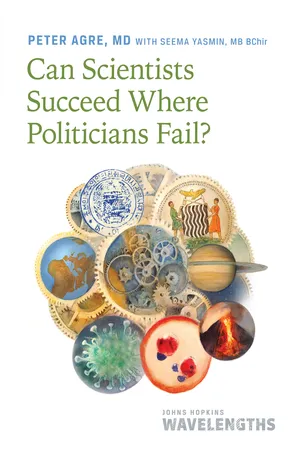
How can science prevail when policies fall short?
Political, military, and intelligence professionals alone can't resolve all global threats. Sometimes, when other solutions have faltered, scientists step out of their classrooms, labs, and offices to help resolve these dangerous crises—often at considerable personal risk. Whether as official ambassadors for their governments or by less formal (or even secret) means, scientists have played pivotal roles in numerous critical moments in modern history, including during the negotiations leading to the Paris Climate Agreement, the global response to the COVID crisis, and many more.
What compels them to enter the high-stakes atmospheres surrounding international emergencies, and what are some of their success stories? Can Scientists Succeed Where Politicians Fail? vividly recounts Nobel laureate Dr. Peter Agre's metamorphosis from a physician-scientist who studied malaria and other diseases into a trusted global voice for scientific collaboration and consensus building. In his travels, he has met with kings, presidents, prime ministers, and other formidable leaders—including Cuba's Fidel Castro, North Korean officials, Zambian tribal leaders, and the inner circles of the Islamic Republic of Iran—to form relationships and defuse tensions.
The dynamic results of scientific knowledge sharing and capacity building shift often tense cross-border relationships, reducing global threats such as climate change, famine, conflict, and epidemics. Thousands of scientists are working on the frontlines—from active volcanoes to remote medical field stations to the halls of government—to help inform policy, change the course of international catastrophes, and build the bonds that promote safety and prosperity.
Johns Hopkins Wavelengths
In classrooms, field stations, and laboratories in Baltimore and around the world, the Bloomberg Distinguished Professors of Johns Hopkins University are opening the boundaries of our understanding of many of the world's most complex challenges. The Johns Hopkins Wavelengths book series brings readers inside their stories, illustrating how their pioneering discoveries benefit people in their neighborhoods and across the globe in artificial intelligence, cancer research, food systems' environmental impacts, health equity, planetary science, science diplomacy, and other critical arenas of study. Through these compelling narratives, their insights will spark conversations from dorm rooms to dining rooms to boardrooms.