- English
- ePUB (mobile friendly)
- Available on iOS & Android
About this book
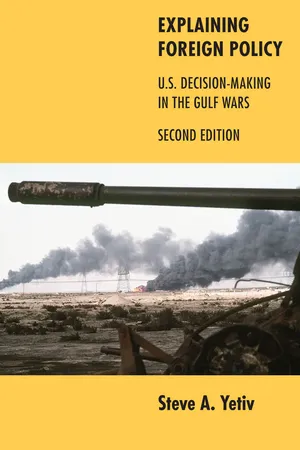
Steve A. Yetiv has developed an interdisciplinary, integrated approach to studying foreign policy decisions, which he applies here to understand better how and why the United States went to war in the Persian Gulf in 1991 and 2003.
Yetiv's innovative method employs the rational actor, cognitive, domestic politics, groupthink, and bureaucratic politics models to explain the foreign policy behavior of governments. Drawing on the widest set of primary sources to date—including a trove of recently declassified documents—and on interviews with key actors, he applies these models to illuminate the decision-making process in the two Gulf Wars and to develop theoretical notions about foreign policy. What Yetiv discovers, in addition to empirical evidence about the Persian Gulf and Iraq wars, is that no one approach provides the best explanation, but when all five are used, a fuller and more complete understanding emerges.
Thoroughly updated with a new preface and a chapter on the 2003 Iraq War, Explaining Foreign Policy, already widely used in courses, will continue to be of interest to students and scholars of foreign policy, international relations, and related fields.
Frequently asked questions
- Essential is ideal for learners and professionals who enjoy exploring a wide range of subjects. Access the Essential Library with 800,000+ trusted titles and best-sellers across business, personal growth, and the humanities. Includes unlimited reading time and Standard Read Aloud voice.
- Complete: Perfect for advanced learners and researchers needing full, unrestricted access. Unlock 1.4M+ books across hundreds of subjects, including academic and specialized titles. The Complete Plan also includes advanced features like Premium Read Aloud and Research Assistant.
Please note we cannot support devices running on iOS 13 and Android 7 or earlier. Learn more about using the app.
Information
Table of contents
- Cover Page
- Title Page
- Copyright Page
- Contents
- Preface to the Second Edition
- Acknowledgments
- Introduction
- 1. The United States, Iraq, and the Crisis: Some Background
- 2. The Rational Actor Model
- 3. A Cognitive Compass: Analogies at Work
- 4. Constructing the Threat: Saddam the Global Menace
- 5. Elements of Groupthink on the Road to War
- 6. Government Politics: Not Much, Actually
- 7. Mirror, Mirror, on the Wall: Evaluating the Perspectives
- 8. Threading the Tale
- 9. Tackling Puzzles and Developing Theory
- 10. Understanding Government Behavior: Integrating Process, Choice, and Outcome
- 11. Invading Iraq
- 12. Beyond the Gulf: Foreign Policy and World Politics
- Appendix: Core Interviews
- Notes
- Bibliography
- Index