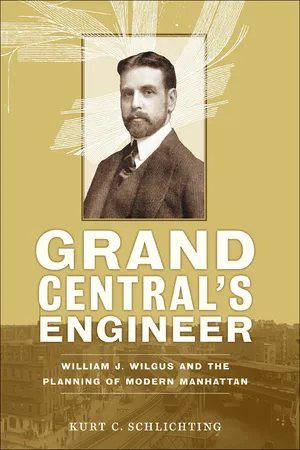
Few people have had as profound an impact on the history of New York City as William J. Wilgus. As chief engineer of the New York Central Railroad, Wilgus conceived the Grand Central Terminal, the city's magnificent monument to America's Railway Age. Kurt C. Schlichting here examines the remarkable career of this innovator, revealing how his tireless work moving people and goods over and under Manhattan Island's surrounding waterways forever changed New York's bustling transportation system.
After his herculean efforts on behalf of Grand Central, the most complicated construction project in New York's history, Wilgus turned to solving the city's transportation quandary: Manhattan—the financial, commercial, and cultural hub of the United States in the twentieth century—was separated from the mainland by two major rivers to the west and east, a deep-water estuary to the south, and the Harlem River to the north.
Wilgus believed that railroads and mass transportation provided the answer to New York City's complicated geography. His ingenious ideas included a freight subway linking rail facilities in New Jersey with manufacturers and shippers in Manhattan, a freight and passenger tunnel connecting Staten Island and Brooklyn, and a belt railway interconnecting sixteen private railroads serving the metropolitan area.
Schlichting's deep passion for Wilgus and his engineering achievements are evident in the pages of this fascinating work. Wilgus was a true pioneer, and Schlichting ensures that his brilliant contributions to New York City's transportation system will not be forgotten.
Praise for Schlichting's Grand Central Terminal
"Grand Central Terminal is celebrated for its Beaux-Arts style, but Kurt C. Schlichting looks behind the facade to see the hidden engineering marvels."—New York Times Book Review
"His study peels away our contemporary expectations and experiences and reveals the layers of history and acts of men that served as the foundation for this great structure."—H-Urban, H-Net Review
"The most detailed account yet of one of the most important events in the history of 20th-century architecture, railroad development, and city building."—Choice
"In his detailed accounts of the fiscal, stylistic, and engineering decisions that went into the creation of . . . Grand Central Terminal, Schlichting clearly shows both how energetic and talented all of the people involved were and how dramatically they altered this central portion of New York City."—Journal of the Society of Architectural Historians
"Ably tells the story of the New York rail system's most active and visible symbol: the architectural and engineering masterpiece, with its grand public concourse, in the heart of Midtown."—New Scientist