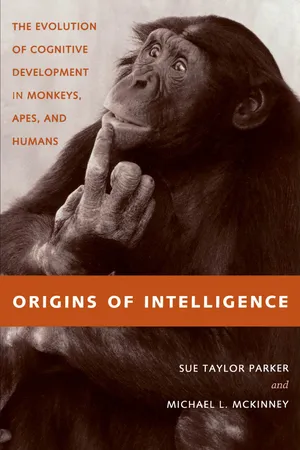
Origins of Intelligence
eBook - ePub

Origins of Intelligence

The Evolution of Cognitive Development in Monkeys, Apes, and Humans

  1. English
  2. ePUB (mobile friendly)
  3. Available on iOS & Android
eBook - ePub

Origins of Intelligence

The Evolution of Cognitive Development in Monkeys, Apes, and Humans

About this book

Selected by Choice Magazine as an Outstanding Academic Title

Since Darwin's time, comparative psychologists have searched for a good way to compare cognition in humans and nonhuman primates. In Origins of Intelligence, Sue Parker and Michael McKinney offer such a framework and make a strong case for using human development theory (both Piagetian and neo-Piagetian) to study the evolution of intelligence across primate species. Their approach is comprehensive, covering a broad range of social, symbolic, physical, and logical domains, which fall under the all-encompassing and much-debated term intelligence.

A widely held theory among developmental psychologists and social and biological anthropologists is that cognitive evolution in humans has occurred through juvenilization—the gradual accentuation and lengthening of childhood in the evolutionary process. In this work, however, Parker and McKinney argue instead that new stages were added at the end of cognitive development in our hominid ancestors, coining the term adultification by terminal extension to explain this process.

Drawing evidence from scores of studies on monkeys, great apes, and human children, this book provides unique insights into ontogenetic constraints that have interacted with selective forces to shape the evolution of cognitive development in our lineage.

Frequently asked questions

Yes, you can cancel anytime from the Subscription tab in your account settings on the Perlego website. Your subscription will stay active until the end of your current billing period. Learn how to cancel your subscription.
At the moment all of our mobile-responsive ePub books are available to download via the app. Most of our PDFs are also available to download and we're working on making the final remaining ones downloadable now. Learn more here.
Perlego offers two plans: Essential and Complete
  • Essential is ideal for learners and professionals who enjoy exploring a wide range of subjects. Access the Essential Library with 800,000+ trusted titles and best-sellers across business, personal growth, and the humanities. Includes unlimited reading time and Standard Read Aloud voice.
  • Complete: Perfect for advanced learners and researchers needing full, unrestricted access. Unlock 1.4M+ books across hundreds of subjects, including academic and specialized titles. The Complete Plan also includes advanced features like Premium Read Aloud and Research Assistant.
Both plans are available with monthly, semester, or annual billing cycles.
We are an online textbook subscription service, where you can get access to an entire online library for less than the price of a single book per month. With over 1 million books across 1000+ topics, we’ve got you covered! Learn more here.
Look out for the read-aloud symbol on your next book to see if you can listen to it. The read-aloud tool reads text aloud for you, highlighting the text as it is being read. You can pause it, speed it up and slow it down. Learn more here.
Yes! You can use the Perlego app on both iOS or Android devices to read anytime, anywhere — even offline. Perfect for commutes or when you’re on the go.
Please note we cannot support devices running on iOS 13 and Android 7 or earlier. Learn more about using the app.
Yes, you can access Origins of Intelligence by Sue Taylor Parker,Michael L. McKinney in PDF and/or ePUB format, as well as other popular books in Biological Sciences & Biology. We have over one million books available in our catalogue for you to explore.

Table of contents

  1. Cover Page
  2. Title Page
  3. Copyright Page
  4. Contents
  5. Preface
  6. Acknowledgments
  7. Introduction
  8. Part I Cognitive Development in Human and Nonhuman Primates
  9. Part II The Evolution of Cognitive Development
  10. References
  11. Index
  12. Foot Notes