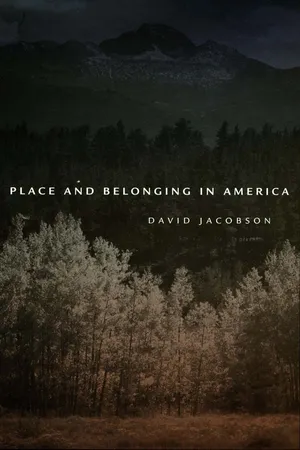
How did the American people come to develop a moral association with this land, such that their very experience of nationhood was rooted in, and their republican virtues depended upon, that land? And what is happening now as the exclusivity of that moral linkage between people and land becomes ever more attenuated? In Place and Belonging in America, David Jacobson addresses the evolving relationship between geography and citizenship in the United States since the nation's origins.
Americans have commonly assumed that only a people rooted in a bounded territory could safeguard republican virtues. But, as Jacobson argues, in the contemporary world of transnational identities, multiple loyalties, and permeable borders, the notion of a singular territorial identity has lost its resonance. The United States has come to represent a diverse quilt of cultures with varying ties to the land. These developments have transformed the character of American politics to one in which the courts take a much larger role in mediating civic life. An expanding web of legal rights enables individuals and groups to pursue their own cultural and social ends, in contrast to the civic republican practice of an active citizenry legislating its collective life.
In the first part of his sweeping study, Jacobson considers the origins of the uniquely American sense of place, exploring such components as the Puritans and their religious vision of the New World; the early Republic and agrarian virtue as extolled in the writings of Thomas Jefferson; the nationalization of place during the Civil War; and the creation of post-Civil War monuments and, later, the national park system. The second part of Place and Belonging in America concerns the contemporary United States and its more complex interactions between space and citizenship. Here Jacobson looks at the multicultural landscape as represented by the 1991 act of Congress that changed the name of the Custer Battlefield National Monument to Little Bighorn Battlefield National Monument and the subsequent construction of a memorial honoring the Indian participants in the battle; the Vietnam Veterans Memorial; and the U.S. Holocaust Memorial Museum. He also reflects upon changing patterns of immigration and settlement. At once far-reaching and detailed, Place and Belonging in America offers a though-provoking new perspective on the myriad, often spiritual connections between territoriality, national identity, and civic culture.