- English
- ePUB (mobile friendly)
- Available on iOS & Android
About this book
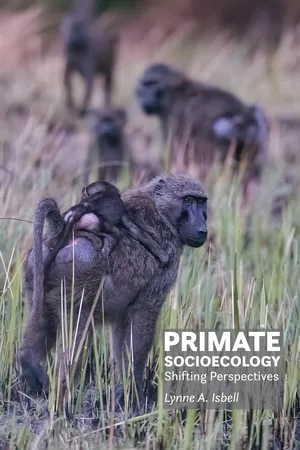
This game-changing book questions long-accepted rules of primate socioecology and redefines the field from the ground up.
In Primate Socioecology, renowned researcher Lynne A. Isbell offers a fresh perspective on primate social organizations that redefines the field from the ground up.
Through her innovative Variable Home Range Sharing model, Isbell unravels the mystery of why some primates live alone while others live in pairs or groups—a question that has perplexed scientists for decades. This new approach diverges from the traditional focus on predation pressure as the main determinant of primate social organization to reveal deeper ecological causes of primate behavior. The implications of this shift are profound, underscoring the critical importance of a behavioral-ecological mechanism in which varying movement strategies affect which females share their home ranges and ultimately pointing to a new functional classification system for primate social organizations.
Isbell also discusses:
• a supportive test of predicted movement strategies using activity budgets
• why thermal constraints explain the dichotomy between small nocturnal primates and large diurnal primates
• the role of sensory differences in nocturnal solitary foragers versus diurnal group-living primates
Useful as both an introduction to primate socioecology and for those seeking a robust examination of the topic, Primate Socioecology addresses scientific debates about primate social organizations and invites researchers to question long-held assumptions.
Frequently asked questions
- Essential is ideal for learners and professionals who enjoy exploring a wide range of subjects. Access the Essential Library with 800,000+ trusted titles and best-sellers across business, personal growth, and the humanities. Includes unlimited reading time and Standard Read Aloud voice.
- Complete: Perfect for advanced learners and researchers needing full, unrestricted access. Unlock 1.4M+ books across hundreds of subjects, including academic and specialized titles. The Complete Plan also includes advanced features like Premium Read Aloud and Research Assistant.
Please note we cannot support devices running on iOS 13 and Android 7 or earlier. Learn more about using the app.
Information
Table of contents
- Cover
- Title Page
- Copyright Page
- Contents
- List of Tables
- Preface
- Acknowledgments
- Chapter 1 Highlights in the History of Primate Socioecology
- Chapter 2 Dispersal and Philopatry
- Chapter 3 The Variable Home Range Sharing Model and Its Classification System for Primate Social Organizations
- Chapter 4 Movement Strategies Help Identify Constraints on Home Range Expansion and Their Importance for Female Social Organizations
- Chapter 5 Beginning to Test the Variable Home Range Sharing Model
- Chapter 6 Problems with Predation as a Selective Force on Primate Social Organizations
- Chapter 7 Resolving the Nocturnal/Diurnal and Solitary/Group Forager Divides
- Chapter 8 Male Contributions to Female Social Organizations
- Chapter 9 Answers to Some Questions about the Model
- Appendix
- References
- Index