- English
- ePUB (mobile friendly)
- Available on iOS & Android
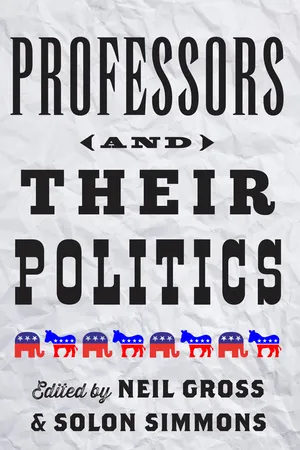
Professors and Their Politics
About this book
Despite assumptions in some quarters of widespread academic radicalism, professors are politically liberal but on the whole democratically tolerant and are focused more on the business of research and teaching than on trying to change the world.
Professors and Their Politics tackles the assumption that universities are ivory towers of radicalism with the potential to corrupt conservative youth. Neil Gross and Solon Simmons gather the work of leading sociologists, historians, and other researchers interested in the relationship between politics and higher education to present evidence to the contrary. In eleven meaty chapters, contributors describe the political makeup of American academia today, consider the causes of its liberal tilt, discuss the college experience for politically conservative students, and delve into historical debates about professorial politics.
Offering readable, rigorous analyses rather than polemics, Professors and Their Politics yields important new insights into the nature of higher education institutions while challenging dogmas of both the left and the right.
Frequently asked questions
- Essential is ideal for learners and professionals who enjoy exploring a wide range of subjects. Access the Essential Library with 800,000+ trusted titles and best-sellers across business, personal growth, and the humanities. Includes unlimited reading time and Standard Read Aloud voice.
- Complete: Perfect for advanced learners and researchers needing full, unrestricted access. Unlock 1.4M+ books across hundreds of subjects, including academic and specialized titles. The Complete Plan also includes advanced features like Premium Read Aloud and Research Assistant.
Please note we cannot support devices running on iOS 13 and Android 7 or earlier. Learn more about using the app.
Information
Table of contents
- Cover Page
- Title Page
- Copyright Page
- Contents
- Introduction
- Part I The Lay of the Land
- Part II Explaining Professorial Liberalism
- Part III The Student Experience
- Part IV Formative Periods
- Part V Institutional Change and Its Limits
- Conclusion
- Appendix. Sample Student Emails
- References
- Contributors
- Index