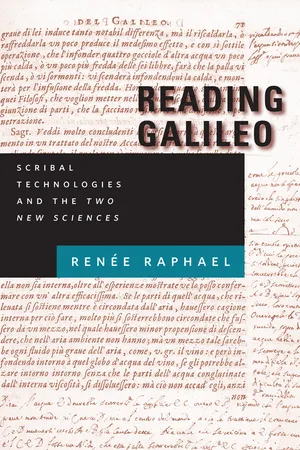
Reading Galileo
eBook - ePub

Reading Galileo

Scribal Technologies and the Two New Sciences

  1. English
  2. ePUB (mobile friendly)
  3. Available on iOS & Android
eBook - ePub

Reading Galileo

Scribal Technologies and the Two New Sciences

About this book

How did early modern scientists interpret Galileo's influential Two New Sciences?

In 1638, Galileo was over seventy years old, blind, and confined to house arrest outside of Florence. With the help of friends and family, he managed to complete and smuggle to the Netherlands a manuscript that became his final published work, Two New Sciences. Treating diverse subjects that became the foundations of mechanical engineering and physics, this book is often depicted as the definitive expression of Galileo's purportedly modern scientific agenda. In Reading Galileo, Renée Raphael offers a new interpretation of Two New Sciences which argues instead that the work embodied no such coherent canonical vision. Raphael alleges that it was written—and originally read—as the eclectic product of the types of discursive textual analysis and meandering descriptive practices Galileo professed to reject in favor of more qualitative scholarship.

Focusing on annotations period readers left in the margins of extant copies and on the notes and teaching materials of seventeenth-century university professors whose lessons were influenced by Galileo's text, Raphael explores the ways in which a range of early-modern readers, from ordinary natural philosophers to well-known savants, responded to Galileo. She highlights the contrast between the practices of Galileo's actual readers, who followed more traditional, "bookish" scholarly methods, and their image, constructed by Galileo and later historians, as "modern" mathematical experimenters.

Two New Sciences has not previously been the subject of such rigorous attention and analysis. Reading Galileo considerably changes our understanding of Galileo's important work while offering a well-executed case study in the reception of an early-modern scientific classic. This important text will be of interest to a wide range of historians—of science, of scholarly practices and the book, and of early-modern intellectual and cultural history.

Frequently asked questions

Yes, you can cancel anytime from the Subscription tab in your account settings on the Perlego website. Your subscription will stay active until the end of your current billing period. Learn how to cancel your subscription.
No, books cannot be downloaded as external files, such as PDFs, for use outside of Perlego. However, you can download books within the Perlego app for offline reading on mobile or tablet. Learn more here.
Perlego offers two plans: Essential and Complete
  • Essential is ideal for learners and professionals who enjoy exploring a wide range of subjects. Access the Essential Library with 800,000+ trusted titles and best-sellers across business, personal growth, and the humanities. Includes unlimited reading time and Standard Read Aloud voice.
  • Complete: Perfect for advanced learners and researchers needing full, unrestricted access. Unlock 1.4M+ books across hundreds of subjects, including academic and specialized titles. The Complete Plan also includes advanced features like Premium Read Aloud and Research Assistant.
Both plans are available with monthly, semester, or annual billing cycles.
We are an online textbook subscription service, where you can get access to an entire online library for less than the price of a single book per month. With over 1 million books across 1000+ topics, we’ve got you covered! Learn more here.
Look out for the read-aloud symbol on your next book to see if you can listen to it. The read-aloud tool reads text aloud for you, highlighting the text as it is being read. You can pause it, speed it up and slow it down. Learn more here.
Yes! You can use the Perlego app on both iOS or Android devices to read anytime, anywhere — even offline. Perfect for commutes or when you’re on the go.
Please note we cannot support devices running on iOS 13 and Android 7 or earlier. Learn more about using the app.
Yes, you can access Reading Galileo by Renée Raphael in PDF and/or ePUB format, as well as other popular books in History & European Medieval History. We have over one million books available in our catalogue for you to explore.

Table of contents

  1. Cover
  2. Title Page
  3. Copyright Page
  4. Contents
  5. Acknowledgments
  6. Introduction
  7. 1. An Anonymous Annotator, Baliani, and the “Ideal” Reader
  8. 2. Editing, Commenting, and Learning Math from Galileo
  9. 3. Modifying Authoritative Reading to New Purposes
  10. 4. An Annotated Book of Many Uses
  11. 5. The University of Pisa and a Dialogue between Old and New
  12. 6. Jesuit Bookish Practices Applied to the Two New Sciences
  13. Epilogue
  14. Notes
  15. Bibliography
  16. Index