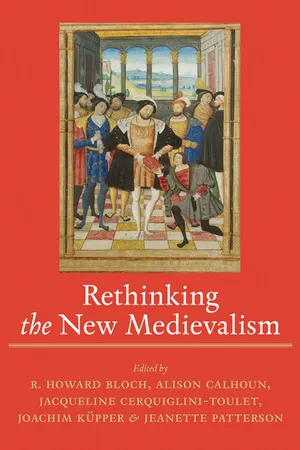
Rethinking the New Medievalism
  1. English
  2. ePUB (mobile friendly)
  3. Available on iOS & Android
eBook - ePub

About this book

Twenty years after Stephen Nichols transformed the study of medieval literature, leaders in the field pay tribute to his work and expand on it.

In the early 1990s, Stephen Nichols introduced the term "new medievalism" to describe an alternative to the traditional philological approach to the study of the romantic texts in the medieval period. While the old approach focused on formal aspects of language, this new approach was historicist and moved beyond a narrow focus on language to examine the broader social and cultural contexts in which literary works were composed and disseminated. Within the field, this transformation of medieval studies was as important as the genetic revolution to the study of biology and has had an enormous influence on the study of medieval literature. Rethinking the New Medievalism offers both a historical account of the movement and its achievements while indicating—in Nichols's innovative spirit—still newer directions for medieval studies.

The essays deal with questions of authorship, theology, and material philology and are written by members of a wide philological and critical circle that Nichols nourished for forty years. Daniel Heller-Roazen's essay, for example, demonstrates the conjunction of the old philology and the new. In a close examination of the history of the words used for maritime raiders from Ancient Greece to the present (pirate, plunderer, bandit), Roazen draws a fine line between lawlessness and lawfulness, between judicial action and war, between war and public policy. Other contributors include Jack Abecassis, Marina Brownlee, Jacqueline Cerquiglini-Toulet, Andreas Kablitz, and Ursula Peters.

Frequently asked questions

Yes, you can cancel anytime from the Subscription tab in your account settings on the Perlego website. Your subscription will stay active until the end of your current billing period. Learn how to cancel your subscription.
No, books cannot be downloaded as external files, such as PDFs, for use outside of Perlego. However, you can download books within the Perlego app for offline reading on mobile or tablet. Learn more here.
Perlego offers two plans: Essential and Complete
  • Essential is ideal for learners and professionals who enjoy exploring a wide range of subjects. Access the Essential Library with 800,000+ trusted titles and best-sellers across business, personal growth, and the humanities. Includes unlimited reading time and Standard Read Aloud voice.
  • Complete: Perfect for advanced learners and researchers needing full, unrestricted access. Unlock 1.4M+ books across hundreds of subjects, including academic and specialized titles. The Complete Plan also includes advanced features like Premium Read Aloud and Research Assistant.
Both plans are available with monthly, semester, or annual billing cycles.
We are an online textbook subscription service, where you can get access to an entire online library for less than the price of a single book per month. With over 1 million books across 1000+ topics, we’ve got you covered! Learn more here.
Look out for the read-aloud symbol on your next book to see if you can listen to it. The read-aloud tool reads text aloud for you, highlighting the text as it is being read. You can pause it, speed it up and slow it down. Learn more here.
Yes! You can use the Perlego app on both iOS or Android devices to read anytime, anywhere — even offline. Perfect for commutes or when you’re on the go.
Please note we cannot support devices running on iOS 13 and Android 7 or earlier. Learn more about using the app.
Yes, you can access Rethinking the New Medievalism by R. Howard Bloch,Alison Calhoun,Jacqueline Cerquiglini-Toulet,Joachim Küpper,Jeanette Patterson in PDF and/or ePUB format, as well as other popular books in Literature & Ancient & Classical Literary Criticism. We have over one million books available in our catalogue for you to explore.

Table of contents

  1. Cover Page
  2. Title Page
  3. Copyright Page
  4. Contents
  5. Introduction. The New Philology Comes of Age
  6. 1 New Challenges for the New Medievalism
  7. 2 Reflections on The New Philology
  8. 3 Virgil’s “Perhaps”: Mythopoiesis and Cosmogony in Dante’s Commedia (Remarks on Inf. 34, 106–26)
  9. 4 Dialectic of the Medieval Course
  10. 5 Religious Horizon and Epic Effect: Considerations on the Iliad, the Chanson de Roland, and the Nibelungenlied
  11. 6 The Possibility of Historical Time in the Crónica Sarracina
  12. 7 Good Friday Magic: Petrarch’s Canzoniere and the Transformation of Medieval Vernacular Poetry
  13. 8 The Identity of a Text
  14. 9 Conceiving the Text in the Middle Ages
  15. 10 Dante’s Transfigured Ovidian Models: Icarus and Daedalus in the Commedia
  16. 11 Ekphrasis in the Knight’s Tale
  17. 12 Montaigne’s Medieval Nominalism and Meschonnic’s Ethics of the Subject
  18. 13 The Pèlerinage Corpus in the European Middle Ages: Processes of Retextualization Reflected in the Prologues
  19. 14 Narrative Frames of Augustinian Thought in the Renaissance: The Case of Rabelais
  20. 15 From Romanesque Architecture to Romance
  21. Contributors
  22. Index