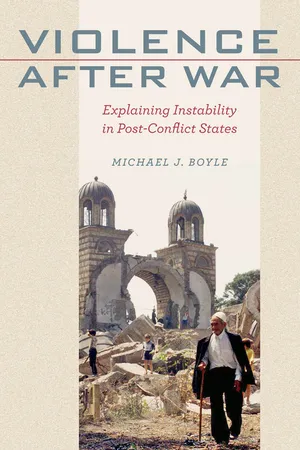
Violence after War
eBook - ePub

Violence after War

Explaining Instability in Post-Conflict States

  1. English
  2. ePUB (mobile friendly)
  3. Available on iOS & Android
eBook - ePub

Violence after War

Explaining Instability in Post-Conflict States

About this book

Developing a better understanding of the dynamics of violence in post-war states can lead to a more durable peace.

The end of one war is frequently the beginning of another because the cessation of conflict produces two new challenges: a contest between the winners and losers over the terms of peace, and a battle within the winning party over the spoils of war. As the victors and the vanquished struggle to establish a new political order, incidents of low-level violence frequently occur and can escalate into an unstable peace or renewed conflict. Michael J. Boyle evaluates the dynamics of post-conflict violence and their consequences in Violence after War.

In this systematic comparative study, Boyle analyzes a cross-national dataset of violent acts from 52 post-conflict states and examines, in depth, violence patterns from five recent post-conflict states: Bosnia, Rwanda, Kosovo, East Timor, and Iraq.

In each of the case studies, Boyle traces multiple pathways through which violence emerges in post-conflict states and highlights how the fragmentation of combatants, especially rebel groups, produces unexpected and sometimes surprising shifts in the nature, type, and targets of attack. His case studies are based on unpublished data on violent crime, including some from fieldwork in Kosovo, East Timor, and Bosnia, and a thorough review of narrative and witness accounts of the attacks. The case study of Iraq comes from data that Boyle obtained directly from U.S. Central Command, published here for the first time.

Violence after War will be essential reading for all those interested in political violence, peacekeeping, and post-conflict reconstruction.

Frequently asked questions

Yes, you can cancel anytime from the Subscription tab in your account settings on the Perlego website. Your subscription will stay active until the end of your current billing period. Learn how to cancel your subscription.
No, books cannot be downloaded as external files, such as PDFs, for use outside of Perlego. However, you can download books within the Perlego app for offline reading on mobile or tablet. Learn more here.
Perlego offers two plans: Essential and Complete
  • Essential is ideal for learners and professionals who enjoy exploring a wide range of subjects. Access the Essential Library with 800,000+ trusted titles and best-sellers across business, personal growth, and the humanities. Includes unlimited reading time and Standard Read Aloud voice.
  • Complete: Perfect for advanced learners and researchers needing full, unrestricted access. Unlock 1.4M+ books across hundreds of subjects, including academic and specialized titles. The Complete Plan also includes advanced features like Premium Read Aloud and Research Assistant.
Both plans are available with monthly, semester, or annual billing cycles.
We are an online textbook subscription service, where you can get access to an entire online library for less than the price of a single book per month. With over 1 million books across 1000+ topics, we’ve got you covered! Learn more here.
Look out for the read-aloud symbol on your next book to see if you can listen to it. The read-aloud tool reads text aloud for you, highlighting the text as it is being read. You can pause it, speed it up and slow it down. Learn more here.
Yes! You can use the Perlego app on both iOS or Android devices to read anytime, anywhere — even offline. Perfect for commutes or when you’re on the go.
Please note we cannot support devices running on iOS 13 and Android 7 or earlier. Learn more about using the app.
Yes, you can access Violence after War by Michael J. Boyle in PDF and/or ePUB format, as well as other popular books in Politics & International Relations & Comparative Politics. We have over one million books available in our catalogue for you to explore.

Table of contents

  1. Cover Page
  2. Title Page
  3. Copyright Page
  4. Contents
  5. Acknowledgments
  6. List of Abbreviations
  7. 1 The Challenge of Violence in Post-Conflict States
  8. PART I UNPACKING VIOLENCE AFTER WARS
  9. PART II FIVE CASE STUDIES OF POST-CONFLICT VIOLENCE
  10. PART III PRODUCING PEACE AFTER WARS
  11. Notes
  12. Bibliography
  13. Index