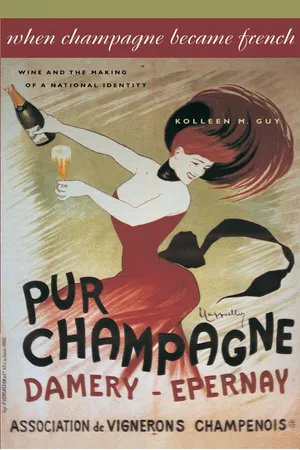
When Champagne Became French
eBook - ePub

When Champagne Became French

Wine and the Making of a National Identity

  1. English
  2. ePUB (mobile friendly)
  3. Available on iOS & Android
eBook - ePub

When Champagne Became French

Wine and the Making of a National Identity

About this book

Winner of the 2002 Manuscript Award from Phi Alpha ThetaWinner of the Gourmand World Cookbook Awards for English Wine, Best Wine History Book, and Best Book on French WineWinner of the Clicquot Wine Book of the Year Competition

Winner of the Outstanding Manuscript Award from Phi Alpha Theta, this work explains how nationhood emerges by viewing countries as cultural artifacts, a product of "invented traditions." In the case of France, scholars sharply disagree, not only over the nature of French national identity but also over the extent to which diverse and sometimes hostile provincial communities became integrated into the nation. In When Champagne Became French: Wine and the Making of a National Identity, Kolleen M. Guy offers a new perspective on this debate by looking at one of the central elements in French national culture—luxury wine—and the rural communities that profited from its production.

Focusing on the development of the champagne industry between 1820 and 1920, Guy explores the role of private interests in the creation of national culture and in the nation-building process. Drawing on concepts from social and cultural history, she shows how champagne helped fuel the revolution in consumption as social groups searched for new ways to develop cohesion and to establish status. By the end of the nineteenth century, Guy concludes, the champagne-producing provinces in the department of Marne had developed a rhetoric of French identity that promoted its own marketing success as national. This ability to mask local interests as national concerns convinced government officials of the need, at both national and international levels, to protect champagne as a French patrimony.

Frequently asked questions

Yes, you can cancel anytime from the Subscription tab in your account settings on the Perlego website. Your subscription will stay active until the end of your current billing period. Learn how to cancel your subscription.
No, books cannot be downloaded as external files, such as PDFs, for use outside of Perlego. However, you can download books within the Perlego app for offline reading on mobile or tablet. Learn more here.
Perlego offers two plans: Essential and Complete
  • Essential is ideal for learners and professionals who enjoy exploring a wide range of subjects. Access the Essential Library with 800,000+ trusted titles and best-sellers across business, personal growth, and the humanities. Includes unlimited reading time and Standard Read Aloud voice.
  • Complete: Perfect for advanced learners and researchers needing full, unrestricted access. Unlock 1.4M+ books across hundreds of subjects, including academic and specialized titles. The Complete Plan also includes advanced features like Premium Read Aloud and Research Assistant.
Both plans are available with monthly, semester, or annual billing cycles.
We are an online textbook subscription service, where you can get access to an entire online library for less than the price of a single book per month. With over 1 million books across 1000+ topics, we’ve got you covered! Learn more here.
Look out for the read-aloud symbol on your next book to see if you can listen to it. The read-aloud tool reads text aloud for you, highlighting the text as it is being read. You can pause it, speed it up and slow it down. Learn more here.
Yes! You can use the Perlego app on both iOS or Android devices to read anytime, anywhere — even offline. Perfect for commutes or when you’re on the go.
Please note we cannot support devices running on iOS 13 and Android 7 or earlier. Learn more about using the app.
Yes, you can access When Champagne Became French by Kolleen M. Guy in PDF and/or ePUB format, as well as other popular books in History & French History. We have over one million books available in our catalogue for you to explore.

Information

Table of contents

  1. Cover Page
  2. Title Page
  3. Copyright Page
  4. Contents
  5. Acknowledgments
  6. Chapter One: Introduction
  7. Chapter Two: Consuming the Nation: Champagne Marketing and Bourgeois Rituals, 1789–1914
  8. Chapter Three: Industry Meets Terroir: Champagne Producers in the Marne, 1789–1890
  9. Chapter Four: Resistance and Identity: Cultivation Methods and the Wine Community, 1890–1900
  10. Chapter Five: Boundaries: The Limits of the “True” Champagne, 1900–1910
  11. Chapter Six: Revolution and Stalemate: The Revolt of 1911
  12. Chapter Seven: Conclusion: Champagne and Modern France
  13. Appendix
  14. Notes
  15. Bibliographic Essay
  16. Index