eBook - ePub
Making Monitoring and Evaluation Systems Work
A Capacity Development Toolkit
- English
- ePUB (mobile friendly)
- Available on iOS & Android
eBook - ePub
Making Monitoring and Evaluation Systems Work
A Capacity Development Toolkit
About this book
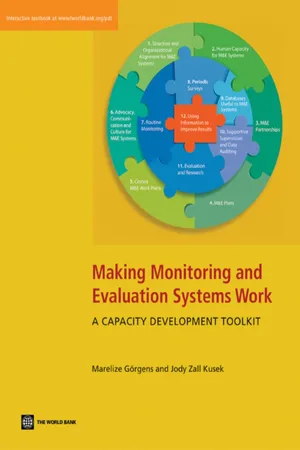
Written for those who said to the authors (and for others in the same situation): "We know we need M and E, but we don't know how to set up an M and E system, or how to make ours work well and provide the information we need." This detailed, practical manual explains the skills and steps for making a monitoring and evaluation (M and E) system that functions well. The goal is an M and E system -- people, processes and partnerships -- that collects, verifies and analyzes good quality information that is useful and used by decision makers, managers, implementers, funders, and other stakeholders. The manual begins by introducing the concept of results-based management, and the internationally accepted "12 components of functional M and E Systems" framework. It describes the purpose and functions of each component, and builds skills by taking users through the steps for setting up, or improving what already exists. (The 12 modules – one for each component – are listed overleaf.) Each module has clear learning objectives, detailed systematic explanations and useful examples, and exercises for learners to work through that apply what is being taught (model answers are available on line). Use: It can be used as a reference manual, a training text, or for self-study. It is likely to be especially useful for trainers and trainees trying to meet the need for skilled professionals, capacity and technical advice in building sustainable M and E systems. Using the 12 components of any working M and E system as a benchmark, users can easily assess their own system for sustainability, identify where improvements are needed, and follow the detailed, systematic steps and "how to" guidance. Potential Users: The broad audience for this manual includes all those responsible for M and E, across all sectors. The primary audience is people who set up, operate, or oversee M and E functions, trying to ensure that data are collected, compiled, and provided in a useful way to decision makers. The book was written mostly for staff in government agencies at national and sub-national levels, but is fully relevant to NGOs, the private sector, and funding agencies. All implementing or policy-making organization with programs that aim for results and change need monitoring and evaluation, will find this guide useful, practical, systematic and thorough. Development: The manual shares the authors' extensive practical, hands-on experience helping clients to build and use M and E systems, and advising on managing for results. The materials were developed and tested "in the field", and benefited from detailed discussions with other M and E practitioner-experts to get consensus on the approach. The draft was refined after extensive peer reviews, and pilot use in training courses inTanzania and Turkey. The manual complements and extends the globally recognized best-selling book co-written by one of the authors, widely used by academic institutions, governments, and developing partners worldwide to better understand the principles and practices of results-based M and E. "Making Monitoring and Evaluation Systems Work" goes beyond the broad consensus on the need to measure, monitor, and manage to results, and the investments in monitoring and evaluation systems, to go step-by-step through the details and practicalities of making sure M and E systems are functional and sustainable. Contents Introductory Module: Introduces the Training Course, the concept of results-based management and the 12 Components of Functional M and E Systems 1. The Enabling Environment: People, organization, partnerships and planning Module 1: Organisational Structures for M and E: Explains the importance of including M and E in organisational structures, and how to plan for human resources to meet the needs of an M and E system.
Information
Subtopic
ManagementIndex
EconomicsTable of contents
- Cover
- Title Page
- Copyright
- Contents
- Acknowledgments
- Abbreviations and Glossary of Terms
- Preface
- Introduction
- Chapter 1 Structure and Organizational Alignment for Monitoring and Evaluation Systems
- Chapter 2: Human Capacity for M&E Systems
- Chapter 3: Monitoring and Evaluation Partnerships
- Chapter 4: M&E Plans
- Chapter 5: Costed Monitoring and Evaluation Work Plans
- Chapter 6: Advocacy, Communication, and Culture for Monitoring and Evaluation
- Chapter 7: Routine Monitoring
- Chapter 8: Periodic Surveys
- Chapter 9: Databases Useful to Monitoring and Evaluation Systems
- Chapter 10: Supportive Supervision and Data Auditing
- Chapter 11: Evaluation and Research
- Chapter 12: Using Information to Improve Results
- References
- Index
- Back cover
Trusted by 375,005 students
Access to over 1.5 million titles for a fair monthly price.
Study more efficiently using our study tools.
Frequently asked questions
Yes, you can cancel anytime from the Subscription tab in your account settings on the Perlego website. Your subscription will stay active until the end of your current billing period. Learn how to cancel your subscription
No, books cannot be downloaded as external files, such as PDFs, for use outside of Perlego. However, you can download books within the Perlego app for offline reading on mobile or tablet. Learn how to download books offline
We are an online textbook subscription service, where you can get access to an entire online library for less than the price of a single book per month. With over 1.5 million books across 990+ topics, we’ve got you covered! Learn about our mission
Look out for the read-aloud symbol on your next book to see if you can listen to it. The read-aloud tool reads text aloud for you, highlighting the text as it is being read. You can pause it, speed it up and slow it down. Learn more about Read Aloud
Yes! You can use the Perlego app on both iOS and Android devices to read anytime, anywhere — even offline. Perfect for commutes or when you’re on the go.
Please note we cannot support devices running on iOS 13 and Android 7 or earlier. Learn more about using the app
Please note we cannot support devices running on iOS 13 and Android 7 or earlier. Learn more about using the app
Yes, you can access Making Monitoring and Evaluation Systems Work by Marelize Göergens,Jody Zall Kusek in PDF and/or ePUB format, as well as other popular books in Economics & Management. We have over 1.5 million books available in our catalogue for you to explore.