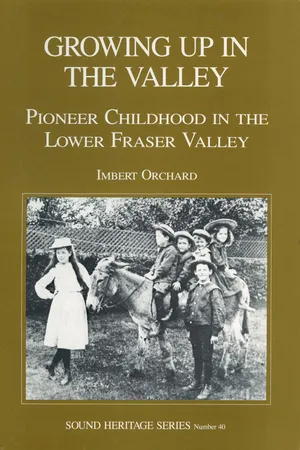
Growing Up in the Valley
eBook - PDF

Growing Up in the Valley

Pioneer Childhood in the Lower Fraser Valley

  1. 92 pages
  2. English
  3. PDF
  4. Available on iOS & Android
eBook - PDF

Growing Up in the Valley

Pioneer Childhood in the Lower Fraser Valley

About this book

In the days of the earliest settlers the Lower Fraser Valley was a vast forest, broken here and there by stretches of open prairie. The latter were islands, and other natural meadows, subject to flooding at high water. It was there that the first farming took place. Around 1840 the Hudson's Bay Company started a farm on Langley Prairie in connection with the fort. Similar areas were settled twenty years or more later by miners, teamsters, and others from the Fraser River gold fields. By then the Pre-emption Acts of 1859 and 1860 had made it possible for anyone to take up land, and quite a few of them settled on the large accessible prairies around Sumas Lake and the lower reaches of the Chilliwack River. They brought in cattle from across the border and fattened them on the wild grass and the pea vine. Although they had little or no clearing to do, they had to cope with annual floods, and hordes of mosquitoes that hatched out when the waters receded. This story is told in "Floodland and Forest" (Sound Heritage Series, No. 37) By contrast, most of the people who concern us now pioneered the uplands of Surrey, Langley and Mission. They arrived during the 1870's or the two following decades, by which time all the suitable land had been taken up, and there was nothing for it but to move in among the firs and the cedars, which presented them with a very different challenge. Access was by wagon roads or trails, meandering through dark woods and marshy bottom lands. Some had been made by Indians—like the one which ran from Semiahmoo Bay on the U.S. border to Brownsville, a small settlement and landing on the Fraser, opposite New Westminster. Another ran from Bellingham Bay to Fort Langley, the so-called Smugglers' Trail. One trail had been cut in 1865 for a telegraph line that was to have been built all the way to Alaska, and then to Siberia. That it never got there is another story. But the trail itself was used by riders and pedestrians prepared to wade or swim any creeks they encountered. There were no bridges. During the 1870s the new provincial government made an effort to open up wagon roads, beginning with the Semiahmoo Trail, which had already been improved by the Royal Engineers. In 1873 it was improved again. And during the next few years an entirely new road was cut through the middle of Surrey, Langley and Matsqui. It was known as the Yale Road, and from it settlers themselves constructed trails north and south into their homesteads. About that time, too, the Old McLellan Road, as it got to be called, was cut from the top of Wood wards Hill on the Semiahmoo Trail to Langley Prairie; and a few years later the Coast Meridian was opened up from the Yale Road south to the border. These so-called wagon roads brought the homesteaders into the very heart of the Surrey and Langley woods, and brought them out again when they went to New Westminster for supplies. But for several years they were hardly more than muddy trails that dodged the stumps and were at their best when frozen hard. Roads and bridges, however, were an immediate concern of the newly formed municipal councils, and many a settler found himself working on the roads in lieu of taxes. Bit by bit it became less difficult to move about, especially when they started using gravel. Loggers and shingle makers also helped to open up the country. As with the farmers, they started at the water's edge and, as hand-loggers, worked their way along the banks of the Fraser and the smaller rivers. Pushing further inland, they built skid roads and brought in ox teams to haul the logs down to a river landing or a ditch they had constructed. From there the logs would be towed to one of the big mills near New Westminster, or perhaps to the one at Elgin. In 1891 the New Westminster and Southern Railway was built from Brownsville, down through the middle of Surrey by way of Cloverdale and Halls Prairie, to link up with the American line at the border.

Frequently asked questions

Yes, you can cancel anytime from the Subscription tab in your account settings on the Perlego website. Your subscription will stay active until the end of your current billing period. Learn how to cancel your subscription.
At the moment all of our mobile-responsive ePub books are available to download via the app. Most of our PDFs are also available to download and we're working on making the final remaining ones downloadable now. Learn more here.
Perlego offers two plans: Essential and Complete
  • Essential is ideal for learners and professionals who enjoy exploring a wide range of subjects. Access the Essential Library with 800,000+ trusted titles and best-sellers across business, personal growth, and the humanities. Includes unlimited reading time and Standard Read Aloud voice.
  • Complete: Perfect for advanced learners and researchers needing full, unrestricted access. Unlock 1.4M+ books across hundreds of subjects, including academic and specialized titles. The Complete Plan also includes advanced features like Premium Read Aloud and Research Assistant.
Both plans are available with monthly, semester, or annual billing cycles.
We are an online textbook subscription service, where you can get access to an entire online library for less than the price of a single book per month. With over 1 million books across 1000+ topics, we’ve got you covered! Learn more here.
Look out for the read-aloud symbol on your next book to see if you can listen to it. The read-aloud tool reads text aloud for you, highlighting the text as it is being read. You can pause it, speed it up and slow it down. Learn more here.
Yes! You can use the Perlego app on both iOS or Android devices to read anytime, anywhere — even offline. Perfect for commutes or when you’re on the go.
Please note we cannot support devices running on iOS 13 and Android 7 or earlier. Learn more about using the app.
Yes, you can access Growing Up in the Valley by The Royal British Columbia Museum in PDF and/or ePUB format, as well as other popular books in History & North American History. We have over one million books available in our catalogue for you to explore.

Information

Table of contents

  1. Cover
  2. Title Page
  3. Copyright
  4. Contents
  5. Patterns of the Valley
  6. The Blue Jays of Langley
  7. Mission Boy
  8. Little Pete
  9. Getting There
  10. Settling In
  11. Around Home
  12. Stores and Pedlars
  13. School Days
  14. Sundays
  15. Neighbours
  16. Going to Market
  17. Transitions
  18. Notes on the Interviews
  19. Sound Heritage Series Backlist
  20. Back Cover