- 94 pages
- English
- PDF
- Available on iOS & Android
eBook - PDF
About this book
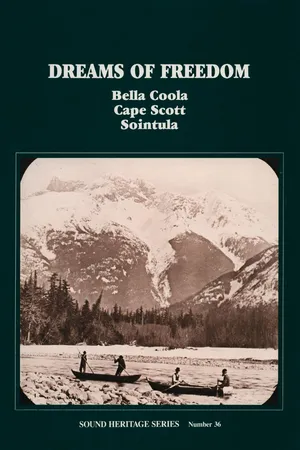
When William Duncan established Metlakatla near the mouth of the Skeena in 1862, he did so to create a sanctuary for his Tsimshian parishioners. Metlakatla was, Duncan believed, distant enough from Fort Simpson and the various nearby Indian villages to ensure there would be little outside influence. At Metlakatla they would worship and live in the way they chose, free individuals. Although no one could have known it at the time, Duncan's action would be repeated by others numerous times in the forthcoming years. Many of these colonies would be created for exactly the same reasons, but in far more isolated areas. His experiment at Metlakatla is well-documented; a certain amount has been written regarding the Doukhobors in the Kootenays, and many of the other religious colonies that sprang up in British Columbia have been documented to a limited extent. Ethnic colonies are less well-documented, particularly those planned before settlement began. Three colonies, which later developed into communities, are of great importance if we are to understand certain economic and sociological aspects of British Columbia's west coast. The Bella Coola Valley was settled by Norwegian immigrants from the United States in 1894. Danish settlers, many also from the United States, began to develop land at Cape Scott in 1896. In 1901, Finnish settlers began to build Sointula on Malcolm Island. These people were neither the first nor the last Scandinavian settlers in this province, nor did they represent a majority of the Scandinavians in British Columbia. Quite simply, they were men and women with a dream. This dream, this freedom to practice or not to practice religion in their own way, to have land of their own, and to live the way they wanted to live, is the first uniting factor between these three colonies. But a number of other factors distinguish these groups from the other settlers and settlements on the coast at that time. The colonists came from the same geographical region of northern Europe. They arrived on the coast within a few years of one another. They settled in the same general area of the coast, and they encountered similar problems of physical isolation and economic hardship. These Scandinavians established their own colonies in the wilderness, and shared a belief in certain ideals such as cooperation and self-reliance. Although a strong sense of "community" is a common feature of small town or village life, the social and economic organization to the colonies and aims and dreams of the colonists combined to make these settlements different from most coastal communities. Many of the men and women interviewed for this issue were born near the opening of this century. They grew up in family units and life-styles difficult to imagine today. The isolation they experienced was a controlling factor in their lives. Bella Coola was cut off from the world for long periods of time; the Cape Scott settlers were not only cut off from the outside but from each other due to the Jack of decent roads, trails and bridges; and Sointula, although not so completely isolated physically, faced a different isolation because of language and traditions. Consequently their picture of that period of their lives is well-remembered and, as we discovered, extremely accurate. This picture is also unique. A great deal has been written about pioneer settlements, but little has appeared regarding pioneer European settlements in British Columbia. Even less has been published on what we may call the atmospherics of pioneer life. The faith and belief these settlers had for their new country, their willingness to settle in isolated locations, and to work as hard as they did for their dream should be more than the footnote it has long been in provincial history. The Norwegian colony in the Bella Coola Valley lost its leader in its third year of existence, but it continued to grow and prosper. The Danish settlement at Cape Scott was confronted with almost insurmountable
Information
Subtopic
North American HistoryIndex
HistoryTable of contents
- Cover
- Title Page
- Copyright
- Contents
- Editorial Note
- This Dream, This Freedom
- The Immigrant Wave
- Three Colonies
- Three Communities
- "No Paradise, No Utopia"
- Sources
- Bibliography
- Credits
- Sound Heritage Series
- Back Cover
Trusted by 375,005 students
Access to over 1.5 million titles for a fair monthly price.
Study more efficiently using our study tools.
Frequently asked questions
Yes, you can cancel anytime from the Subscription tab in your account settings on the Perlego website. Your subscription will stay active until the end of your current billing period. Learn how to cancel your subscription
No, books cannot be downloaded as external files, such as PDFs, for use outside of Perlego. However, you can download books within the Perlego app for offline reading on mobile or tablet. Learn how to download books offline
We are an online textbook subscription service, where you can get access to an entire online library for less than the price of a single book per month. With over 1.5 million books across 990+ topics, we’ve got you covered! Learn about our mission
Look out for the read-aloud symbol on your next book to see if you can listen to it. The read-aloud tool reads text aloud for you, highlighting the text as it is being read. You can pause it, speed it up and slow it down. Learn more about Read Aloud
Yes! You can use the Perlego app on both iOS and Android devices to read anytime, anywhere — even offline. Perfect for commutes or when you’re on the go.
Please note we cannot support devices running on iOS 13 and Android 7 or earlier. Learn more about using the app
Please note we cannot support devices running on iOS 13 and Android 7 or earlier. Learn more about using the app
Yes, you can access Dreams of Freedom by The Royal British Columbia Museum in PDF and/or ePUB format, as well as other popular books in History & North American History. We have over 1.5 million books available in our catalogue for you to explore.