Two European siblings travel to New England to meet their American cousins in this classic satire.
Henry James's short novel
The Europeans—which made its debut in serial form in the
Atlantic Monthly—is the beloved tale of Eugenia Münster and her brother, Felix Young, who travel to Boston after having spent most of their lives in France, Italy, Spain, and Germany. At the heart of the story rest the concerns that most intrigued the iconic author: When does one choose money over love? When do the desires of the self become more important than the traditional wishes of a family or society?
Eugenia's marriage to Prince Adolf of Silberstadt-Schreckenstein is in the process being dissolved as a result of political pressures from his family, and the jilted bride has little in common with her more docile and domestic cousins, Gertrude and Charlotte Wentworth, with whom she and her artistic brother, Felix, have come to stay. And soon Felix falls in love with cousin Gertrude, a host of other suitors threatening to complicate matters.
Described by literary critic F. R. Leavis as "a masterpiece of major quality,"
The Europeans is one of James's most popular works, and a delightful showcase for his keen wit and empathy.
This ebook has been professionally proofread to ensure accuracy and readability on all devices.
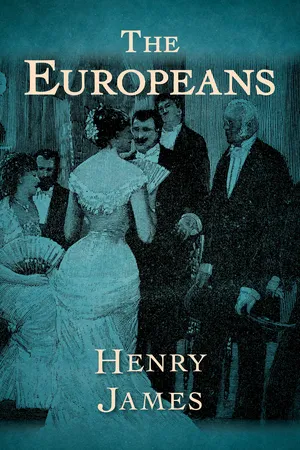
- 289 pages
- English
- ePUB (mobile friendly)
- Available on iOS & Android
eBook - ePub
The Europeans
About this book
Trusted by 375,005 students
Access to over 1.5 million titles for a fair monthly price.
Study more efficiently using our study tools.
Information
Subtopic
ClassicsIndex
LiteratureCHAPTER I
A narrow grave-yard in the heart of a bustling, indifferent city, seen from the windows of a gloomy-looking inn, is at no time an object of enlivening suggestion; and the spectacle is not at its best when the mouldy tombstones and funereal umbrage have received the ineffectual refreshment of a dull, moist snow-fall. If, while the air is thickened by this frosty drizzle, the calendar should happen to indicate that the blessed vernal season is already six weeks old, it will be admitted that no depressing influence is absent from the scene. This fact was keenly felt on a certain 12th of May, upwards of thirty years since, by a lady who stood looking out of one of the windows of the best hotel in the ancient city of Boston. She had stood there for half an hour—stood there, that is, at intervals; for from time to time she turned back into the room and measured its length with a restless step. In the chimney-place was a red-hot fire which emitted a small blue flame; and in front of the fire, at a table, sat a young man who was busily plying a pencil. He had a number of sheets of paper cut into small equal squares, and he was apparently covering them with pictorial designs—strange-looking figures. He worked rapidly and attentively, sometimes threw back his head and held out his drawing at arm’s-length, and kept up a soft, gay-sounding humming and whistling. The lady brushed past him in her walk; her much-trimmed skirts were voluminous. She never dropped her eyes upon his work; she only turned them, occasionally, as she passed, to a mirror suspended above the toilet-table on the other side of the room. Here she paused a moment, gave a pinch to her waist with her two hands, or raised these members—they were very plump and pretty—to the multifold braids of her hair, with a movement half caressing, half corrective. An attentive observer might have fancied that during these periods of desultory self-inspection her face forgot its melancholy; but as soon as she neared the window again it began to proclaim that she was a very ill-pleased woman. And indeed, in what met her eyes there was little to be pleased with. The window-panes were battered by the sleet; the head-stones in the grave-yard beneath seemed to be holding themselves askance to keep it out of their faces. A tall iron railing protected them from the street, and on the other side of the railing an assemblage of Bostonians were trampling about in the liquid snow. Many of them were looking up and down; they appeared to be waiting for something. From time to time a strange vehicle drew near to the place where they stood,—such a vehicle as the lady at the window, in spite of a considerable acquaintance with human inventions, had never seen before: a huge, low omnibus, painted in brilliant colors, and decorated apparently with jangling bells, attached to a species of groove in the pavement, through which it was dragged, with a great deal of rumbling, bouncing and scratching, by a couple of remarkably small horses. When it reached a certain point the people in front of the grave-yard, of whom much the greater number were women, carrying satchels and parcels, projected themselves upon it in a compact body—a movement suggesting the scramble for places in a life-boat at sea—and were engulfed in its large interior. Then the life-boat—or the life-car, as the lady at the window of the hotel vaguely designated it—went bumping and jingling away upon its invisible wheels, with the helmsman (the man at the wheel) guiding its course incongruously from the prow. This phenomenon was repeated every three minutes, and the supply of eagerly-moving women in cloaks, bearing reticules and bundles, renewed itself in the most liberal manner. On the other side of the grave-yard was a row of small red brick houses, showing a series of homely, domestic-looking backs; at the end opposite the hotel a tall wooden church-spire, painted white, rose high into the vagueness of the snow-flakes. The lady at the window looked at it for some time; for reasons of her own she thought it the ugliest thing she had ever seen. She hated it, she despised it; it threw her into a state of irritation that was quite out of proportion to any sensible motive. She had never known herself to care so much about church-spires.
She was not pretty; but even when it expressed perplexed irritation her face was most interesting and agreeable. Neither was she in her first youth; yet, though slender, with a great deal of extremely well-fashioned roundness of contour—a suggestion both of maturity and flexibility—she carried her three and thirty years as a light-wristed Hebe might have carried a brimming wine-cup. Her complexion was fatigued, as the French say; her mouth was large, her lips too full, her teeth uneven, her chin rather commonly modeled; she had a thick nose, and when she smiled—she was constantly smiling—the lines beside it rose too high, toward her eyes. But these eyes were charming: gray in color, brilliant, quickly glancing, gently resting, full of intelligence. Her forehead was very low—it was her only handsome feature; and she had a great abundance of crisp dark hair, finely frizzled, which was always braided in a manner that suggested some Southern or Eastern, some remotely foreign, woman. She had a large collection of ear-rings, and wore them in alternation; and they seemed to give a point to her Oriental or exotic aspect. A compliment had once been paid her, which, being repeated to her, gave her greater pleasure than anything she had ever heard. “A pretty woman?” someone had said. “Why, her features are very bad.” “I don’t know about her features,” a very discerning observer had answered; “but she carries her head like a pretty woman.” You may imagine whether, after this, she carried her head less becomingly.
She turned away from the window at last, pressing her hands to her eyes. “It’s too horrible!” she exclaimed. “I shall go back—I shall go back!” And she flung herself into a chair before the fire.
“Wait a little, dear child,” said the young man softly, sketching away at his little scraps of paper.
The lady put out her foot; it was very small, and there was an immense rosette on her slipper. She fixed her eyes for a while on this ornament, and then she looked at the glowing bed of anthracite coal in the grate. “Did you ever see anything so hideous as that fire?” she demanded. “Did you ever see anything so—so affreux as—as everything?” She spoke English with perfect purity; but she brought out this French epithet in a manner that indicated that she was accustomed to using French epithets.
“I think the fire is very pretty,” said the young man, glancing at it a moment. “Those little blue tongues, dancing on top of the crimson embers, are extremely picturesque. They are like a fire in an alchemist’s laboratory.”
“You are too good-natured, my dear,” his companion declared.
The young man held out one of his drawings, with his head on one side. His tongue was gently moving along his under-lip. “Good-natured—yes. Too good-natured—no.”
“You are irritating,” said the lady, looking at her slipper.
He began to retouch his sketch. “I think you mean simply that you are irritated.”
“Ah, for that, yes!” said his companion, with a little bitter laugh. “It’s the darkest day of my life—and you know what that means.”
“Wait till tomorrow,” rejoined the young man.
“Yes, we have made a great mistake. If there is any doubt about it today, there certainly will be none tomorrow. Ce sera clair, au moins!”
The young man was silent a few moments, driving his pencil. Then at last, “There are no such things as mistakes,” he affirmed.
“Very true—for those who are not clever enough to perceive them. Not to recognize one’s mistakes—that would be happiness in life,” the lady went on, still looking at her pretty foot.
“My dearest sister,” said the young man, always intent upon his drawing, “it’s the first time you have told me I am not clever.”
“Well, by your own theory I can’t call it a mistake,” answered his sister, pertinently enough.
The young man gave a clear, fresh laugh. “You, at least, are clever enough, dearest sister,” he said.
“I was not so when I proposed this.”
“Was it you who proposed it?” asked her brother.
She turned her head and gave him a little stare. “Do you desire the credit of it?”
“If you like, I will take the blame,” he said, looking up with a smile.
“Yes,” she rejoined in a moment, “you make no difference in these things. You have no sense of property.”
The young man gave his joyous laugh again. “If that means I have no property, you are right!”
“Don’t joke about your poverty,” said his sister. “That is quite as vulgar as to boast about it.”
“My poverty! I have just finished a drawing that will bring me fifty francs!”
“Voyons,” said the lady, putting out her hand.
He added a touch or two, and then gave her his sketch. She looked at it, but she went on with her idea of a moment before. “If a woman were to ask you to marry her you would say, ‘Certainly, my dear, with pleasure!’ And you would marry her and be ridiculously happy. Then at the end of three months you would say to her, ‘You know that blissful day when I begged you to be mine!’”
The young man had risen from the table, stretching his arms a little; he walked to the window. “That is a description of a charming nature,” he said.
“Oh, yes, you have a charming nature; I regard that as our capital. If I had not been convinced of that I should never have taken the risk of bringing you to this dreadful country.”
“This co...
Table of contents
- Cover
- Title Page
- CHAPTER I
- CHAPTER II
- CHAPTER III
- CHAPTER IV
- CHAPTER V
- CHAPTER VI
- CHAPTER VII
- CHAPTER VIII
- CHAPTER IX
- CHAPTER X
- CHAPTER XI
- CHAPTER XII
- Copyright
Frequently asked questions
Yes, you can cancel anytime from the Subscription tab in your account settings on the Perlego website. Your subscription will stay active until the end of your current billing period. Learn how to cancel your subscription
No, books cannot be downloaded as external files, such as PDFs, for use outside of Perlego. However, you can download books within the Perlego app for offline reading on mobile or tablet. Learn how to download books offline
Perlego offers two plans: Essential and Complete
- Essential is ideal for learners and professionals who enjoy exploring a wide range of subjects. Access the Essential Library with 800,000+ trusted titles and best-sellers across business, personal growth, and the humanities. Includes unlimited reading time and Standard Read Aloud voice.
- Complete: Perfect for advanced learners and researchers needing full, unrestricted access. Unlock 1.5M+ books across hundreds of subjects, including academic and specialized titles. The Complete Plan also includes advanced features like Premium Read Aloud and Research Assistant.
We are an online textbook subscription service, where you can get access to an entire online library for less than the price of a single book per month. With over 1.5 million books across 990+ topics, we’ve got you covered! Learn about our mission
Look out for the read-aloud symbol on your next book to see if you can listen to it. The read-aloud tool reads text aloud for you, highlighting the text as it is being read. You can pause it, speed it up and slow it down. Learn more about Read Aloud
Yes! You can use the Perlego app on both iOS and Android devices to read anytime, anywhere — even offline. Perfect for commutes or when you’re on the go.
Please note we cannot support devices running on iOS 13 and Android 7 or earlier. Learn more about using the app
Please note we cannot support devices running on iOS 13 and Android 7 or earlier. Learn more about using the app
Yes, you can access The Europeans by Henry James in PDF and/or ePUB format, as well as other popular books in Literature & Classics. We have over 1.5 million books available in our catalogue for you to explore.