- 449 pages
- English
- PDF
- Available on iOS & Android
eBook - PDF
About this book
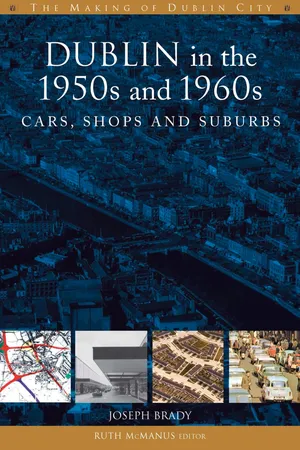
After the relative gloom of the 1950s, there was a rapid economic pick-up in the early 1960s. Car ownership increased as standards of living improved and Dublin, in common with other European cities, engaged in much soul-searching about what kind of city was needed for a car-owning population and whether this differed from the kind of city that people wanted. Cars offered greater accessibility and this, combined with changes in the nature of industry and, especially, in the nature of retailing, profoundly altered the relationship between Dubliners and the city center. A move to self-service and larger and larger scale retail units (especially in food retailing) prompted the move to suburban locations; industry too found benefits in being able to have large-scale, low-rise operations on greenfield sites. The city centre had to redefine its role, but it had a boom in service employment in the 1960s which demanded purpose-built office accommodation. The preferred location for this commercial activity was the southeastern sector of Dublin, where the Georgian landscape was best preserved. The nature, scale and speed of change demanded a robust approach to planning. This was the period in which Dublin eventually got its first statutory town plan. These issues are explored in this, the seventh volume in the Making of Dublin City series. (Series: The Making of Dublin, Vol. 7) [Subject: History, Urban Planning & Growth, Housing, Architecture, Social & Cultural History, Irish Studies]
Information
Topic
ArchitectureSubtopic
History of ArchitectureTable of contents
- Contents
- Acknowledgments
- Series editors’ introduction
- The growing footprint
- Planning for future growth
- The urban landscape
- The city and the motor car
- The suburban city
- Dublin for visitors
- Sources and bibliography
- List of illustrations
- Index
Trusted by 375,005 students
Access to over 1.5 million titles for a fair monthly price.
Study more efficiently using our study tools.
Frequently asked questions
Yes, you can cancel anytime from the Subscription tab in your account settings on the Perlego website. Your subscription will stay active until the end of your current billing period. Learn how to cancel your subscription
No, books cannot be downloaded as external files, such as PDFs, for use outside of Perlego. However, you can download books within the Perlego app for offline reading on mobile or tablet. Learn how to download books offline
Perlego offers two plans: Essential and Complete
- Essential is ideal for learners and professionals who enjoy exploring a wide range of subjects. Access the Essential Library with 800,000+ trusted titles and best-sellers across business, personal growth, and the humanities. Includes unlimited reading time and Standard Read Aloud voice.
- Complete: Perfect for advanced learners and researchers needing full, unrestricted access. Unlock 1.5M+ books across hundreds of subjects, including academic and specialized titles. The Complete Plan also includes advanced features like Premium Read Aloud and Research Assistant.
We are an online textbook subscription service, where you can get access to an entire online library for less than the price of a single book per month. With over 1.5 million books across 990+ topics, we’ve got you covered! Learn about our mission
Look out for the read-aloud symbol on your next book to see if you can listen to it. The read-aloud tool reads text aloud for you, highlighting the text as it is being read. You can pause it, speed it up and slow it down. Learn more about Read Aloud
Yes! You can use the Perlego app on both iOS and Android devices to read anytime, anywhere — even offline. Perfect for commutes or when you’re on the go.
Please note we cannot support devices running on iOS 13 and Android 7 or earlier. Learn more about using the app
Please note we cannot support devices running on iOS 13 and Android 7 or earlier. Learn more about using the app
Yes, you can access Dublin in the 1950s and 1960s by Joseph Brady in PDF and/or ePUB format, as well as other popular books in Architecture & History of Architecture. We have over 1.5 million books available in our catalogue for you to explore.