The contributions in this book address various issues pertaining to the judicialization of politics and the politicization of justice. This theme lends itself to a number of approaches that are of the highest interest to contemporary public law (e.g., the appropriateness of judicial deference to political and administrative discretion in constitutional adjudication; and judicial review of administrative action, theories, and methodologies of constitutional and statutory interpretation; and legal theory debates ranging from Hans Kelsen to Carl Schmitt, from Antonin Scalia to Ronald Dworkin; etc.). The context of transitional constitutionalism presents a number of compounded complications and interesting contradictions related to the topic. In conceptual terms, the contributions do not assume a unitary definition of the phenomenon of politicization/judicialization, instead starting from the premise that such definitions are by necessity grossly oversimplifying and therefore of limited epistemological use. The contributors build an understanding of the general phenomenon by exploring the law/politics distinction along distinct relevant dimensions (the private/public distinction, "political questions" doctrines, the disciplining effect of interpretive methodology, the limits of interpretation, the special problematic of individual vs. collective rights, etc.). Due to its unique approach, this work is a distinctive and unique product compared to the existing literature on the subject.
- 225 pages
- English
- PDF
- Available on iOS & Android
eBook - PDF
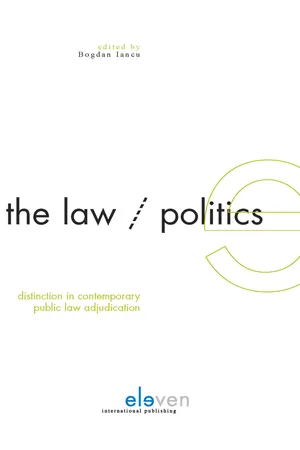
The Law/Politics Distinction in Contemporary Public Law Adjudication
About this book
Information
Subtopic
Public LawIndex
LawTable of contents
- Cover
- Table of Contents
- List of Contributors
- Acknowledgements
- INTRODUCTION
- Law/Politics Distinctions – The Elusive Reference Points
- PART I: CONSTITUTIONALISM IN TRANSFORMATION
- Chapter 1:
- Constitutions, Constitutional Courts, and Constitutional Interpretation at the Interface of Law and Politics
- Chapter 2:
- The Law/Politics Distinction in the Experience of the European Court of Justice and the Supreme Court of Canada: A Comparative Study
- Chapter 3:
- Judicialization and Transnational Governance: The Example of WTO Law and the GMO Dispute
- The Judicialized Handling of Global Risk
- Chapter 4:
- Myths of Miscegenation. Should the Concept of “Reasonable Accommodation” for Subordinated Groups and Minorities Be Constitutionalized?
- PART II: TRANSITIONAL CONSTITUTIONALISM
- Chapter 5:
- The Functions of Law and Lawyers in Political and Social Transformation Processes
- Socialist Law Unaccounted
- Chapter 6:
- Idealization, De-Politicization and Economic Due Process: System Transition in the European Union
- Chapter 7:
- On Post-Communist Transformation, Structural Corruption and Dealing with the Past as Constitutional Process
- Chapter 8:
- Constitutionalism in Perpetual Transition: The Case of Romania
Trusted by 375,005 students
Access to over 1.5 million titles for a fair monthly price.
Study more efficiently using our study tools.
Frequently asked questions
Yes, you can cancel anytime from the Subscription tab in your account settings on the Perlego website. Your subscription will stay active until the end of your current billing period. Learn how to cancel your subscription
No, books cannot be downloaded as external files, such as PDFs, for use outside of Perlego. However, you can download books within the Perlego app for offline reading on mobile or tablet. Learn how to download books offline
Perlego offers two plans: Essential and Complete
- Essential is ideal for learners and professionals who enjoy exploring a wide range of subjects. Access the Essential Library with 800,000+ trusted titles and best-sellers across business, personal growth, and the humanities. Includes unlimited reading time and Standard Read Aloud voice.
- Complete: Perfect for advanced learners and researchers needing full, unrestricted access. Unlock 1.5M+ books across hundreds of subjects, including academic and specialized titles. The Complete Plan also includes advanced features like Premium Read Aloud and Research Assistant.
We are an online textbook subscription service, where you can get access to an entire online library for less than the price of a single book per month. With over 1.5 million books across 990+ topics, we’ve got you covered! Learn about our mission
Look out for the read-aloud symbol on your next book to see if you can listen to it. The read-aloud tool reads text aloud for you, highlighting the text as it is being read. You can pause it, speed it up and slow it down. Learn more about Read Aloud
Yes! You can use the Perlego app on both iOS and Android devices to read anytime, anywhere — even offline. Perfect for commutes or when you’re on the go.
Please note we cannot support devices running on iOS 13 and Android 7 or earlier. Learn more about using the app
Please note we cannot support devices running on iOS 13 and Android 7 or earlier. Learn more about using the app
Yes, you can access The Law/Politics Distinction in Contemporary Public Law Adjudication by Bogdan Iancu in PDF and/or ePUB format, as well as other popular books in Law & Public Law. We have over 1.5 million books available in our catalogue for you to explore.