Firesetting can have devastating effects, including loss of life and serious financial damage. With its potentially severe negative consequences, this type of behaviour has enormous impact on society. Remarkably, however, this phenomenon has received little attention in research, leaving the questions largely unanswered regarding how firesetters can best be individualised, caught by the police and treated in forensic mental health institutions. Based on the first large-scale research project studying firesetters in the Netherlands, this monograph provides answers resulting from analyses at a macro, meso and micro level. These analyses show that firesetters are a heterogeneous group, whose subgroups have their own specific diagnostics and characteristics. These characteristics can guide the police investigation in cases of firesetting. Furthermore, the subgroups found have specific treatment needs, as described in a differentiated treatment model. In order to be effective, treatment should focus on these specific needs. In short, this study contributes to knowledge on the firesetting phenomenon, highlighting the need for differentiation both in individualising and identifying as well as in treating firesetters. This book is part of the so-called Pompe series, which contains publications by staff members of the Willem Pompe Institute for Criminal Law and Criminology in Utrecht, and by authors closely aligned to the school of thought for which the Institute is known. One of its main characteristics has always been the combination of legal and social-scientific approaches to problems of criminal law. The central theme of the Institute's research programme is the protection and enforcement of fundamental rights in a changing world. Within that programme, research focuses on the position of vulnerable groups in relation to the state and on the significance of individual human rights in an international context. (Series: Willem Pompe Institute, Vol. 83) [Subject: Criminal Law, Criminology]
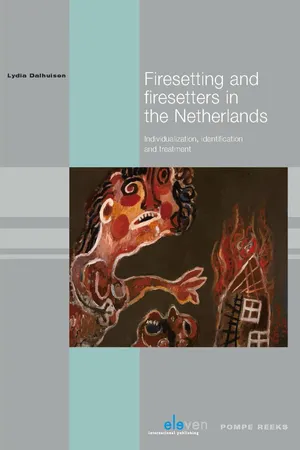
eBook - PDF
Firesetting and Firesetters in the Netherlands
Individualization, Identification and Treatment
- 373 pages
- English
- PDF
- Available on iOS & Android
eBook - PDF
Firesetting and Firesetters in the Netherlands
Individualization, Identification and Treatment
About this book
Information
Subtopic
CriminologyIndex
Social SciencesTable of contents
- Cover
- Title page
- Preface
- Overview
- Table of contents
- Chapter 1
- Chapter 2 Methods of data collection and analysis
- Part I Historical and theoretical background
- Chapter 3 The historical development of firesetting from a medico-legal perspective 1800-1950
- Chapter 4 The observation of mental disorder and dangerousness in firesetters A Dutch contemporary appraisal
- Chapter 5 Explaining firesetting A multidisciplinary approach
- Part II Literature review
- Chapter 6 Characterization and categorization of firesetters
- Chapter 7 Treatment of firesetters
- Part III Firesetters and their fires from an empirical perspective
- Chapter 8 Populations of firesetters A description and comparison
- Chapter 9 Subgroups of firesetters The next step towards individualization
- Chapter 10 From offence to offender Identification of firesetters based on relevant characteristics
- Chapter 11 A model of differentiated treatment
- Chapter 12 Integration
- Appendices
- Samenvatting
- References
- Index
- Previous publications
- Curriculum Vitae
Trusted by 375,005 students
Access to over 1.5 million titles for a fair monthly price.
Study more efficiently using our study tools.
Frequently asked questions
Yes, you can cancel anytime from the Subscription tab in your account settings on the Perlego website. Your subscription will stay active until the end of your current billing period. Learn how to cancel your subscription
No, books cannot be downloaded as external files, such as PDFs, for use outside of Perlego. However, you can download books within the Perlego app for offline reading on mobile or tablet. Learn how to download books offline
Perlego offers two plans: Essential and Complete
- Essential is ideal for learners and professionals who enjoy exploring a wide range of subjects. Access the Essential Library with 800,000+ trusted titles and best-sellers across business, personal growth, and the humanities. Includes unlimited reading time and Standard Read Aloud voice.
- Complete: Perfect for advanced learners and researchers needing full, unrestricted access. Unlock 1.5M+ books across hundreds of subjects, including academic and specialized titles. The Complete Plan also includes advanced features like Premium Read Aloud and Research Assistant.
We are an online textbook subscription service, where you can get access to an entire online library for less than the price of a single book per month. With over 1.5 million books across 990+ topics, we’ve got you covered! Learn about our mission
Look out for the read-aloud symbol on your next book to see if you can listen to it. The read-aloud tool reads text aloud for you, highlighting the text as it is being read. You can pause it, speed it up and slow it down. Learn more about Read Aloud
Yes! You can use the Perlego app on both iOS and Android devices to read anytime, anywhere — even offline. Perfect for commutes or when you’re on the go.
Please note we cannot support devices running on iOS 13 and Android 7 or earlier. Learn more about using the app
Please note we cannot support devices running on iOS 13 and Android 7 or earlier. Learn more about using the app
Yes, you can access Firesetting and Firesetters in the Netherlands by Lydia Dalhuisen in PDF and/or ePUB format, as well as other popular books in Social Sciences & Criminology. We have over 1.5 million books available in our catalogue for you to explore.