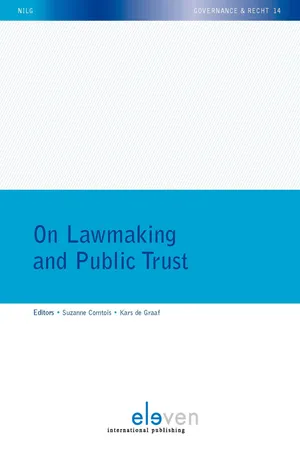
Over the last decades, the evolution of public law has been marked by a trend towards the diversification of sources and forms of law, processes and governance tools. In our globalized world, various factors - such as the increasing importance of European law, international law and fundamental rights, as well as the greater prevalence of social and economic concerns - have tended to justify the need to harmonize legal norms and practices and, thus, to open the borders of legal normativity. The increased interaction between legal systems and other sources of normativity that has followed has led to the coexistence of a diversity of normative authorities (ranging from civil society and the industry itself, to European and international organizations). It has also resulted in the emergence, within domestic law, of a broad range of norms grounded in different sources of legitimacy and with varying degrees of normative force, not merely constrained to the narrow formal definition of "legal norm". This book explores ways in which public lawmaking is changing and examines the impact of such changes on the law itself, on the lawmaking processes, and on the role of decision-makers (judges, public administrators and stakeholders). It also questions the legitimacy of the new governance tools that have emerged from this transformation as well as their impact on the public's trust and confidence.(Series: Governance & Recht, Vol. 14) [Subject: Constitutional Law, Public Law, International Law, Administrative Law]
- 258 pages
- English
- PDF
- Available on iOS & Android
eBook - PDF
On Lawmaking and Public Trust
About this book
Information
Subtopic
Administrative LawIndex
LawTable of contents
- Cover
- INTRODUCTION Contemporary Lawmaking and Public Trust:Challenges, Threats and Opportunities
- Chapter 1 “Front-Door” versus “Back-Door” Lawmaking.A Case Study Concerning German Responses to the Challenges of the Aarhus Convention
- Chapter 2 Who Decides What Is Significant?The Case of Nitrogen Deposition on Dutch and German Natura 2000 Sites
- Chapter 3 Goal Regulation, Democracy and Organised Distrust
- Chapter 4 Principles-Based Regulation and Public Trustin the Post-Crisis World:The Dutch Case of Financial Services
- Chapter 5 Public Trust and the Preparation of Regulation:The Case of ex ante Studies in the Netherlands
- Chapter 6 Policy Change and Public Trust The Case of the Atomausstieg in Germany:Who Has to Pay?
- Chapter 7 On Administrative Adjudication, Administrative Justice and Public Trust. Analyzing Developments on Access to Justice in Dutch Administrative Law and Its Application in Practice
- Chapter 8 Participation Societies or Repressive Welfare States?
- Chapter 9 Public Trust in the Regulatory Welfare State
- Chapter 10 Crowding Out Administrative Justice
- Chapter 11 Mediation and the Psychology of Trust within Organizations
- Chapter 12 Tacit Authorization: A Legal Solution for Administrative Silence
- Chapter 13 The European Citizens’ Initiative’s Role in Having the Grass Roots Associations Connect to the European Public Sphere
- Chapter 14 The Influence of Economic Agents in the Lawmaking Process of Environmental Laws: The Case of Waste Electrical and Electronic Equipment (WEEE) Legislation in Europe
- CLOSING CHAPTER Rethinking Lawmaking and Public Trust: Five Lessons from the Low Countries
Trusted by 375,005 students
Access to over 1.5 million titles for a fair monthly price.
Study more efficiently using our study tools.
Frequently asked questions
Yes, you can cancel anytime from the Subscription tab in your account settings on the Perlego website. Your subscription will stay active until the end of your current billing period. Learn how to cancel your subscription
No, books cannot be downloaded as external files, such as PDFs, for use outside of Perlego. However, you can download books within the Perlego app for offline reading on mobile or tablet. Learn how to download books offline
Perlego offers two plans: Essential and Complete
- Essential is ideal for learners and professionals who enjoy exploring a wide range of subjects. Access the Essential Library with 800,000+ trusted titles and best-sellers across business, personal growth, and the humanities. Includes unlimited reading time and Standard Read Aloud voice.
- Complete: Perfect for advanced learners and researchers needing full, unrestricted access. Unlock 1.5M+ books across hundreds of subjects, including academic and specialized titles. The Complete Plan also includes advanced features like Premium Read Aloud and Research Assistant.
We are an online textbook subscription service, where you can get access to an entire online library for less than the price of a single book per month. With over 1.5 million books across 990+ topics, we’ve got you covered! Learn about our mission
Look out for the read-aloud symbol on your next book to see if you can listen to it. The read-aloud tool reads text aloud for you, highlighting the text as it is being read. You can pause it, speed it up and slow it down. Learn more about Read Aloud
Yes! You can use the Perlego app on both iOS and Android devices to read anytime, anywhere — even offline. Perfect for commutes or when you’re on the go.
Please note we cannot support devices running on iOS 13 and Android 7 or earlier. Learn more about using the app
Please note we cannot support devices running on iOS 13 and Android 7 or earlier. Learn more about using the app
Yes, you can access On Lawmaking and Public Trust by Suzanne Comtois,Kars de Graaf in PDF and/or ePUB format, as well as other popular books in Law & Administrative Law. We have over 1.5 million books available in our catalogue for you to explore.