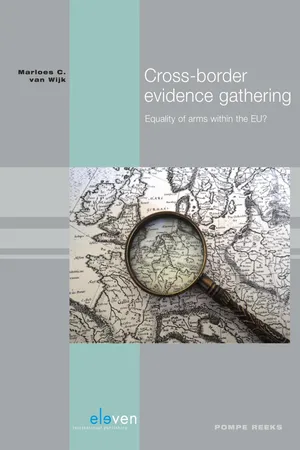
In order to develop an Area of Freedom, Security and Justice, the European Union is adopting measures to enhance international cooperation in criminal matters among the police and judicial authorities of its Member States. The adopted instruments concerning evidentiary matters-such as the gathering of evidence in another EU Member State-seem to serve the main purpose of assisting the authorities in investigating and prosecuting (cross-border) crime. This raises the question to what extent the defence is also given the possibility to gather information and materials in another EU Member State with the aim of preparing and presenting its case at trial and, in particular, whether the current (EU) legal framework on cross-border evidence gathering meets the requirements of the principle of equality of arms. This book addresses these questions by, first of all, discussing the application of the principle of equality of arms, as enshrined in both Article 6 ECHR and Article 47 CFR, in cross-border criminal cases. Secondly, it provides an overview of the European treaties and legislation on cross-border evidence gathering to explain to what extent they give opportunities to the defence to request the assistance of foreign authorities in obtaining specific information and materials in another EU Member State, and also to participate in the execution of these requests. In addition, in order to understand how the European treaties and legislation on cross-border evidence gathering are applied by the EU Member States, this book includes a comparative study of three national jurisdictions: the Netherlands, England and Wales, and Italy. Furthermore, it analyzes the criminal justice system of the International Criminal Court as a potential source of inspiration for new EU legislation to strengthen the ability of the defence to obtain evidence in another EU Member State. This book is part of the Pompe series, which contains publications by staff members of the Willem Pompe Institute for Criminal Law and Criminology in Utrecht, and by authors closely aligned to the school of thought for which the Institute is known. (Series: Willem Pompe Institute, Vol. 85) [Subject: Criminology, EU Law]
- 346 pages
- English
- PDF
- Available on iOS & Android
eBook - PDF
About this book
Information
Subtopic
Criminal LawTable of contents
- Chapter 1 - Introduction
- Chapter 2 - The principle of equality of arms within the EU
- Chapter 3 - Cross-border evidence gathering within the EU
- Chapter 4 - The Netherlands
- Chapter 5 - England & Wales
- Chapter 6 - Italy
- Chapter 7 - The International Criminal Court
- Chapter 8 - The comparative analysis and conclusion
- Summary
- Samenvatting
- Bibliography
- Table of cases
- Table of treaties, legislation and other documents
- Curriculum Vitae
Trusted by 375,005 students
Access to over 1.5 million titles for a fair monthly price.
Study more efficiently using our study tools.
Frequently asked questions
Yes, you can cancel anytime from the Subscription tab in your account settings on the Perlego website. Your subscription will stay active until the end of your current billing period. Learn how to cancel your subscription
No, books cannot be downloaded as external files, such as PDFs, for use outside of Perlego. However, you can download books within the Perlego app for offline reading on mobile or tablet. Learn how to download books offline
Perlego offers two plans: Essential and Complete
- Essential is ideal for learners and professionals who enjoy exploring a wide range of subjects. Access the Essential Library with 800,000+ trusted titles and best-sellers across business, personal growth, and the humanities. Includes unlimited reading time and Standard Read Aloud voice.
- Complete: Perfect for advanced learners and researchers needing full, unrestricted access. Unlock 1.5M+ books across hundreds of subjects, including academic and specialized titles. The Complete Plan also includes advanced features like Premium Read Aloud and Research Assistant.
We are an online textbook subscription service, where you can get access to an entire online library for less than the price of a single book per month. With over 1.5 million books across 990+ topics, we’ve got you covered! Learn about our mission
Look out for the read-aloud symbol on your next book to see if you can listen to it. The read-aloud tool reads text aloud for you, highlighting the text as it is being read. You can pause it, speed it up and slow it down. Learn more about Read Aloud
Yes! You can use the Perlego app on both iOS and Android devices to read anytime, anywhere — even offline. Perfect for commutes or when you’re on the go.
Please note we cannot support devices running on iOS 13 and Android 7 or earlier. Learn more about using the app
Please note we cannot support devices running on iOS 13 and Android 7 or earlier. Learn more about using the app
Yes, you can access Cross-border evidence gathering by Marloes C. van Wijk in PDF and/or ePUB format, as well as other popular books in Politics & International Relations & Criminal Law. We have over 1.5 million books available in our catalogue for you to explore.