Corruption is generally referred to as bribery. This books deals with a different form of corruption: corruption caused by networks. Network corruption is the form of corruption in which the interaction of multiple actors within a social network results in corruption but in which the individual behaviour as such is not necessarily corrupt. The main reason for this research is that a gap appears to exist in the available theories on corruption: very little research is available on corruption by a network, nor does the network theory thoroughly discuss the risks or pitfalls of networks or how such a collective can become corrupt. As such this books offers a 'new layer' by clearly defining what distinguishes network corruption from corruption networks. The other reason for this research is the observation that policies and investigations appear to be limited in dealing with corruption in network-like structures.
This book deals with the question how corruption is linked to the functioning of social networks. The available literature of both corruption and networks was reviewed. Some theories support the idea of collective acting and collective responsibility which can be used in cases of corruption by a network. The conceptual analysis results in one assessment frame which helps in distinguishing when networks are a form of social capital and when they deteriorate into corruption. The assessment frame was applied to three case studies from developed western societies in which corruption was brought in connection with a network (the international FIFA case, the News of the World International phone-hacking scandal from the United Kingdom and the Dutch city of Roermond). This allowed for a better understanding of the mechanisms and characteristics of networks. Thefindings on the link between networks and corruption gained from this book call for alternative routes for policy development and for a greater network awareness. This book concludes with policy recommendation and ways to ensure networks remain the essential Social Capital needed in our society.
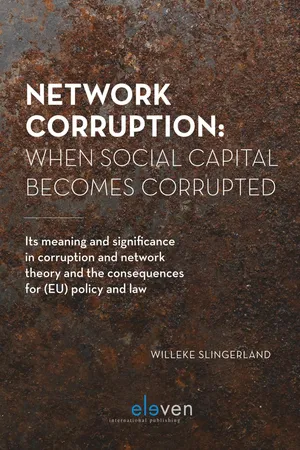
eBook - PDF
Network Corruption: When Social Capital Becomes Corrupted
Its Meaning and Significance in Corruption and Network Theory and the Consequences for (EU) Policy and Law
- 264 pages
- English
- PDF
- Available on iOS & Android
eBook - PDF
Network Corruption: When Social Capital Becomes Corrupted
Its Meaning and Significance in Corruption and Network Theory and the Consequences for (EU) Policy and Law
About this book
Information
Subtopic
Law Theory & PracticeIndex
LawTable of contents
- Preface
- Table of Contents
- List of Abbreviations
- 1. Introduction
- 2. Methodology
- 3. Corruption: Definitions Across Disciplines and Addressing it in Policies
- 4. Social Networks: From Social Capital to Corruption and the Attribution of Responsibility
- 5. The Link Between Networks and Corruption
- 6. Case Studies: Global, National and Local Networks
- 7. Case Findings: The Analysis
- 8. Networks and Influencing: An Overview
- 9. Organising Routes for Development
- 10. Conclusions
- Literature
- Case Law
Trusted by 375,005 students
Access to over 1.5 million titles for a fair monthly price.
Study more efficiently using our study tools.
Frequently asked questions
Yes, you can cancel anytime from the Subscription tab in your account settings on the Perlego website. Your subscription will stay active until the end of your current billing period. Learn how to cancel your subscription
No, books cannot be downloaded as external files, such as PDFs, for use outside of Perlego. However, you can download books within the Perlego app for offline reading on mobile or tablet. Learn how to download books offline
Perlego offers two plans: Essential and Complete
- Essential is ideal for learners and professionals who enjoy exploring a wide range of subjects. Access the Essential Library with 800,000+ trusted titles and best-sellers across business, personal growth, and the humanities. Includes unlimited reading time and Standard Read Aloud voice.
- Complete: Perfect for advanced learners and researchers needing full, unrestricted access. Unlock 1.5M+ books across hundreds of subjects, including academic and specialized titles. The Complete Plan also includes advanced features like Premium Read Aloud and Research Assistant.
We are an online textbook subscription service, where you can get access to an entire online library for less than the price of a single book per month. With over 1.5 million books across 990+ topics, we’ve got you covered! Learn about our mission
Look out for the read-aloud symbol on your next book to see if you can listen to it. The read-aloud tool reads text aloud for you, highlighting the text as it is being read. You can pause it, speed it up and slow it down. Learn more about Read Aloud
Yes! You can use the Perlego app on both iOS and Android devices to read anytime, anywhere — even offline. Perfect for commutes or when you’re on the go.
Please note we cannot support devices running on iOS 13 and Android 7 or earlier. Learn more about using the app
Please note we cannot support devices running on iOS 13 and Android 7 or earlier. Learn more about using the app
Yes, you can access Network Corruption: When Social Capital Becomes Corrupted by Willeke Slingerland in PDF and/or ePUB format, as well as other popular books in Law & Law Theory & Practice. We have over 1.5 million books available in our catalogue for you to explore.