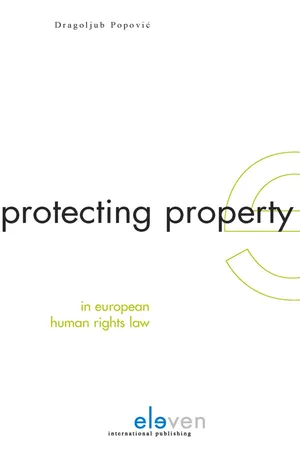
This book examines the development of the protection of property in the jurisprudence of the European Court of Human Rights (ECHR). The First Additional Protocol to the Convention for the Protection of Human Rights and Fundamental Freedoms introduced the protection of property into the Convention system. The ECHR's case law developed an autonomous concept of property and set out the modes and conditions of State interference with property. Various legal developments can be discerned in the protection of property, such as the emergence of restitution cases and pilot judgments. The author shows that the system of protection has evolved from a system where the State merely refrains from interfering with property, to one in which the State has the obligation to protect property. Although the ECHR has been guided by the concept of social justice in recent judgments, the author concludes that it is doubtful whether social rights, such as the right to housing, will be included among the values enjoying protection as property.
- 177 pages
- English
- PDF
- Available on iOS & Android
eBook - PDF
Protecting Property in European Human Rights Law
About this book
Information
Subtopic
International LawIndex
LawTable of contents
- Cover
- Table of Contents
- Preface
- Foreword
- Part One: Convention Mechanism of Protecting Property
- Chapter One: Emergence of The Mechanism
- A. DRAFTING THE CONVENTION FOR THE PROTECTION OF HUMAN RIGHTS AND FUNDAMENTAL FREEDOMS
- 1. General Background
- 2. Fundamental Dilemma
- 3. Refusing Inclusion of the Protection of Property into the Text of the Convention
- B. FIRST ADDITIONAL PROTOCOL TO THE CONVENTION
- 1. Continuing Work of the Consultative Assembly
- 2. Including the Protection of Property – Foundations of the Mechanism
- Chapter Two: Basic Features of the Mechanism
- A. INTRODUCTION
- B. AUTONOMOUS CONCEPT OF PROPERTY
- 1. Concept of Property in Comparative Law
- 2. Concept of Property/Possessions in the Law of the Convention
- 2.1. Attempts of the Doctrine
- 2.2. Case-Law of the ECHR
- 2.2.1. Including Trend
- 2.2.2. Excluding Trend
- C. STRUCTURE OF PROVISIONS OF ARTICLE 1 FIRST PROTOCOL
- 1. Provisions
- 2. Handling the Rules
- Chapter Three: State Interference with Property
- A. INTRODUCTION: MODES AND CONDITIONS OF STATE INTERFERENCE WITHPROPERTY
- B. MODES OF INTERFERENCE
- 1. Deprivation of Property / Expropriation
- 1.1. Formal Expropriation
- 1.2. De facto Expropriation
- 1.3. Indirect Expropriation
- 2. Regulation of the Use of Property
- 2.1. Regulation of the Use of Property Resulting in Deprivation
- 2.2. Other Types of Regulation of the Use of Property
- 2.3. General Interest
- 3. Peaceful Enjoyment of Property
- C. CONDITIONS OF INTERFERENCE
- 1. Lawfulness
- 2. Legitimate Aim
- 3. Fair Balance
- 3.1. General Rule
- 3.2. Exceptional Circumstances
- Part Two: Developments
- Chapter Four: Restitution Cases
- A. BACKGROUND
- 1. Roots of Evil
- 2. Goals, Purposes and Consequences
- 3. Overcoming the Past
- B. RESTITUTION OF CHATTELS
- 1. Earlier Stage of Development
- 2. Evolution
- 3. Interpreting the Evolution
- C. RESTITUTION OF IMMOVABLE PROPERTY
- 1. General Developments
- 2. Specific Issues
- Chapter Five: Pilot Judgments
- A. INTRODUCTION
- B. ROLE OF PRECEDENT
- C. EMERGENCE OF THE CONCEPT
- 1. The Broniowski Case
- 2. The Case of Hutten-Czapska
- 3. The Viasu Case
- D. FEATURES AND CONTROVERSIES OF THE CONCEPT
- 1. Introduction
- 2. In Search of a Definition
- 2.1. A More Restrictive Approach
- 2.2. A Broader Approach
- 3. Characteristic Features
- 4. Controversies
- Chapter Six: Bank Deposits
- A. INTRODUCTION
- B. DEVELOPMENTS
- 1. Specific Problems and Approaches
- 2. Blocking of Assets
- 3. Bank Deposits in Successor-States of the Former Yugoslavia
- Part Three: Prospects
- Chapter Seven: Advancing the Mechanism
- A. POSITIVE OBLIGATION
- 1. General Rule
- 2. Physical Protection
- 3. Obligation to Recover
- B. PROCEDURAL GUARANTEES
- Chapter Eight: Dilemmas and Challenges
- A. CONTINUING VIOLATION
- B. TOWARDS SOCIAL RIGHTS
- Chapter Nine: Conclusions
- List of Cases
- Bibliography
Trusted by 375,005 students
Access to over 1.5 million titles for a fair monthly price.
Study more efficiently using our study tools.
Frequently asked questions
Yes, you can cancel anytime from the Subscription tab in your account settings on the Perlego website. Your subscription will stay active until the end of your current billing period. Learn how to cancel your subscription
No, books cannot be downloaded as external files, such as PDFs, for use outside of Perlego. However, you can download books within the Perlego app for offline reading on mobile or tablet. Learn how to download books offline
We are an online textbook subscription service, where you can get access to an entire online library for less than the price of a single book per month. With over 1.5 million books across 990+ topics, we’ve got you covered! Learn about our mission
Look out for the read-aloud symbol on your next book to see if you can listen to it. The read-aloud tool reads text aloud for you, highlighting the text as it is being read. You can pause it, speed it up and slow it down. Learn more about Read Aloud
Yes! You can use the Perlego app on both iOS and Android devices to read anytime, anywhere — even offline. Perfect for commutes or when you’re on the go.
Please note we cannot support devices running on iOS 13 and Android 7 or earlier. Learn more about using the app
Please note we cannot support devices running on iOS 13 and Android 7 or earlier. Learn more about using the app
Yes, you can access Protecting Property in European Human Rights Law by Dragoljub Popovic in PDF and/or ePUB format, as well as other popular books in Law & International Law. We have over 1.5 million books available in our catalogue for you to explore.