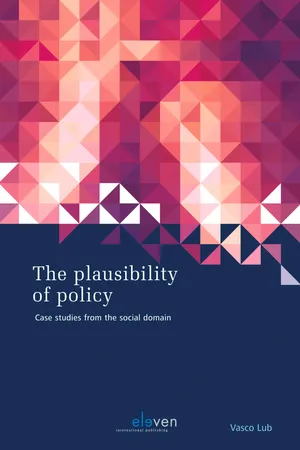
The social domain has seen a growing debate on the effectiveness of public measures. The realization is taking shape that the legitimacy of social policies - such as the socialization of vulnerable groups, anti-radicalization programs, or regeneration projects in deprived neighborhoods - has to go beyond the intuition that they "should" work. But, unlike methods in spheres such as medicine and healthcare, social programs typically have no sharp demarcation in time, intensity, or target group, and are implemented in a rich context of unforeseen and unknown variables. This makes it difficult (if not impossible) to assess their impact with research methods that centralize a mono causal effect. In The Plausibility of Policy, author Vasco Lub presents alternative approaches to assessing the likelihood of social policy measures achieving their intended effects. One of his main lines of argument is to confront policy assumptions with existing scientific data. In doing so, he sheds light on how such measures can be assessed and to what degree claims about those intended effects can be substantiated. [Subject: Social Policy, Public Administration]
- 128 pages
- English
- PDF
- Available on iOS & Android
eBook - PDF
About this book
Information
Table of contents
- Title Page
- Preface
- Contents
- 1 Introduction
- 2 The paradoxical policies of the Social Support Act
- 3 Polarisation, radicalisation and social policy
- 4. The softer side of urban regeneration
- 5. Validity in qualitative evaluation
- 6. Studying policy from multiple order perspectives
- References
- Summary
- Samenvatting
- CURRICULUM VITAE
Trusted by 375,005 students
Access to over 1.5 million titles for a fair monthly price.
Study more efficiently using our study tools.
Frequently asked questions
Yes, you can cancel anytime from the Subscription tab in your account settings on the Perlego website. Your subscription will stay active until the end of your current billing period. Learn how to cancel your subscription
No, books cannot be downloaded as external files, such as PDFs, for use outside of Perlego. However, you can download books within the Perlego app for offline reading on mobile or tablet. Learn how to download books offline
Perlego offers two plans: Essential and Complete
- Essential is ideal for learners and professionals who enjoy exploring a wide range of subjects. Access the Essential Library with 800,000+ trusted titles and best-sellers across business, personal growth, and the humanities. Includes unlimited reading time and Standard Read Aloud voice.
- Complete: Perfect for advanced learners and researchers needing full, unrestricted access. Unlock 1.5M+ books across hundreds of subjects, including academic and specialized titles. The Complete Plan also includes advanced features like Premium Read Aloud and Research Assistant.
We are an online textbook subscription service, where you can get access to an entire online library for less than the price of a single book per month. With over 1.5 million books across 990+ topics, we’ve got you covered! Learn about our mission
Look out for the read-aloud symbol on your next book to see if you can listen to it. The read-aloud tool reads text aloud for you, highlighting the text as it is being read. You can pause it, speed it up and slow it down. Learn more about Read Aloud
Yes! You can use the Perlego app on both iOS and Android devices to read anytime, anywhere — even offline. Perfect for commutes or when you’re on the go.
Please note we cannot support devices running on iOS 13 and Android 7 or earlier. Learn more about using the app
Please note we cannot support devices running on iOS 13 and Android 7 or earlier. Learn more about using the app
Yes, you can access The Plausibility of Policy by Vasco Lub in PDF and/or ePUB format, as well as other popular books in Politics & International Relations & Public Affairs & Administration. We have over 1.5 million books available in our catalogue for you to explore.